10: a tire completes a revolution every 2 seconds. a nail gets stuck in the tire. the height y (in meter) of…
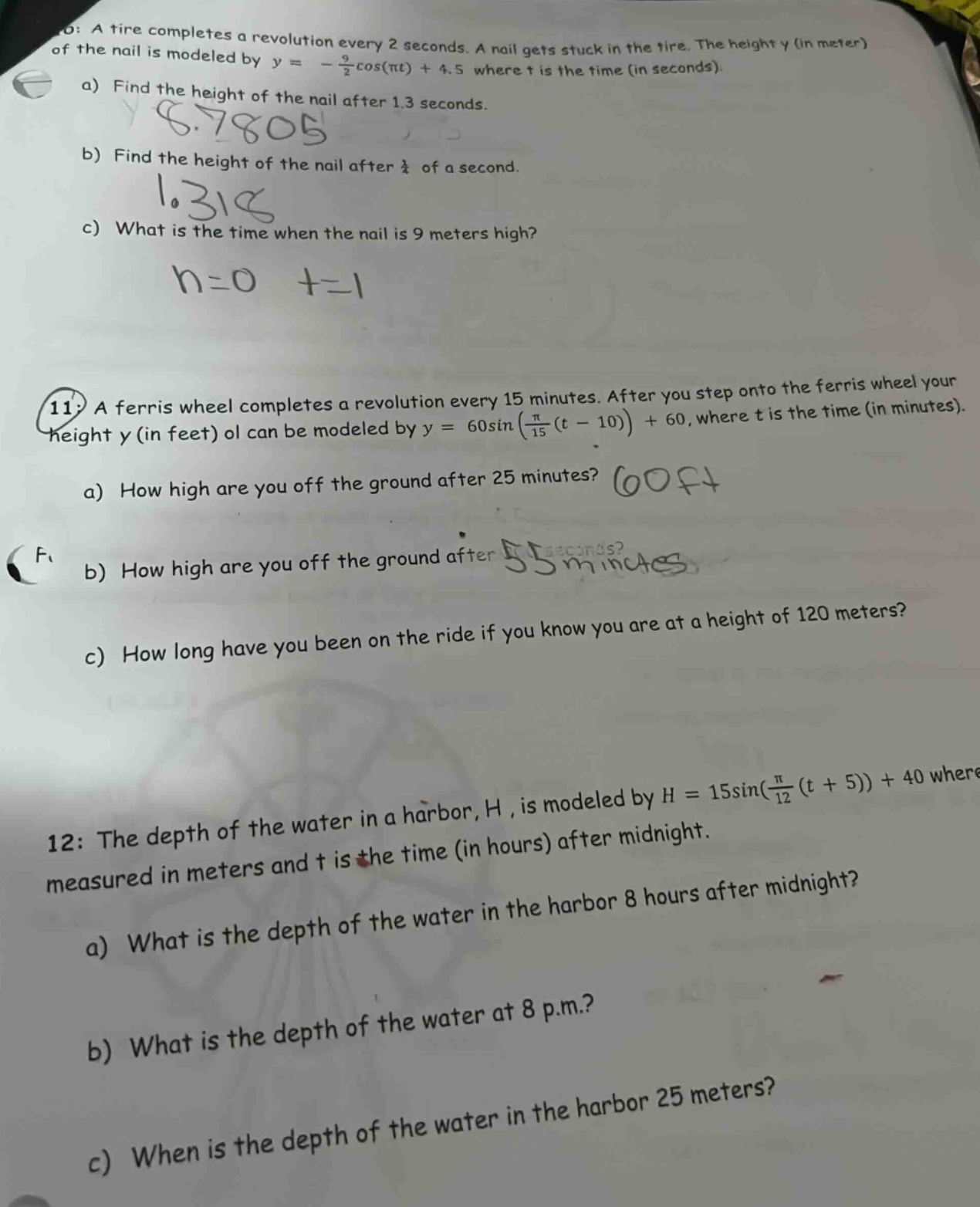
10: a tire completes a revolution every 2 seconds. a nail gets stuck in the tire. the height y (in meter) of the nail is modeled by y = - 9/2 cos(πt) + 4.5 where t is the time (in seconds). a) find the height of the nail after 1.3 seconds. b) find the height of the nail after 1/2 of a second. c) what is the time when the nail is 9 meters high? 11: a ferris wheel completes a revolution every 15 minutes. after you step onto the ferris wheel your height y (in feet) ol can be modeled by y = 60sin(π/15(t - 10)) + 60, where t is the time (in minutes). a) how high are you off the ground after 25 minutes? b) how high are you off the ground after 55 minutes? c) how long have you been on the ride if you know you are at a height of 120 meters? 12: the depth of the water in a harbor, h, is modeled by h = 15sin(π/12(t + 5)) + 40 where measured in meters and t is the time (in hours) after midnight. a) what is the depth of the water in the harbor 8 hours after midnight? b) what is the depth of the water at 8 p.m.? c) when is the depth of the water in the harbor 25 meters?
Answer
Explanation:
Step1: Solve problem 11 - a
Substitute (t = 25) into (y=60\sin(\frac{\pi}{15}(t - 10))+60). First, calculate (\frac{\pi}{15}(25 - 10)=\frac{\pi}{15}\times15=\pi). Then, (\sin(\pi)=0). So, (y = 60\times0+60=60) feet.
Step2: Solve problem 11 - b
Substitute (t = 55) into (y=60\sin(\frac{\pi}{15}(t - 10))+60). First, calculate (\frac{\pi}{15}(55 - 10)=\frac{\pi}{15}\times45 = 3\pi). Then, (\sin(3\pi)=0). So, (y=60\times0 + 60=60) feet.
Step3: Solve problem 11 - c
Set (y = 120) in (y=60\sin(\frac{\pi}{15}(t - 10))+60). We get (120=60\sin(\frac{\pi}{15}(t - 10))+60). Subtract 60 from both sides: (60=60\sin(\frac{\pi}{15}(t - 10))). Then (\sin(\frac{\pi}{15}(t - 10)) = 1). We know that (\sin\theta=1) when (\theta=\frac{\pi}{2}+2k\pi,k\in\mathbb{Z}). So (\frac{\pi}{15}(t - 10)=\frac{\pi}{2}+2k\pi). Divide both sides by (\pi): (\frac{1}{15}(t - 10)=\frac{1}{2}+2k). Multiply both sides by 15: (t - 10=\frac{15}{2}+30k). (t=\frac{15}{2}+10 + 30k=\frac{15 + 20}{2}+30k=\frac{35}{2}+30k). For the first - positive solution ((k = 0)), (t=\frac{35}{2}=17.5) minutes.
Step4: Solve problem 12 - a
Substitute (t = 8) into (H = 15\sin(\frac{\pi}{12}(t + 5))+40). First, calculate (\frac{\pi}{12}(8 + 5)=\frac{13\pi}{12}). (H=15\sin(\frac{13\pi}{12})+40). Since (\sin(\frac{13\pi}{12})=\sin(\pi+\frac{\pi}{12})=-\sin(\frac{\pi}{12})\approx - 0.259). (H=15\times(-0.259)+40=-3.885 + 40=36.115) meters.
Step5: Solve problem 12 - b
8 p.m. is (t = 20) hours after midnight. Substitute (t = 20) into (H = 15\sin(\frac{\pi}{12}(t + 5))+40). First, calculate (\frac{\pi}{12}(20 + 5)=\frac{25\pi}{12}). (\sin(\frac{25\pi}{12})=\sin(2\pi+\frac{\pi}{12})=\sin(\frac{\pi}{12})\approx0.259). (H=15\times0.259+40 = 3.885+40=43.885) meters.
Step6: Solve problem 12 - c
Set (H = 25) in (H = 15\sin(\frac{\pi}{12}(t + 5))+40). We get (25=15\sin(\frac{\pi}{12}(t + 5))+40). Subtract 40 from both sides: (- 15=15\sin(\frac{\pi}{12}(t + 5))). Then (\sin(\frac{\pi}{12}(t + 5))=-1). We know that (\sin\theta=-1) when (\theta=\frac{3\pi}{2}+2k\pi,k\in\mathbb{Z}). So (\frac{\pi}{12}(t + 5)=\frac{3\pi}{2}+2k\pi). Divide both sides by (\pi): (\frac{1}{12}(t + 5)=\frac{3}{2}+2k). Multiply both sides by 12: (t + 5=18+24k). (t=13 + 24k). For the first - positive solution ((k = 0)), (t = 13) hours after midnight.
Answer:
11 - a: 60 feet 11 - b: 60 feet 11 - c: 17.5 minutes 12 - a: 36.115 meters 12 - b: 43.885 meters 12 - c: 13 hours after midnight