11. differentiate, then simplify.\na) $f(x)=\frac{x^{2}}{x - 1}$\nb) $f(x)=\frac{x^{2}-1}{x^{2}+1}$\nc)…
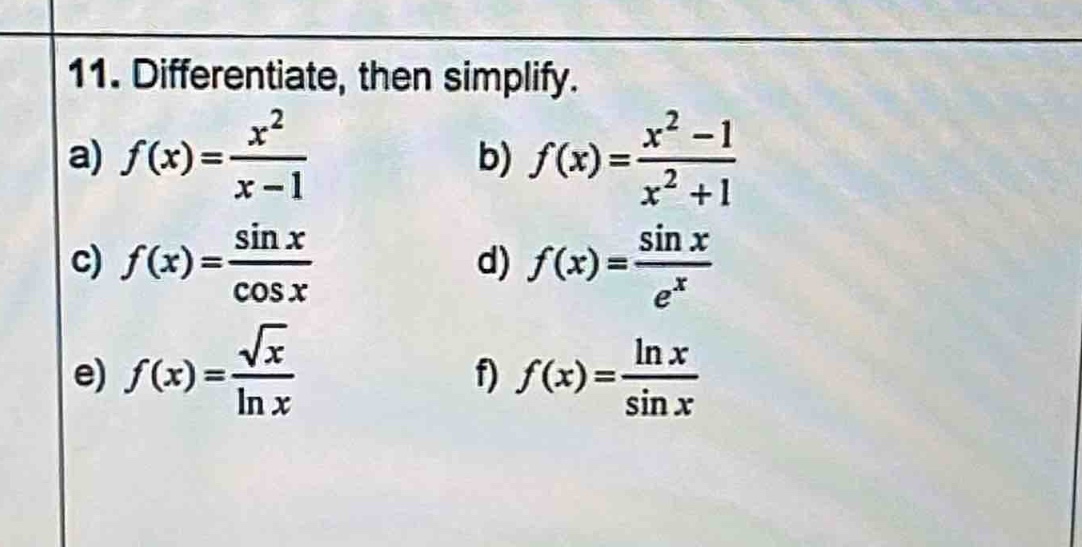
11. differentiate, then simplify.\na) $f(x)=\frac{x^{2}}{x - 1}$\nb) $f(x)=\frac{x^{2}-1}{x^{2}+1}$\nc) $f(x)=\frac{sin x}{cos x}$\nd) $f(x)=\frac{sin x}{e^{x}}$\ne) $f(x)=\frac{sqrt{x}}{ln x}$\nf) $f(x)=\frac{ln x}{sin x}$
Answer
a)
Explanation:
Step1: Simplify the function first
We can simplify $f(x)=\frac{x^{2}}{x - 1}$ using long - division or rewrite $x^{2}=(x - 1)(x + 1)+1$, so $f(x)=x + 1+\frac{1}{x - 1}=x + 1+(x - 1)^{-1}$.
Step2: Differentiate term - by - term
The derivative of $x$ is $1$, the derivative of a constant $1$ is $0$, and using the power rule $\frac{d}{dx}(u^{n})=nu^{n - 1}\frac{du}{dx}$ for $u=x - 1$ and $n=-1$. The derivative of $(x - 1)^{-1}$ is $-1\times(x - 1)^{-2}\times1=-\frac{1}{(x - 1)^{2}}$. So $f^\prime(x)=1-\frac{1}{(x - 1)^{2}}=\frac{(x - 1)^{2}-1}{(x - 1)^{2}}=\frac{x^{2}-2x + 1-1}{(x - 1)^{2}}=\frac{x^{2}-2x}{(x - 1)^{2}}$.
b)
Explanation:
Step1: Use the quotient rule
The quotient rule states that if $y=\frac{u}{v}$, then $y^\prime=\frac{u^\prime v - uv^\prime}{v^{2}}$. Here, $u=x^{2}-1$, $u^\prime = 2x$, $v=x^{2}+1$, $v^\prime=2x$.
Step2: Substitute into the quotient rule
$f^\prime(x)=\frac{2x(x^{2}+1)-2x(x^{2}-1)}{(x^{2}+1)^{2}}=\frac{2x^{3}+2x-2x^{3}+2x}{(x^{2}+1)^{2}}=\frac{4x}{(x^{2}+1)^{2}}$.
c)
Explanation:
Step1: Recall the identity
Since $\frac{\sin x}{\cos x}=\tan x$.
Step2: Differentiate
The derivative of $\tan x$ is $\sec^{2}x$. So $f^\prime(x)=\sec^{2}x$.
d)
Explanation:
Step1: Use the quotient rule
If $y = \frac{u}{v}$, where $u=\sin x$, $u^\prime=\cos x$, $v = e^{x}$, $v^\prime=e^{x}$.
Step2: Substitute into the quotient rule
$f^\prime(x)=\frac{\cos x\cdot e^{x}-\sin x\cdot e^{x}}{(e^{x})^{2}}=\frac{e^{x}(\cos x-\sin x)}{e^{2x}}=\frac{\cos x-\sin x}{e^{x}}$.
e)
Explanation:
Step1: Rewrite the function
$f(x)=\frac{\sqrt{x}}{\ln x}=x^{\frac{1}{2}}(\ln x)^{-1}$.
Step2: Use the product rule
The product rule states that if $y = uv$, then $y^\prime=u^\prime v+uv^\prime$. Here, $u = x^{\frac{1}{2}}$, $u^\prime=\frac{1}{2}x^{-\frac{1}{2}}$, $v = (\ln x)^{-1}$, $v^\prime=-(\ln x)^{-2}\times\frac{1}{x}$. $f^\prime(x)=\frac{1}{2}x^{-\frac{1}{2}}(\ln x)^{-1}-x^{\frac{1}{2}}\times\frac{1}{x}(\ln x)^{-2}=\frac{1}{2\sqrt{x}\ln x}-\frac{1}{\sqrt{x}(\ln x)^{2}}=\frac{\ln x - 2}{2\sqrt{x}(\ln x)^{2}}$.
f)
Explanation:
Step1: Use the quotient rule
If $y=\frac{u}{v}$, where $u = \ln x$, $u^\prime=\frac{1}{x}$, $v=\sin x$, $v^\prime=\cos x$.
Step2: Substitute into the quotient rule
$f^\prime(x)=\frac{\frac{1}{x}\cdot\sin x-\ln x\cdot\cos x}{\sin^{2}x}=\frac{\sin x - x\ln x\cos x}{x\sin^{2}x}$.
Answer:
a) $f^\prime(x)=\frac{x^{2}-2x}{(x - 1)^{2}}$ b) $f^\prime(x)=\frac{4x}{(x^{2}+1)^{2}}$ c) $f^\prime(x)=\sec^{2}x$ d) $f^\prime(x)=\frac{\cos x-\sin x}{e^{x}}$ e) $f^\prime(x)=\frac{\ln x - 2}{2\sqrt{x}(\ln x)^{2}}$ f) $f^\prime(x)=\frac{\sin x - x\ln x\cos x}{x\sin^{2}x}$