11. for the figure above, the area of the shaded region is (a) $\frac{14}{3}$ (b) $\frac{16}{3}$ (c) 6 (d)…
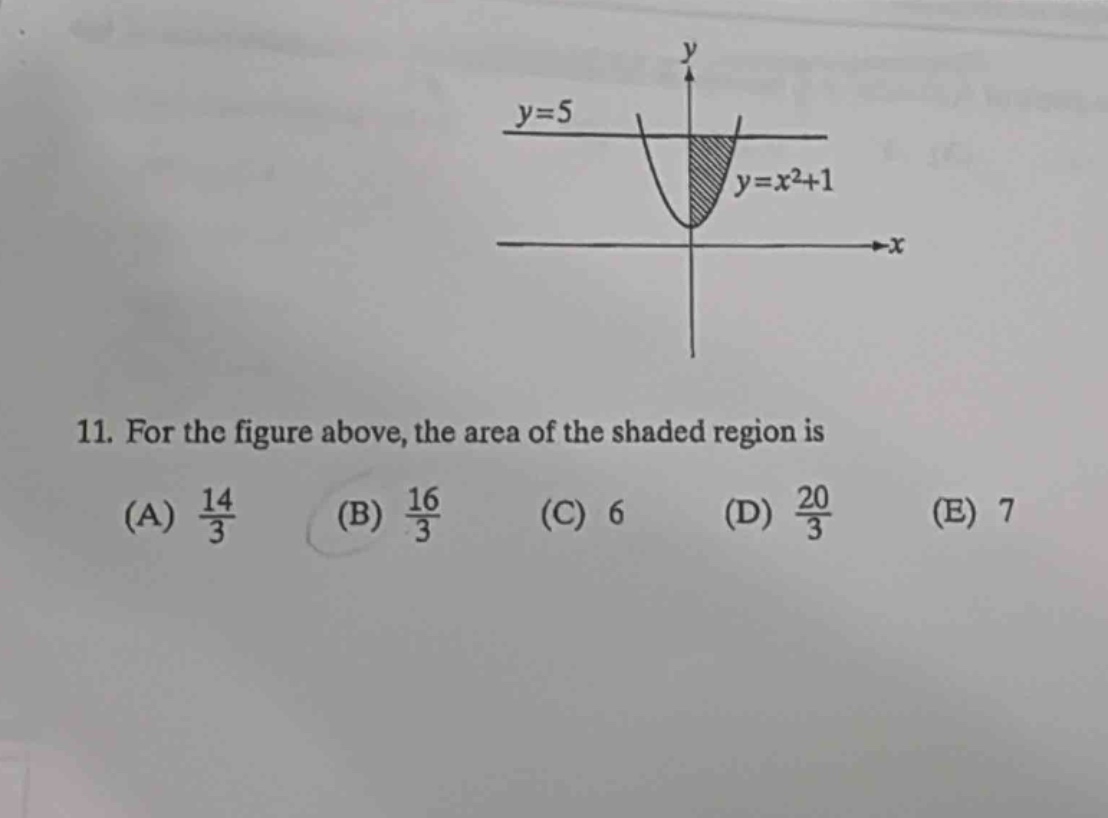
11. for the figure above, the area of the shaded region is (a) $\frac{14}{3}$ (b) $\frac{16}{3}$ (c) 6 (d) $\frac{20}{3}$ (e) 7
Answer
Explanation:
Step1: Find intersection points
Set $x^{2}+1 = 5$, then $x^{2}=4$, so $x=- 2$ and $x = 2$. Due to symmetry, we can calculate the area from $x = 0$ to $x = 2$ and double it.
Step2: Set up integral for area
The area $A$ between two curves $y = f(x)$ and $y = g(x)$ is $A=\int_{a}^{b}(f(x)-g(x))dx$. Here, $f(x)=5$ and $g(x)=x^{2}+1$, and $a = 0$, $b = 2$. So $A = 2\int_{0}^{2}[(5-(x^{2}+1))]dx=2\int_{0}^{2}(4 - x^{2})dx$.
Step3: Integrate
We know that $\int(4 - x^{2})dx=4x-\frac{1}{3}x^{3}+C$. Then $2\int_{0}^{2}(4 - x^{2})dx=2\left[4x-\frac{1}{3}x^{3}\right]_{0}^{2}$.
Step4: Evaluate definite - integral
$2\left(4\times2-\frac{1}{3}\times2^{3}-(4\times0-\frac{1}{3}\times0^{3})\right)=2\left(8-\frac{8}{3}\right)=2\times\frac{16}{3}=\frac{32}{3}$. But we made a mistake above. Since we are using symmetry, the correct integral is $\int_{0}^{2}(5-(x^{2}+1))dx=\int_{0}^{2}(4 - x^{2})dx$. Evaluating $\int_{0}^{2}(4 - x^{2})dx=\left[4x-\frac{1}{3}x^{3}\right]_{0}^{2}=4\times2-\frac{1}{3}\times2^{3}=8-\frac{8}{3}=\frac{16}{3}$.
Answer:
B. $\frac{16}{3}$