11. identify the horizontal asymptotes in each expression.\na. (x³ + 2x² + 3x + 5)/(2x³ + 3x² + 4x + 5)\nb…
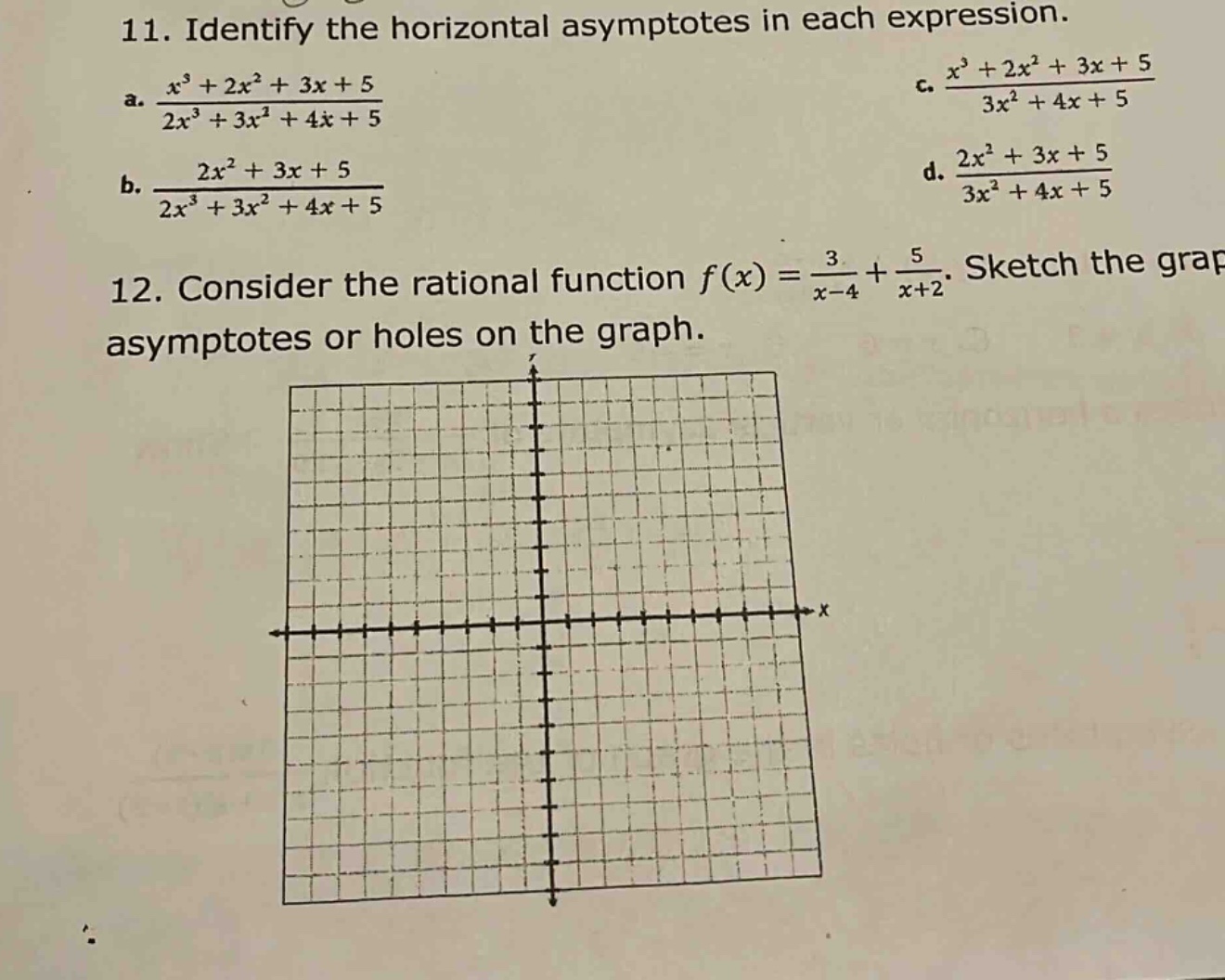
11. identify the horizontal asymptotes in each expression.\na. (x³ + 2x² + 3x + 5)/(2x³ + 3x² + 4x + 5)\nb. (2x² + 3x + 5)/(2x³ + 3x² + 4x + 5)\nc. (x³ + 2x² + 3x + 5)/(3x² + 4x + 5)\nd. (2x² + 3x + 5)/(3x² + 4x + 5)\n12. consider the rational function f(x) = 3/(x - 4)+5/(x + 2). sketch the graph and identify the asymptotes or holes on the graph.
Answer
Explanation:
Step1: Recall horizontal - asymptote rules for rational functions
For a rational function $y = \frac{f(x)}{g(x)}=\frac{a_nx^n+\cdots+a_0}{b_mx^m+\cdots + b_0}$, if $n = m$, the horizontal asymptote is $y=\frac{a_n}{b_m}$; if $n\lt m$, the horizontal asymptote is $y = 0$; if $n>m$, there is no horizontal asymptote.
Step2: Analyze part a
For $y=\frac{x^{3}+2x^{2}+3x + 5}{2x^{3}+3x^{2}+4x + 5}$, since $n = m=3$, the horizontal asymptote is $y=\frac{1}{2}$.
Step3: Analyze part b
For $y=\frac{2x^{2}+3x + 5}{2x^{3}+3x^{2}+4x + 5}$, since $n = 2$ and $m = 3$ ($n\lt m$), the horizontal asymptote is $y = 0$.
Step4: Analyze part c
For $y=\frac{x^{3}+2x^{2}+3x + 5}{3x^{2}+4x + 5}$, since $n = 3$ and $m = 2$ ($n>m$), there is no horizontal asymptote.
Step5: Analyze part d
For $y=\frac{2x^{2}+3x + 5}{3x^{2}+4x + 5}$, since $n = m = 2$, the horizontal asymptote is $y=\frac{2}{3}$.
For the function $f(x)=\frac{3}{x - 4}+\frac{5}{x + 2}=\frac{3(x + 2)+5(x - 4)}{(x - 4)(x + 2)}=\frac{3x+6 + 5x-20}{(x - 4)(x + 2)}=\frac{8x-14}{(x - 4)(x + 2)}$
Step6: Find vertical asymptotes
Set the denominator equal to zero: $(x - 4)(x + 2)=0$. So $x = 4$ and $x=-2$ are vertical asymptotes.
Step7: Find horizontal asymptote
Since the degree of the numerator ($n = 1$) is less than the degree of the denominator ($m = 2$), the horizontal asymptote is $y = 0$.
Answer:
a. $y=\frac{1}{2}$ b. $y = 0$ c. No horizontal asymptote d. $y=\frac{2}{3}$ For $f(x)=\frac{3}{x - 4}+\frac{5}{x + 2}$, vertical asymptotes: $x = 4,x=-2$, horizontal asymptote: $y = 0$