11 the table below gives values of a function f and its derivative at selected values of x. if f is…
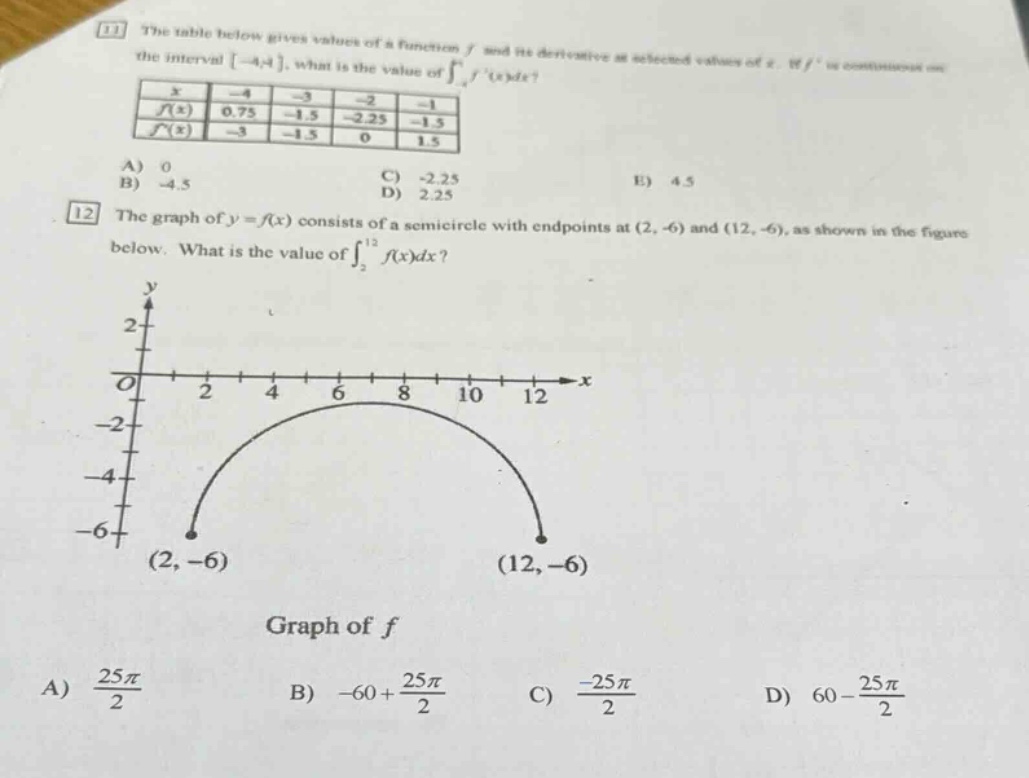
11 the table below gives values of a function f and its derivative at selected values of x. if f is continuous on the interval -4,4, what is the value of ∫-4,4 f(x)dx? x -4 -3 -2 -1 f(x) 0.75 -1.5 -2.25 -1.5 f(x) -3 -1.5 0 1.5 a) 0 b) -4.5 c) -2.25 d) 2.25 e) 4.5 12 the graph of y = f(x) consists of a semi - circle with endpoints at (2,-6) and (12,-6), as shown in the figure below. what is the value of ∫2,12 f(x)dx? graph of f a) 25π/2 b) -60 + 25π/2 c) -25π/2 d) 60 - 25π/2
Answer
Explanation:
Step1: Recall the fundamental theorem of calculus
By the fundamental theorem of calculus, $\int_{a}^{b}f^{\prime}(x)dx=f(b)-f(a)$. Here, $a = - 4$ and $b=-1$, and from the table $f(-4)=0.75$ and $f(-1)=-1.5$. So, $\int_{-4}^{-1}f^{\prime}(x)dx=f(-1)-f(-4)=-1.5 - 0.75=-2.25$.
Step2: Analyze the integral of the semi - circle function
The equation of a semi - circle with endpoints $(x_1,y_1)=(2,-6)$ and $(x_2,y_2)=(12,-6)$ has a center at $(7,-6)$ and a radius $r = 5$. The integral $\int_{2}^{12}f(x)dx$ is the net signed area between the curve $y = f(x)$ and the $x$ - axis. The area of a semi - circle is $A=\frac{1}{2}\pi r^{2}=\frac{25\pi}{2}$. But the semi - circle is below the line $y = 0$, and we also need to consider the rectangular area between the semi - circle and the $x$ - axis. The rectangle has height $6$ and width $10$, so its area is $A_{rect}=6\times10 = 60$. The value of $\int_{2}^{12}f(x)dx=-60+\frac{25\pi}{2}$ (negative because the region is below the $x$ - axis).
Answer:
- C) -2.25
- B) $-60+\frac{25\pi}{2}$