11. write the equation of the trigonometric graph.
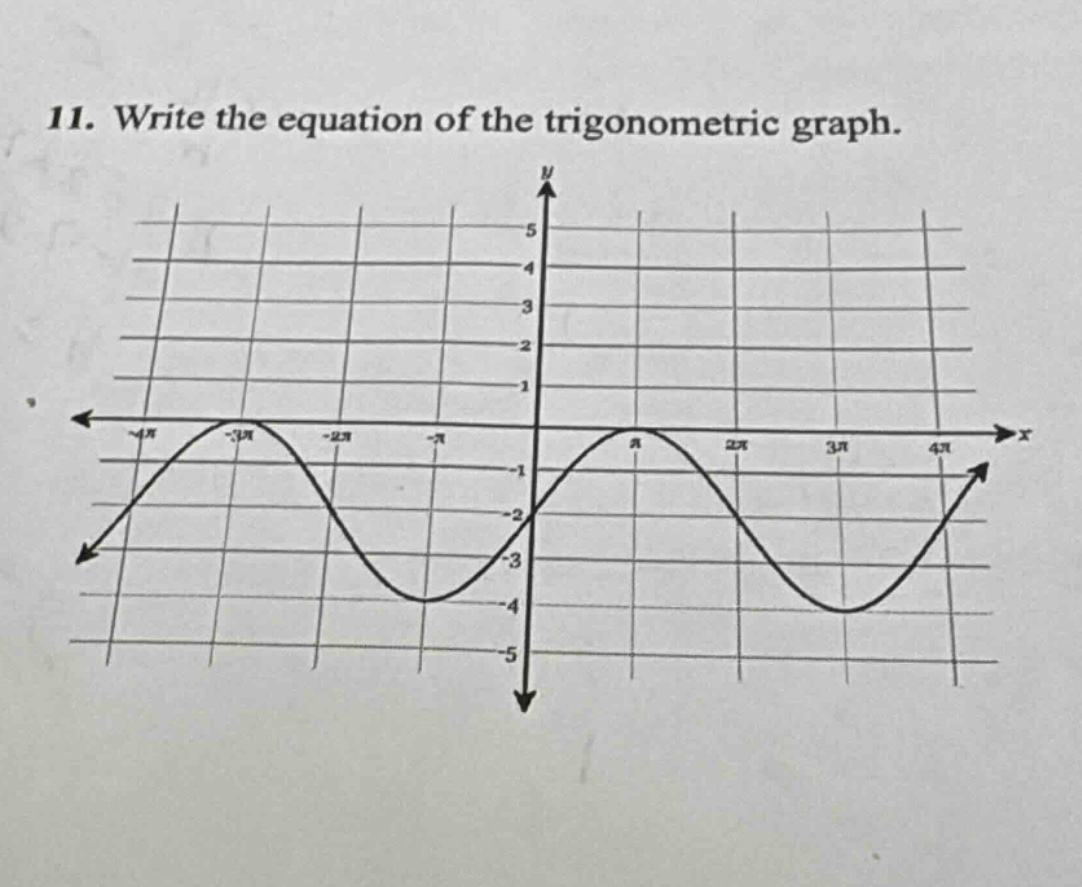
11. write the equation of the trigonometric graph.
Answer
Explanation:
Step1: Determine the amplitude
The amplitude $A$ is half the distance between the maximum and minimum values. The maximum value is $2$ and the minimum is $ - 4$. So $A=\frac{2 - (-4)}{2}=\frac{6}{2}=3$.
Step2: Determine the vertical - shift
The mid - line of the graph is $y=\frac{2+( - 4)}{2}=-1$. So the vertical shift $D=-1$.
Step3: Determine the period
The period $P$ is the distance between two consecutive peaks or troughs. Here, $P = 2\pi$. Since the formula for the period of a trigonometric function $y = A\sin(Bx - C)+D$ or $y = A\cos(Bx - C)+D$ is $P=\frac{2\pi}{|B|}$, and $P = 2\pi$, then $|B| = 1$. Let's assume $B = 1$ for simplicity.
Step4: Determine the phase - shift
The graph passes through the point $(0,-2)$. For a sine function $y=A\sin(Bx - C)+D$, substituting $x = 0$, $y=-2$, $A = 3$, $B = 1$, and $D=-1$ gives: $-2=3\sin(-C)-1$. $-1 = 3\sin(-C)$, so $\sin(-C)=-\frac{1}{3}$, and $C=\frac{\pi}{6}$ (a possible value). Let's assume the function is a sine function.
The equation of the trigonometric graph is $y = 3\sin(x-\frac{\pi}{6})-1$.
Answer:
$y = 3\sin(x-\frac{\pi}{6})-1$