12. find the inverse of $f(x) = e^{3x}$. $f^{-1}(x) = \\square$
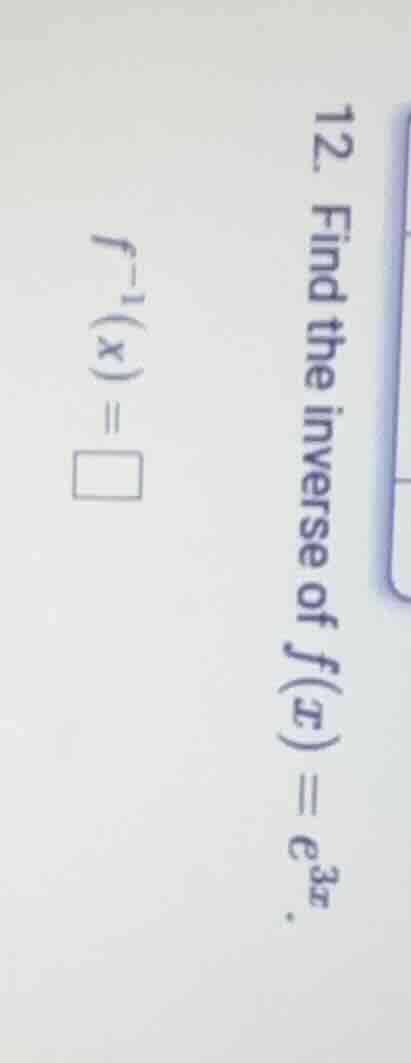
12. find the inverse of $f(x) = e^{3x}$. $f^{-1}(x) = \\square$
Answer
Explanation:
Step1: Let ( y = f(x) )
We start by setting ( y = e^{3x} ). This is the original function, and our goal is to solve for ( x ) in terms of ( y ) to find the inverse.
Step2: Take the natural logarithm of both sides
To isolate the exponent, we take the natural logarithm (ln) of both sides. Recall that ( \ln(e^u)=u ) by the property of logarithms and exponential functions (they are inverses of each other). So, taking ( \ln ) of both sides of ( y = e^{3x} ) gives: ( \ln(y)=\ln(e^{3x}) ) Simplifying the right - hand side using the property ( \ln(e^u) = u ), we get ( \ln(y)=3x ).
Step3: Solve for ( x )
Now, we solve the equation ( \ln(y) = 3x ) for ( x ). We divide both sides of the equation by 3: ( x=\frac{\ln(y)}{3} )
Step4: Replace ( x ) with ( f^{-1}(x) ) and ( y ) with ( x )
To express the inverse function, we replace ( y ) with ( x ) (since the input of the inverse function is the output of the original function) and ( x ) with ( f^{-1}(x) ). So we have: ( f^{-1}(x)=\frac{\ln(x)}{3} ) (we assume ( x>0 ) because the domain of the original function ( f(x)=e^{3x} ) is all real numbers, and the range is ( y > 0 ), so the domain of the inverse function is ( x>0 ))
Answer:
( f^{-1}(x)=\frac{\ln(x)}{3} )