12 mark for review let f and g be continuous functions. if ∫₂⁶ f(x)dx = 5 and ∫₆² g(x)dx = 7, then ∫₂⁶…
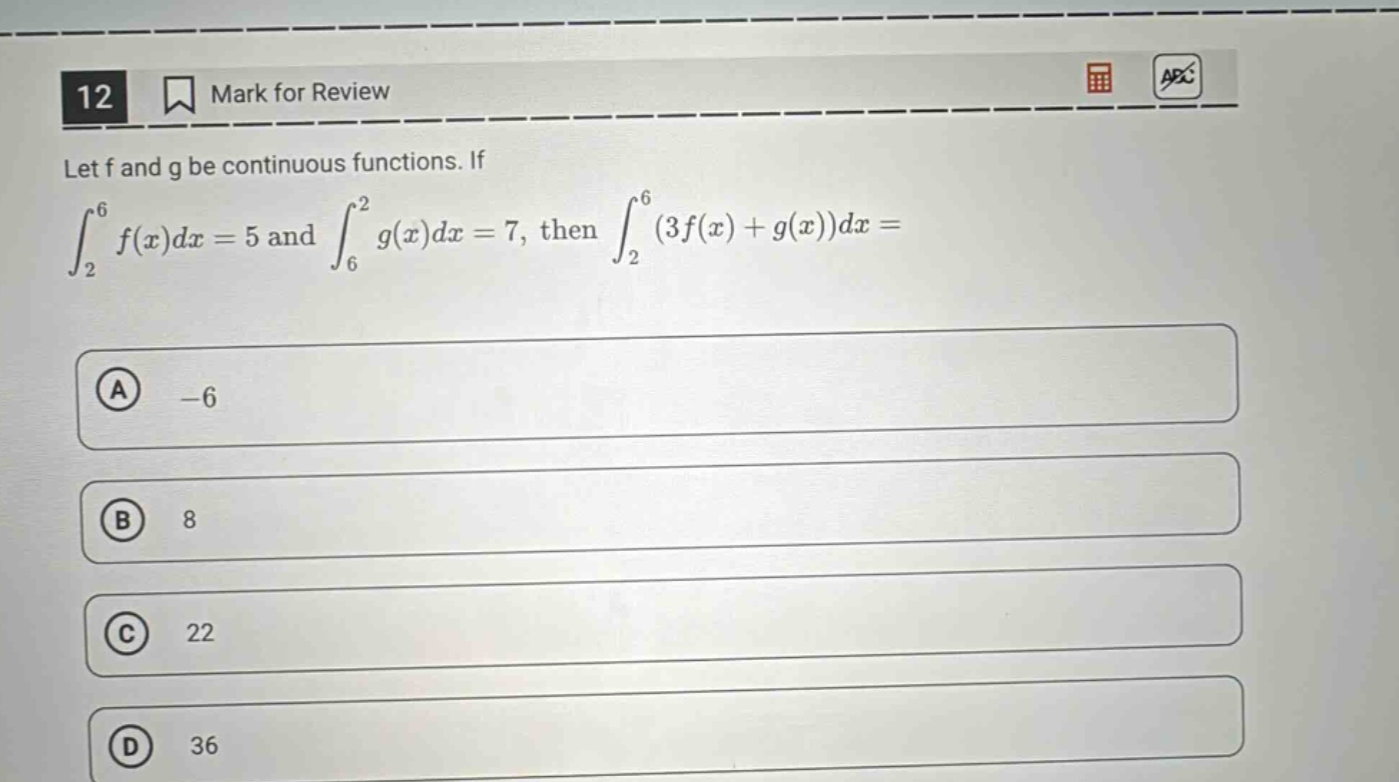
12 mark for review let f and g be continuous functions. if ∫₂⁶ f(x)dx = 5 and ∫₆² g(x)dx = 7, then ∫₂⁶ (3f(x)+g(x))dx = a -6 b 8 c 22 d 36
Answer
Explanation:
Step1: Use integral properties
By the linear - property of definite integrals, $\int_{2}^{6}(3f(x)+g(x))dx = 3\int_{2}^{6}f(x)dx+\int_{2}^{6}g(x)dx$.
Step2: Reverse the limits of integration for $\int_{6}^{2}g(x)dx$
We know that $\int_{a}^{b}h(x)dx=-\int_{b}^{a}h(x)dx$. So, if $\int_{6}^{2}g(x)dx = 7$, then $\int_{2}^{6}g(x)dx=- 7$.
Step3: Substitute the given values
We are given that $\int_{2}^{6}f(x)dx = 5$. Substitute $\int_{2}^{6}f(x)dx = 5$ and $\int_{2}^{6}g(x)dx=-7$ into $3\int_{2}^{6}f(x)dx+\int_{2}^{6}g(x)dx$. We get $3\times5+( - 7)=15 - 7=8$.
Answer:
B. 8