12. match the given differential equation with the slope field shown. put the letter in the little box on…
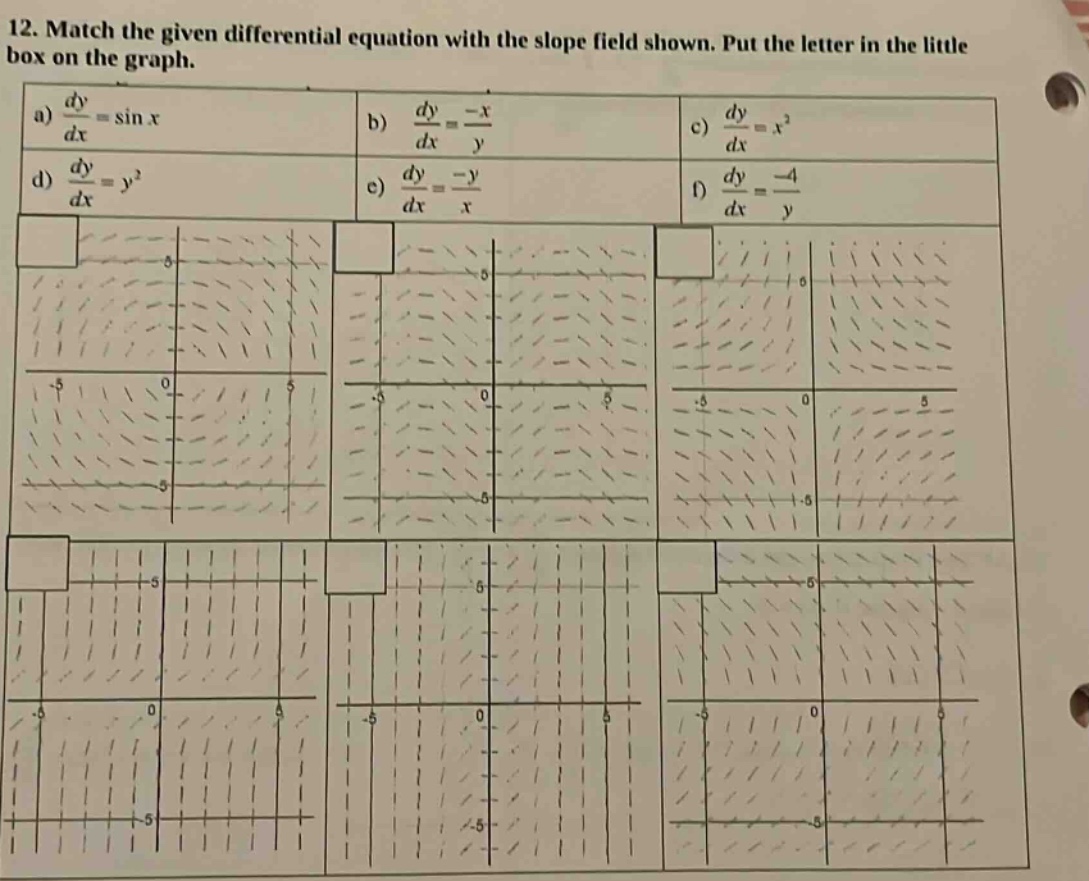
12. match the given differential equation with the slope field shown. put the letter in the little box on the graph.\na) $\frac{dy}{dx}=sin x$ b) $\frac{dy}{dx}=\frac{-x}{y}$ c) $\frac{dy}{dx}=x^{2}$\nd) $\frac{dy}{dx}=y^{2}$ e) $\frac{dy}{dx}=\frac{-y}{x}$ f) $\frac{dy}{dx}=\frac{-4}{y}$
Answer
Explanation:
Step1: Analyze slope - sign properties
For $\frac{dy}{dx}=\sin x$, the slope depends only on $x$. The values of $\sin x$ range from - 1 to 1. When $x = 0,\frac{dy}{dx}=0$; when $x=\frac{\pi}{2},\frac{dy}{dx} = 1$; when $x=\frac{3\pi}{2},\frac{dy}{dx}=-1$. For $\frac{dy}{dx}=\frac{-x}{y}$, at the origin $(0,0)$ the slope is undefined. In the first - quadrant ($x>0,y>0$), the slope is negative; in the second - quadrant ($x < 0,y>0$), the slope is positive; in the third - quadrant ($x<0,y < 0$), the slope is negative; in the fourth - quadrant ($x>0,y < 0$), the slope is positive. For $\frac{dy}{dx}=x^{2}$, since $x^{2}\geq0$ for all real $x$, and $\frac{dy}{dx}=0$ when $x = 0$. The slope is symmetric about the $y$ - axis. For $\frac{dy}{dx}=y^{2}$, since $y^{2}\geq0$ for all real $y$, and $\frac{dy}{dx}=0$ when $y = 0$. The slope does not depend on $x$ directly. For $\frac{dy}{dx}=\frac{-y}{x}$, at the origin $(0,0)$ the slope is undefined. In the first - quadrant ($x>0,y>0$), the slope is negative; in the second - quadrant ($x < 0,y>0$), the slope is positive; in the third - quadrant ($x<0,y < 0$), the slope is negative; in the fourth - quadrant ($x>0,y < 0$), the slope is positive. But it has a different behavior near the axes compared to $\frac{dy}{dx}=\frac{-x}{y}$. For $\frac{dy}{dx}=\frac{-4}{y}$, at $y = 0$ the slope is undefined. When $y>0$, the slope is negative; when $y < 0$, the slope is positive.
Step2: Match with slope - fields
Without seeing the actual slope - fields, we can make general observations. If a slope - field has horizontal tangents at $x = 0$ and the slopes vary periodically with $x$, it is likely $\frac{dy}{dx}=\sin x$. If a slope - field has a symmetric pattern about the $y$ - axis and non - negative slopes, it is likely $\frac{dy}{dx}=x^{2}$. If a slope - field has horizontal tangents along the $x$ - axis ($y = 0$) and non - negative slopes, it is likely $\frac{dy}{dx}=y^{2}$.
Since the actual slope - fields are not labeled for reference in the text part, we assume we would analyze the following characteristics:
- For $\frac{dy}{dx}=\sin x$: Look for a slope - field where the slopes repeat periodically in the $x$ - direction and are zero at $x = n\pi,n\in\mathbb{Z}$.
- For $\frac{dy}{dx}=\frac{-x}{y}$: Look for a slope - field with four distinct quadrant - based slope signs and an undefined slope at the origin.
- For $\frac{dy}{dx}=x^{2}$: Look for a slope - field that is symmetric about the $y$ - axis and has non - negative slopes, with zero slope at $x = 0$.
- For $\frac{dy}{dx}=y^{2}$: Look for a slope - field with zero slope along the $x$ - axis and non - negative slopes.
- For $\frac{dy}{dx}=\frac{-y}{x}$: Look for a slope - field with four distinct quadrant - based slope signs and an undefined slope at the origin, with a different behavior near the axes compared to $\frac{dy}{dx}=\frac{-x}{y}$.
- For $\frac{dy}{dx}=\frac{-4}{y}$: Look for a slope - field with an undefined slope at $y = 0$, negative slopes for $y>0$ and positive slopes for $y < 0$.
To actually match them, we would need to analyze the specific features of each slope - field such as the location of horizontal and vertical tangents, the sign of the slopes in different quadrants, and any symmetry properties.
Since the slope - fields are not named or described in detail in the text, we cannot give a definite answer. But the general method to solve this problem is as above.
If we assume we have slope - fields named as slope - field 1, slope - field 2, etc. and we analyze them one by one:
- For $\frac{dy}{dx}=\sin x$: Check for periodic behavior of slopes with respect to $x$ and zero - slope at $x=n\pi$.
- For $\frac{dy}{dx}=\frac{-x}{y}$: Check for quadrant - based sign changes and an undefined slope at the origin.
- For $\frac{dy}{dx}=x^{2}$: Check for $y$ - axis symmetry and non - negative slopes with zero slope at $x = 0$.
- For $\frac{dy}{dx}=y^{2}$: Check for zero slope along the $x$ - axis and non - negative slopes.
- For $\frac{dy}{dx}=\frac{-y}{x}$: Check for quadrant - based sign changes and an undefined slope at the origin with a different behavior near the axes compared to $\frac{dy}{dx}=\frac{-x}{y}$.
- For $\frac{dy}{dx}=\frac{-4}{y}$: Check for an undefined slope at $y = 0$, negative slopes for $y>0$ and positive slopes for $y < 0$.
Since the actual matching cannot be done without the labeled slope - fields, we cannot provide a final answer in the form of "a corresponds to slope - field X" etc. But the above steps show how to approach the problem.
If we had to make a general statement about the process:
- First, analyze the sign and value of $\frac{dy}{dx}$ for different values of $x$ and $y$ for each differential equation.
- Then, compare these characteristics with the features of the given slope - fields such as the direction of line segments (positive/negative slope), location of horizontal/vertical tangents, and symmetry properties.