12 the perimeter of a rectangle is 12m. find the dimensions for which the diagonal is as short as possible…
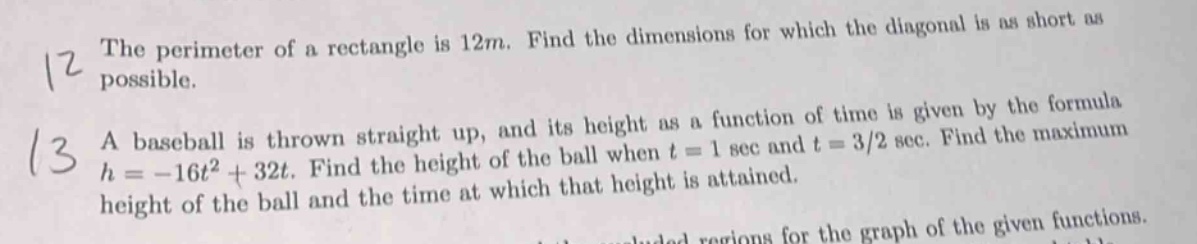
12 the perimeter of a rectangle is 12m. find the dimensions for which the diagonal is as short as possible. 13 a baseball is thrown straight up, and its height as a function of time is given by the formula h = -16t² + 32t. find the height of the ball when t = 1 sec and t = 3/2 sec. find the maximum height of the ball and the time at which that height is attained.
Answer
Question 12
Explanation:
Step1: Define variables
Let the length of the rectangle be $x$ and the width be $y$. The perimeter $P = 2(x + y)=12$, so $x + y=6$, and $y = 6 - x$.
Step2: Express the diagonal length
The diagonal length $d$ of the rectangle is given by the Pythagorean - theorem: $d=\sqrt{x^{2}+y^{2}}=\sqrt{x^{2}+(6 - x)^{2}}=\sqrt{x^{2}+36-12x + x^{2}}=\sqrt{2x^{2}-12x + 36}$.
Step3: Minimize the function
To minimize $d$, we can minimize the function $f(x)=2x^{2}-12x + 36$. Take the derivative $f^\prime(x)=4x-12$.
Step4: Find the critical points
Set $f^\prime(x)=0$, so $4x-12 = 0$, which gives $x = 3$.
Step5: Check the second - derivative
The second - derivative $f^{\prime\prime}(x)=4>0$, so $x = 3$ is a point of minimum. When $x = 3$, then $y=6 - 3=3$.
Answer:
The rectangle is a square with length and width both equal to $3m$.
Question 13
Explanation:
Step1: Find the height at given times
For $t = 1$: Substitute $t = 1$ into the height function $h(t)=-16t^{2}+32t$. Then $h(1)=-16\times1^{2}+32\times1=-16 + 32=16$. For $t=\frac{3}{2}$: Substitute $t=\frac{3}{2}$ into the height function $h(t)=-16t^{2}+32t$. Then $h(\frac{3}{2})=-16\times(\frac{3}{2})^{2}+32\times\frac{3}{2}=-16\times\frac{9}{4}+48=-36 + 48 = 12$.
Step2: Find the maximum of the function
The height function $h(t)=-16t^{2}+32t$ is a quadratic function of the form $y = ax^{2}+bx + c$ with $a=-16$, $b = 32$, $c = 0$. The time $t$ at which the maximum occurs is given by $t=-\frac{b}{2a}$. $t=-\frac{32}{2\times(-16)} = 1$.
Step3: Find the maximum height
Substitute $t = 1$ into the height function $h(t)$. $h(1)=-16\times1^{2}+32\times1=16$.
Answer:
The height of the ball at $t = 1$ sec is $16$ units, at $t=\frac{3}{2}$ sec is $12$ units. The maximum height of the ball is $16$ units and it is attained at $t = 1$ sec.