12. -/1 points details my notes sesscalcet2 3.7.035.mi. find the limit. use lhospitals rule if appropriate…
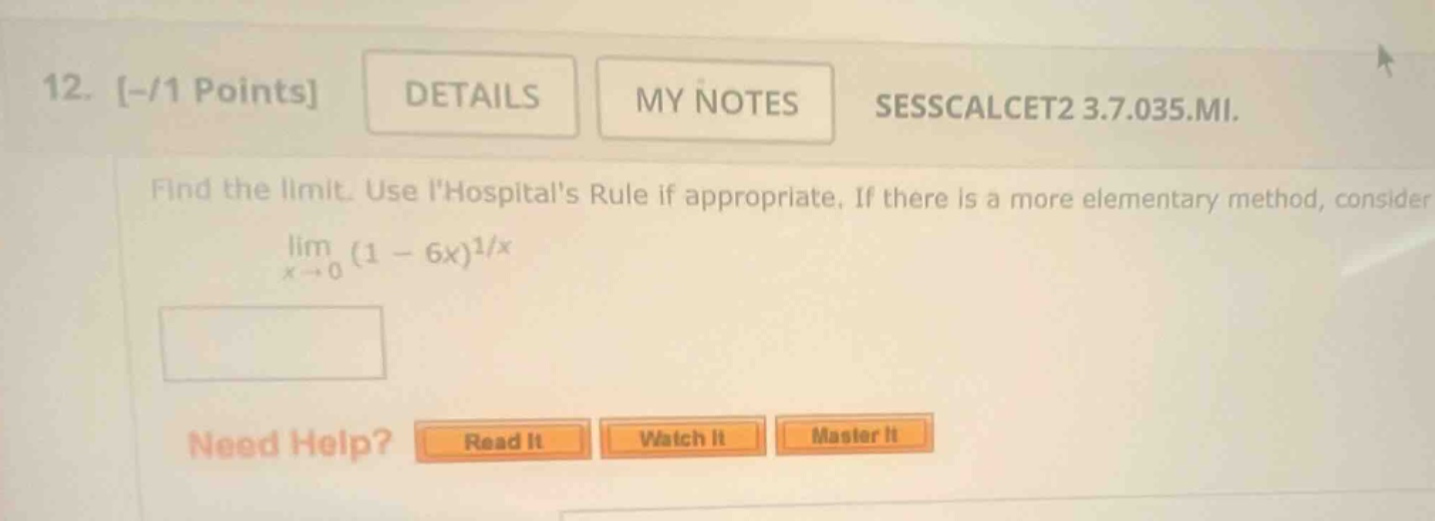
12. -/1 points details my notes sesscalcet2 3.7.035.mi. find the limit. use lhospitals rule if appropriate. if there is a more elementary method, consider lim (1 - 6x)^(1/x) x→0
Answer
Explanation:
Step1: Let $y=(1 - 6x)^{\frac{1}{x}}$.
Take the natural - logarithm of both sides: $\ln y=\frac{1}{x}\ln(1 - 6x)=\frac{\ln(1 - 6x)}{x}$.
Step2: Find the limit of $\ln y$ as $x\rightarrow0$.
We have $\lim_{x\rightarrow0}\ln y=\lim_{x\rightarrow0}\frac{\ln(1 - 6x)}{x}$. This is in the $\frac{0}{0}$ form, so we can apply L'Hopital's Rule. Differentiate the numerator and denominator. The derivative of $\ln(1 - 6x)$ with respect to $x$ is $\frac{-6}{1 - 6x}$, and the derivative of $x$ with respect to $x$ is 1. So, $\lim_{x\rightarrow0}\ln y=\lim_{x\rightarrow0}\frac{-6}{1 - 6x}$.
Step3: Evaluate the limit of $\ln y$.
Substitute $x = 0$ into $\frac{-6}{1 - 6x}$, we get $\lim_{x\rightarrow0}\ln y=-6$.
Step4: Find the limit of $y$.
Since $y = e^{\ln y}$, then $\lim_{x\rightarrow0}y=\lim_{x\rightarrow0}e^{\ln y}=e^{\lim_{x\rightarrow0}\ln y}$. Since $\lim_{x\rightarrow0}\ln y=-6$, then $\lim_{x\rightarrow0}(1 - 6x)^{\frac{1}{x}}=e^{-6}=\frac{1}{e^{6}}$.
Answer:
$\frac{1}{e^{6}}$