12. the points indicated on the graph shown represent the x - intercepts and the maximum and minimum values…
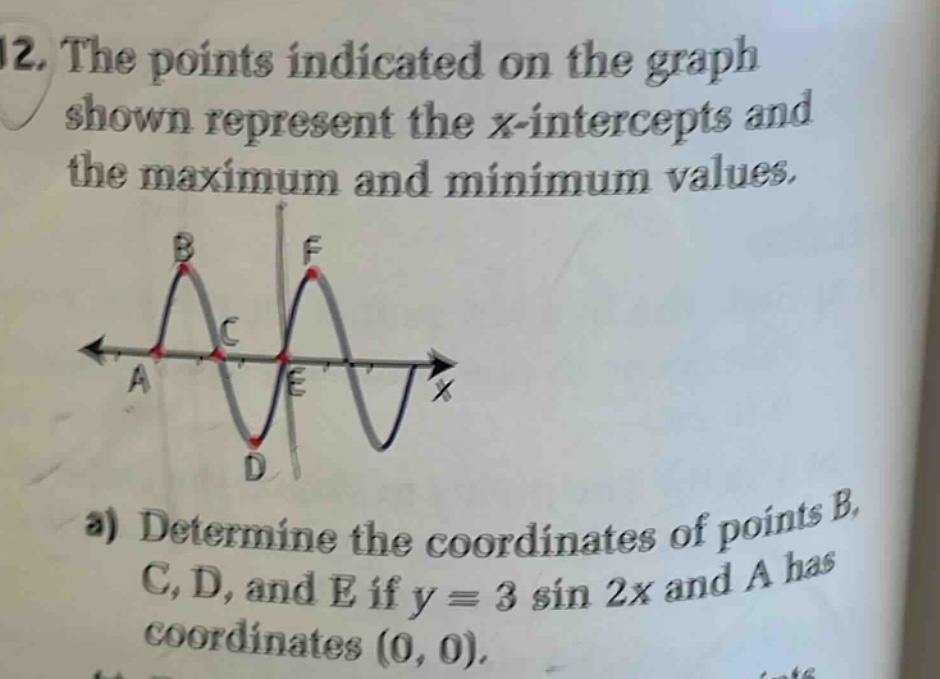
12. the points indicated on the graph shown represent the x - intercepts and the maximum and minimum values. a) determine the coordinates of points b, c, d, and e if y = 3 sin 2x and a has coordinates (0, 0).
Answer
Explanation:
Step1: Recall the properties of sine - function
The general form of a sine - function is $y = A\sin(Bx - C)+D$. For the function $y = 3\sin(2x)$, $A = 3$, $B = 2$, $C = 0$, $D = 0$. The amplitude is $|A|=3$, and the period is $T=\frac{2\pi}{B}=\frac{2\pi}{2}=\pi$.
Step2: Find the coordinates of point B
The maximum value of $y = \sin t$ is 1. For $y = 3\sin(2x)$, the maximum value of $y$ is 3. When $y = 3\sin(2x)$ reaches its maximum, $\sin(2x)=1$. Then $2x=\frac{\pi}{2}+2k\pi,k\in\mathbb{Z}$. Let $k = 0$, we get $x=\frac{\pi}{4}$. So the coordinates of point B are $(\frac{\pi}{4},3)$.
Step3: Find the coordinates of point C
The $x$ - intercepts of $y = 3\sin(2x)$ occur when $y = 0$. So $3\sin(2x)=0$, then $\sin(2x)=0$. So $2x = k\pi,k\in\mathbb{Z}$, or $x=\frac{k\pi}{2},k\in\mathbb{Z}$. Since point A is $(0,0)$ and we are moving to the right, when $k = 1$, $x=\frac{\pi}{2}$. The coordinates of point C are $(\frac{\pi}{2},0)$.
Step4: Find the coordinates of point D
The minimum value of $y=\sin t$ is - 1. For $y = 3\sin(2x)$, the minimum value of $y$ is - 3. When $y = 3\sin(2x)$ reaches its minimum, $\sin(2x)=-1$. Then $2x=\frac{3\pi}{2}+2k\pi,k\in\mathbb{Z}$. Let $k = 0$, we get $x=\frac{3\pi}{4}$. So the coordinates of point D are $(\frac{3\pi}{4}, - 3)$.
Step5: Find the coordinates of point E
The next $x$ - intercept after point C: When $y = 3\sin(2x)=0$, $2x = 2\pi$ (taking $k = 2$ in $2x=k\pi$), then $x=\pi$. So the coordinates of point E are $(\pi,0)$.
Answer:
B: $(\frac{\pi}{4},3)$; C: $(\frac{\pi}{2},0)$; D: $(\frac{3\pi}{4}, - 3)$; E: $(\pi,0)$