5.13 - 5.15 polar review\nthe figure shows the graph of the polar function r = f(θ), for 0 ≤ θ ≤ 2π, in the…
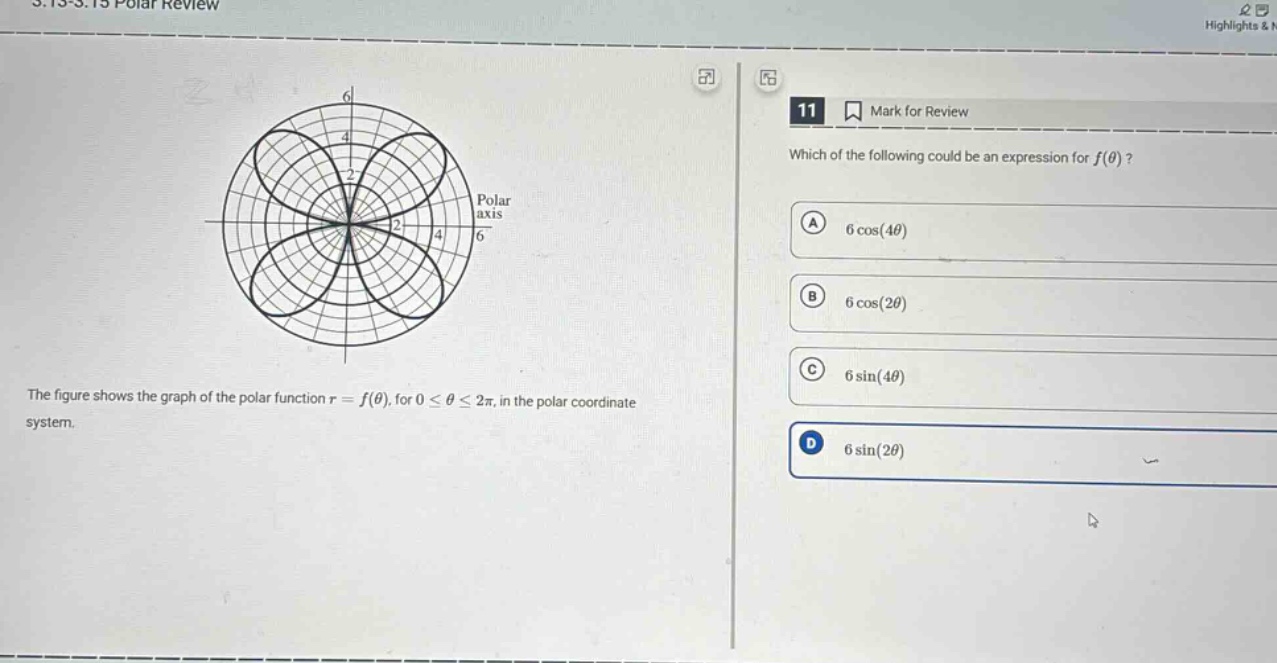
5.13 - 5.15 polar review\nthe figure shows the graph of the polar function r = f(θ), for 0 ≤ θ ≤ 2π, in the polar coordinate system.\n11 mark for review\nwhich of the following could be an expression for f(θ)?\na 6 cos(4θ)\nb 6 cos(2θ)\nc 6 sin(4θ)\nd 6 sin(2θ)
Answer
Explanation:
Step1: Recall polar - rose curve formula
The general form of a polar rose curve is $r = a\sin(n\theta)$ or $r=a\cos(n\theta)$. If $n$ is even, the number of petals is $2n$; if $n$ is odd, the number of petals is $n$.
Step2: Count the number of petals
The given polar - graph has 4 petals. Since the number of petals is 4 (an even number), using the rule for the number of petals of a polar rose curve, if $r = a\sin(n\theta)$ or $r=a\cos(n\theta)$ and the number of petals $N = 2n$ (for $n$ even), then $2n=4$, so $n = 2$.
Step3: Determine the function type
The graph is symmetric about the $y$ - axis. The polar function $r=a\sin(n\theta)$ is symmetric about the $y$ - axis and $r = a\cos(n\theta)$ is symmetric about the $x$ - axis. Since our graph is symmetric about the $y$ - axis, the function should be of the form $r=a\sin(n\theta)$. Here, $a = 6$ and $n = 2$.
Answer:
D. $6\sin(2\theta)$