13. $f(x)=cos^{-1}x - \frac{3pi}{4}$
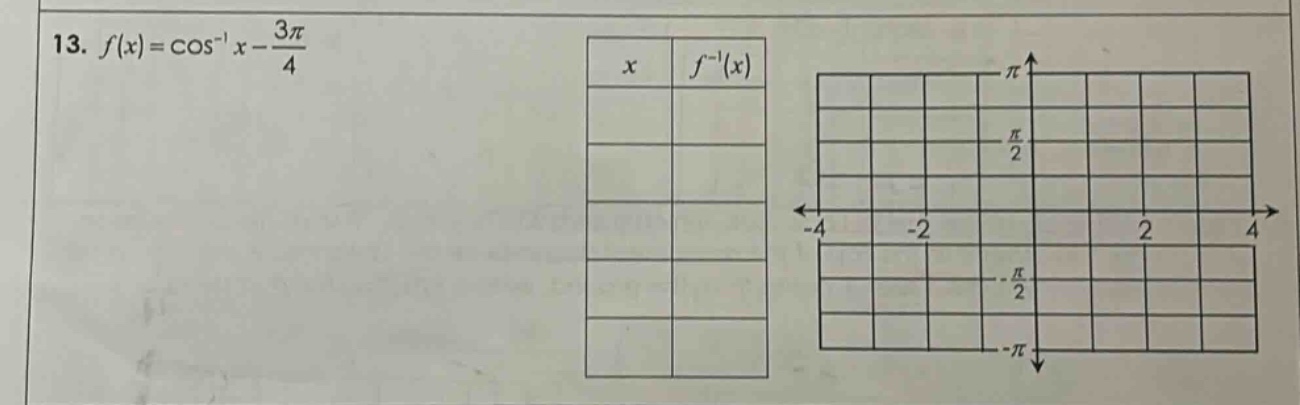
13. $f(x)=cos^{-1}x - \frac{3pi}{4}$
Answer
Explanation:
Step1: Let (y = f(x))
Let (y=\cos^{-1}x-\frac{3\pi}{4}).
Step2: Solve for (x) in terms of (y)
First, isolate (\cos^{-1}x): (\cos^{-1}x=y + \frac{3\pi}{4}). Then, take the cosine of both sides: (x=\cos(y+\frac{3\pi}{4})).
Step3: Swap (x) and (y)
The inverse - function (f^{-1}(x)=\cos(x+\frac{3\pi}{4})). To fill the table, we can choose some values of (x) and find (f^{-1}(x)): If (x=- 4), (f^{-1}(-4)=\cos(-4+\frac{3\pi}{4})\approx\cos(-4 + 2.356)= \cos(-1.644)\approx0.06). If (x = - 2), (f^{-1}(-2)=\cos(-2+\frac{3\pi}{4})\approx\cos(-2 + 2.356)=\cos(0.356)\approx0.94). If (x = 2), (f^{-1}(2)=\cos(2+\frac{3\pi}{4})\approx\cos(2 + 2.356)=\cos(4.356)\approx - 0.94). If (x = 4), (f^{-1}(4)=\cos(4+\frac{3\pi}{4})\approx\cos(4 + 2.356)=\cos(6.356)\approx0.06). To graph (y = f^{-1}(x)=\cos(x+\frac{3\pi}{4})), we know that the general form of the cosine function is (y = A\cos(Bx - C)+D), here (A = 1), (B = 1), (C=-\frac{3\pi}{4}), (D = 0). The amplitude is (|A| = 1), the period is (T=\frac{2\pi}{|B|}=2\pi), and the phase - shift is (\frac{C}{B}=-\frac{3\pi}{4}).
Answer:
The inverse function is (f^{-1}(x)=\cos(x+\frac{3\pi}{4})). Values for the table can be calculated as above and the graph has amplitude 1, period (2\pi) and phase - shift (-\frac{3\pi}{4}).