13. if y³ + y = x², then dy/dx = (a) 0 (b) x/2 (c) 2x/3y² (d) 2x - 3y²
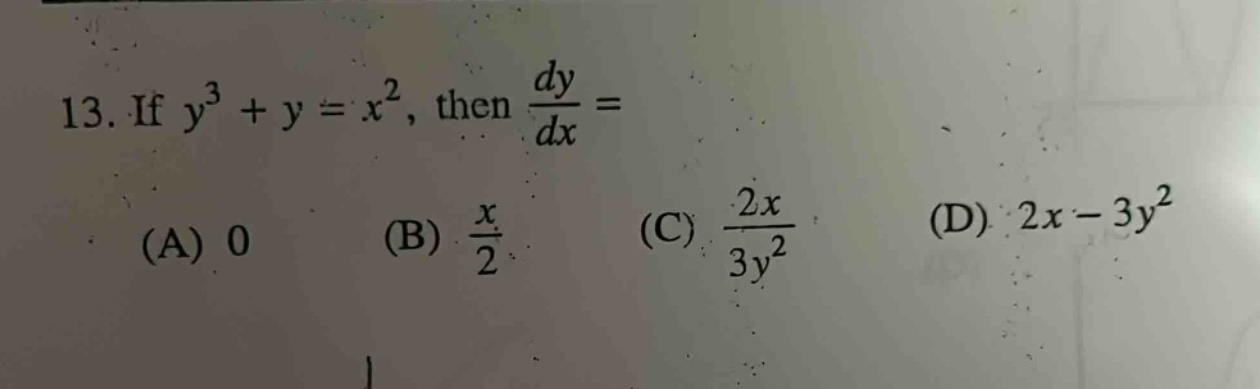
13. if y³ + y = x², then dy/dx = (a) 0 (b) x/2 (c) 2x/3y² (d) 2x - 3y²
Answer
Explanation:
Step1: Differentiate both sides
Differentiate $y^{3}+y = x^{2}$ with respect to $x$. Using the chain - rule for the left - hand side and power rule for the right - hand side. The derivative of $y^{3}$ with respect to $x$ is $3y^{2}\frac{dy}{dx}$ (by chain rule: if $u = y$, then $\frac{d}{dx}(u^{3})=3u^{2}\frac{du}{dx}=3y^{2}\frac{dy}{dx}$), and the derivative of $y$ with respect to $x$ is $\frac{dy}{dx}$, and the derivative of $x^{2}$ with respect to $x$ is $2x$. So we get $3y^{2}\frac{dy}{dx}+\frac{dy}{dx}=2x$.
Step2: Factor out $\frac{dy}{dx}$
Factor out $\frac{dy}{dx}$ on the left - hand side: $\frac{dy}{dx}(3y^{2}+1)=2x$.
Step3: Solve for $\frac{dy}{dx}$
Divide both sides by $3y^{2}+1$ to isolate $\frac{dy}{dx}$. So $\frac{dy}{dx}=\frac{2x}{3y^{2}+1}$.
Answer:
C. $\frac{2x}{3y^{2}+1}$