13 which of the following could be a function expression for f(θ) shown in the graph? select all that apply…
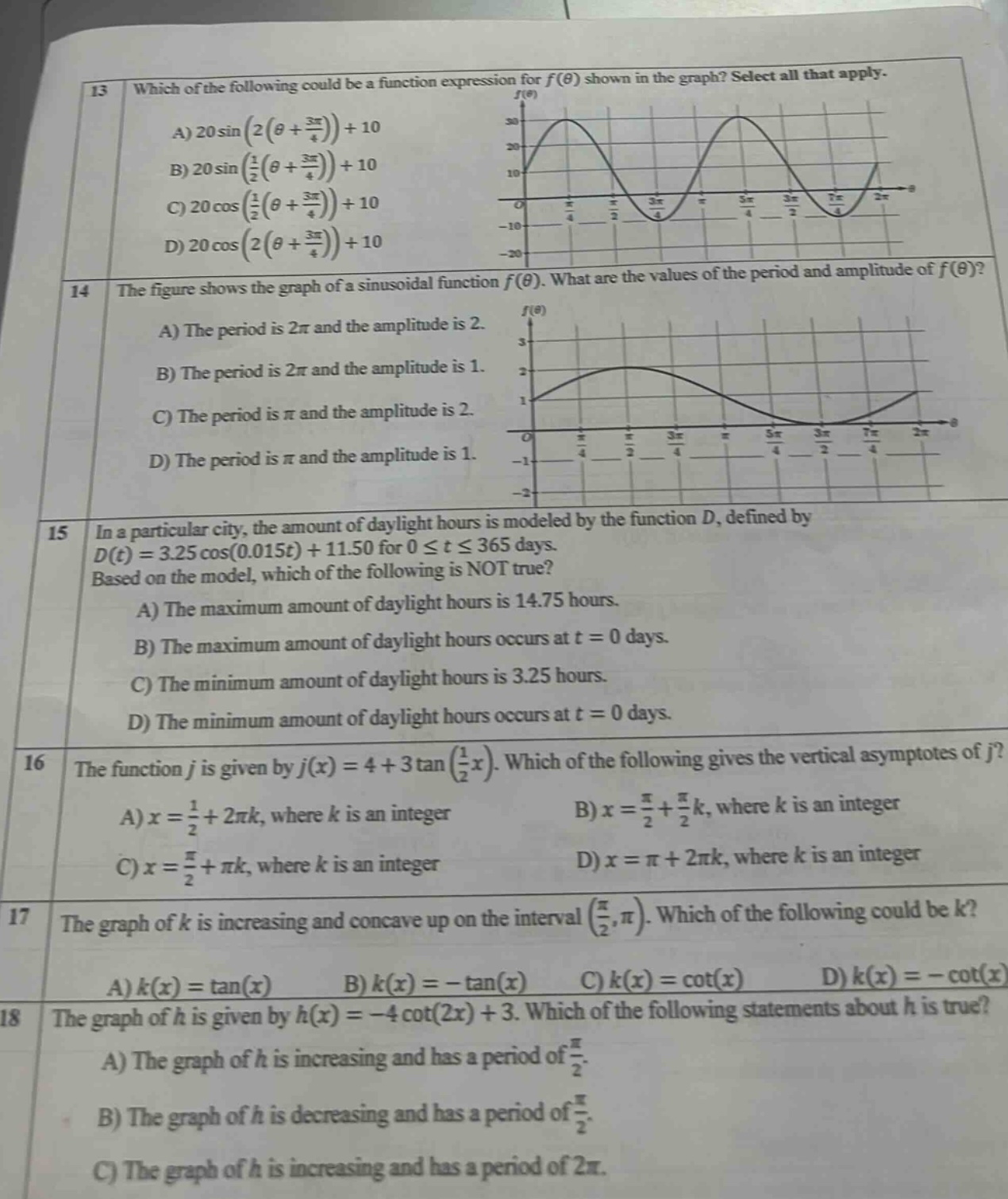
13 which of the following could be a function expression for f(θ) shown in the graph? select all that apply. a) 20 sin(2(θ + 3π/4)) + 10 b) 20 sin(1/2(θ + 3π/4)) + 10 c) 20 cos(1/2(θ + 3π/4)) + 10 d) 20 cos(2(θ + 3π/4)) + 10 14 the figure shows the graph of a sinusoidal function f(θ). what are the values of the period and amplitude of f(θ)? a) the period is 2π and the amplitude is 2. b) the period is 2π and the amplitude is 1. c) the period is π and the amplitude is 2. d) the period is π and the amplitude is 1. 15 in a particular city, the amount of daylight hours is modeled by the function d, defined by d(t)=3.25 cos(0.015t)+11.50 for 0 ≤ t ≤ 365 days. based on the model, which of the following is not true? a) the maximum amount of daylight hours is 14.75 hours. b) the maximum amount of daylight hours occurs at t = 0 days. c) the minimum amount of daylight hours is 3.25 hours. d) the minimum amount of daylight hours occurs at t = 0 days. 16 the function j is given by j(x)=4 + 3 tan(1/2x). which of the following gives the vertical asymptotes of j? a) x = 1/2+2πk, where k is an integer b) x = π/2+π/2k, where k is an integer c) x = π/2+πk, where k is an integer d) x = π+2πk, where k is an integer 17 the graph of k is increasing and concave up on the interval (π/2,π). which of the following could be k? a) k(x)=tan(x) b) k(x)= - tan(x) c) k(x)=cot(x) d) k(x)= - cot(x) 18 the graph of h is given by h(x)= - 4 cot(2x)+3. which of the following statements about h is true? a) the graph of h is increasing and has a period of π/2. b) the graph of h is decreasing and has a period of π/2. c) the graph of h is increasing and has a period of 2π.
Answer
Explanation:
Step1: Analyze question 13
For a sinusoidal function of the form $y = A\sin(B(\theta - C))+D$ or $y = A\cos(B(\theta - C))+D$, the amplitude is $|A|$, the period is $T=\frac{2\pi}{|B|}$. From the graph, the amplitude is 10 and the period is $\pi$. For a period of $\pi$, $B = 2$. Also, the graph seems to be a sine - type function shifted vertically by 10. Option A: $y = 20\sin(2(\theta+\frac{3\pi}{4})) + 10$ has amplitude 20 and period $\pi$. Option B has period $4\pi$. Option C and D are cosine - type functions and the graph looks more like a sine - type function. So the answer for 13 is A.
Step2: Analyze question 14
For a sinusoidal function $y = A\sin(B\theta)+D$ or $y = A\cos(B\theta)+D$, the amplitude is $|A|$ and the period is $T=\frac{2\pi}{|B|}$. From the graph, the maximum value is 2 and the minimum value is 0, so the amplitude $A=\frac{2 - 0}{2}=1$. The function repeats itself over an interval of $2\pi$, so the period is $2\pi$. The answer for 14 is B.
Step3: Analyze question 15
For the function $D(t)=3.25\cos(0.015t)+11.50$, the maximum value of $\cos(0.015t)$ is 1 and the minimum value is - 1. The maximum value of $D(t)$ is $3.25\times1 + 11.50=14.75$ and the minimum value is $3.25\times(-1)+11.50 = 8.25$. The cosine function $y=\cos(x)$ has a maximum at $x = 2k\pi,k\in\mathbb{Z}$. For $y=\cos(0.015t)$, when $t = 0$, $D(0)=3.25\cos(0)+11.50=3.25 + 11.50=14.75$. The minimum value of $D(t)$ does not occur at $t = 0$. The answer for 15 is C.
Step4: Analyze question 16
For the tangent function $y = a\tan(bx)+c$, the vertical asymptotes occur at $bx=\frac{\pi}{2}+k\pi,k\in\mathbb{Z}$. For $j(x)=4 + 3\tan(\frac{1}{2}x)$, we set $\frac{1}{2}x=\frac{\pi}{2}+k\pi$. Solving for $x$ gives $x=\pi + 2k\pi,k\in\mathbb{Z}$. The answer for 16 is D.
Step5: Analyze question 17
The tangent function $y = \tan(x)$ is increasing and concave - up on intervals of the form $(-\frac{\pi}{2}+k\pi,\frac{\pi}{2}+k\pi)$. The cotangent function $y=\cot(x)$ is decreasing on its domain. The negative of the tangent function $y =-\tan(x)$ is decreasing and the negative of the cotangent function $y=-\cot(x)$ is increasing and concave - up on intervals of the form $(\frac{\pi}{2}+k\pi,\pi + k\pi)$. So for the interval $(\frac{\pi}{2},\pi)$, the function could be $k(x)=-\cot(x)$. The answer for 17 is D.
Step6: Analyze question 18
For the cotangent function $y = a\cot(bx)+c$, the period is $T=\frac{\pi}{|b|}$. For $h(x)=-4\cot(2x)+3$, the period is $\frac{\pi}{2}$. The coefficient of $\cot(2x)$ is negative, so the function $h(x)$ is decreasing. The answer for 18 is B.
Answer:
- A
- B
- C
- D
- D
- B