13. use the law of sines to find how many triangles, abc, have the following parameters: α = 30°, c = 49.2…
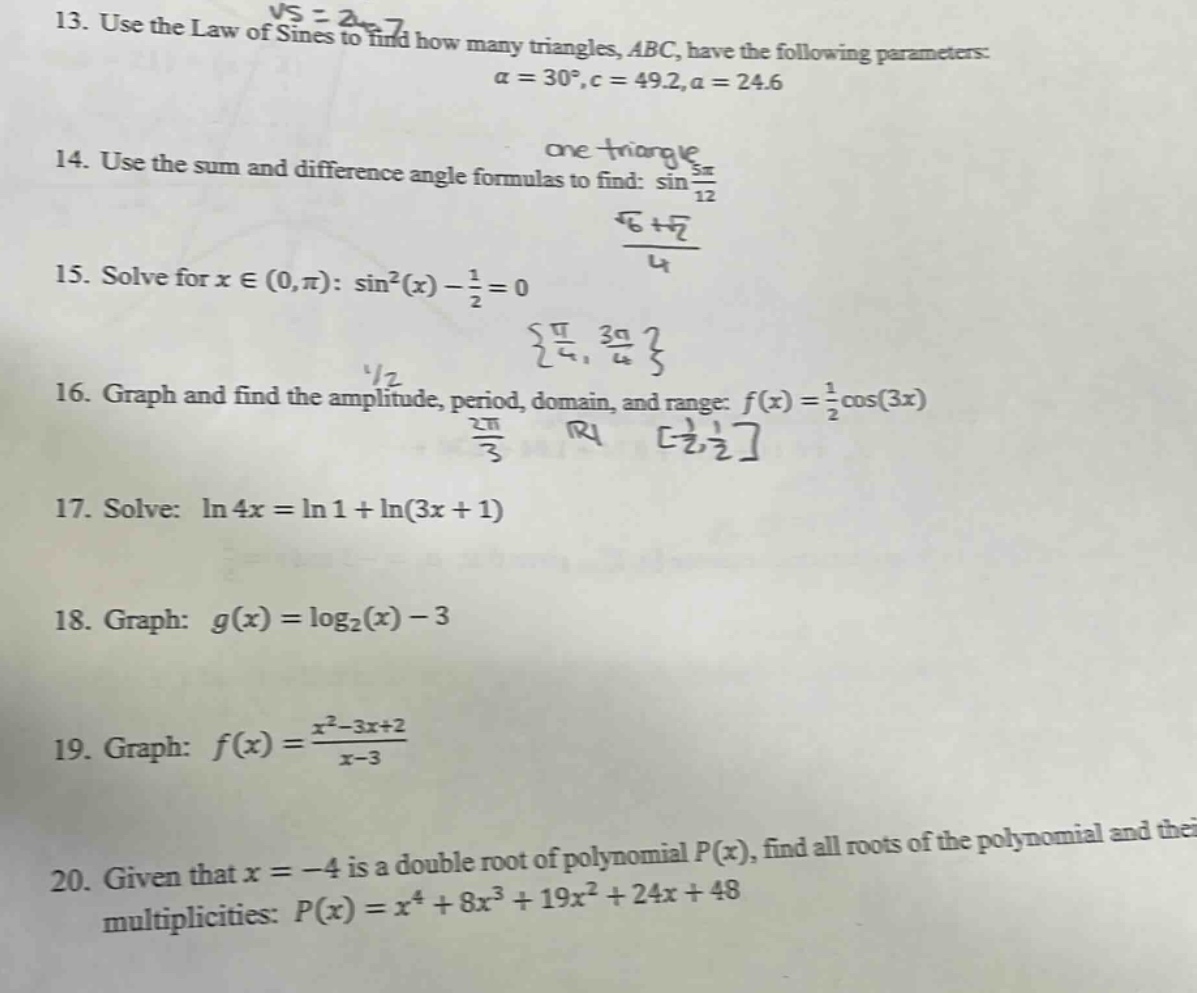
13. use the law of sines to find how many triangles, abc, have the following parameters: α = 30°, c = 49.2, a = 24.6\n14. use the sum and difference angle formulas to find: sin(5π/12)\n15. solve for x ∈ (0,π): sin²(x) - 1/2 = 0\n16. graph and find the amplitude, period, domain, and range: f(x) = 1/2 cos(3x)\n17. solve: ln 4x = ln 1 + ln(3x + 1)\n18. graph: g(x) = log₂(x) - 3\n19. graph: f(x) = (x² - 3x + 2)/(x - 3)\n20. given that x = -4 is a double root of polynomial p(x), find all roots of the polynomial and their multiplicities: p(x) = x⁴ + 8x³ + 19x² + 24x + 48
Answer
13.
Explanation:
Step1: Apply Law of Sines
By the Law of Sines, $\frac{\sin\alpha}{a}=\frac{\sin\gamma}{c}$. Substitute $\alpha = 30^{\circ},c = 49.2,a = 24.6$. So $\sin\gamma=\frac{c\sin\alpha}{a}=\frac{49.2\times\sin30^{\circ}}{24.6}$.
Step2: Calculate $\sin\gamma$
$\sin\gamma=\frac{49.2\times\frac{1}{2}}{24.6}=\frac{24.6}{24.6}=1$. Since $\sin\gamma = 1$, $\gamma = 90^{\circ}$, and there is one - triangle.
Answer:
One triangle
14.
Explanation:
Step1: Rewrite $\frac{5\pi}{12}$
$\frac{5\pi}{12}=\frac{\pi}{4}+\frac{\pi}{6}$. Then $\sin\frac{5\pi}{12}=\sin(\frac{\pi}{4}+\frac{\pi}{6})$.
Step2: Apply sum - of - angles formula
$\sin(A + B)=\sin A\cos B+\cos A\sin B$. Here $A=\frac{\pi}{4},B = \frac{\pi}{6}$. So $\sin(\frac{\pi}{4}+\frac{\pi}{6})=\sin\frac{\pi}{4}\cos\frac{\pi}{6}+\cos\frac{\pi}{4}\sin\frac{\pi}{6}$.
Step3: Substitute values
$\sin\frac{\pi}{4}=\frac{\sqrt{2}}{2},\cos\frac{\pi}{6}=\frac{\sqrt{3}}{2},\cos\frac{\pi}{4}=\frac{\sqrt{2}}{2},\sin\frac{\pi}{6}=\frac{1}{2}$. Then $\sin(\frac{\pi}{4}+\frac{\pi}{6})=\frac{\sqrt{2}}{2}\times\frac{\sqrt{3}}{2}+\frac{\sqrt{2}}{2}\times\frac{1}{2}=\frac{\sqrt{6}+\sqrt{2}}{4}$.
Answer:
$\frac{\sqrt{6}+\sqrt{2}}{4}$
15.
Explanation:
Step1: Rearrange the equation
Given $\sin^{2}(x)-\frac{1}{2}=0$, then $\sin^{2}(x)=\frac{1}{2}$, so $\sin(x)=\pm\frac{\sqrt{2}}{2}$.
Step2: Find $x$ in the given interval
For $\sin(x)=\frac{\sqrt{2}}{2}$ and $x\in(0,\pi)$, $x = \frac{\pi}{4}$ or $x=\frac{3\pi}{4}$.
Answer:
$\left{\frac{\pi}{4},\frac{3\pi}{4}\right}$
16.
Explanation:
Step1: Find the amplitude
For the function $y = A\cos(Bx)$, the amplitude is $|A|$. For $f(x)=\frac{1}{2}\cos(3x)$, $A=\frac{1}{2}$, so the amplitude is $\frac{1}{2}$.
Step2: Find the period
The period of $y = A\cos(Bx)$ is $T=\frac{2\pi}{|B|}$. Here $B = 3$, so $T=\frac{2\pi}{3}$.
Step3: Find the domain
The domain of $y=\cos(3x)$ and thus of $y=\frac{1}{2}\cos(3x)$ is all real numbers, $\mathbb{R}$.
Step4: Find the range
Since $- 1\leqslant\cos(3x)\leqslant1$, then $-\frac{1}{2}\leqslant\frac{1}{2}\cos(3x)\leqslant\frac{1}{2}$, so the range is $\left[-\frac{1}{2},\frac{1}{2}\right]$.
Answer:
Amplitude: $\frac{1}{2}$, Period: $\frac{2\pi}{3}$, Domain: $\mathbb{R}$, Range: $\left[-\frac{1}{2},\frac{1}{2}\right]$
17.
Explanation:
Step1: Use logarithm properties
Since $\ln a+\ln b=\ln(ab)$ and $\ln1 = 0$, the equation $\ln4x=\ln1+\ln(3x + 1)$ becomes $\ln4x=\ln(3x + 1)$.
Step2: Remove the logarithms
If $\ln a=\ln b$, then $a = b$. So $4x=3x + 1$.
Step3: Solve for $x$
Subtract $3x$ from both sides: $4x-3x=3x + 1-3x$, getting $x = 1$.
Answer:
$x = 1$
18.
To graph $g(x)=\log_{2}(x)-3$:
- The domain of $y = \log_{2}(x)$ is $x>0$.
- The vertical asymptote is $x = 0$.
- When $x = 1$, $g(1)=\log_{2}(1)-3=0 - 3=-3$.
- The graph of $y=\log_{2}(x)$ is shifted down 3 units.
19.
To graph $f(x)=\frac{x^{2}-3x + 2}{x - 3}=\frac{(x - 1)(x - 2)}{x - 3}$:
- The domain is $x\neq3$.
- Vertical asymptote: $x = 3$.
- To find the $x$ - intercepts, set $y = 0$, then $(x - 1)(x - 2)=0$, so $x=1$ and $x = 2$ are the $x$ - intercepts.
- To find the $y$ - intercept, set $x = 0$, then $y=\frac{2}{-3}=-\frac{2}{3}$.
- We can also use long - division or rewrite it as $f(x)=x+\frac{2}{x - 3}$.
20.
Explanation:
Step1: Since $x=-4$ is a double root
$(x + 4)^{2}=x^{2}+8x + 16$ is a factor of $P(x)=x^{4}+8x^{3}+19x^{2}+24x + 48$.
Step2: Perform polynomial long - division
Divide $x^{4}+8x^{3}+19x^{2}+24x + 48$ by $x^{2}+8x + 16$. We get $x^{4}+8x^{3}+19x^{2}+24x + 48=(x^{2}+8x + 16)(x^{2}+3)$.
Step3: Find the roots
For $x^{2}+8x + 16=(x + 4)^{2}=0$, $x=-4$ with multiplicity 2. For $x^{2}+3=0$, $x=\pm\sqrt{-3}=\pm i\sqrt{3}$ with multiplicity 1.
Answer:
$x=-4$ (multiplicity 2), $x = i\sqrt{3}$ (multiplicity 1), $x=-i\sqrt{3}$ (multiplicity 1)