4. 14/16 points details my notes scalcet9 11.8.ae.001. example for what values of x does the series ∑(n = 1…
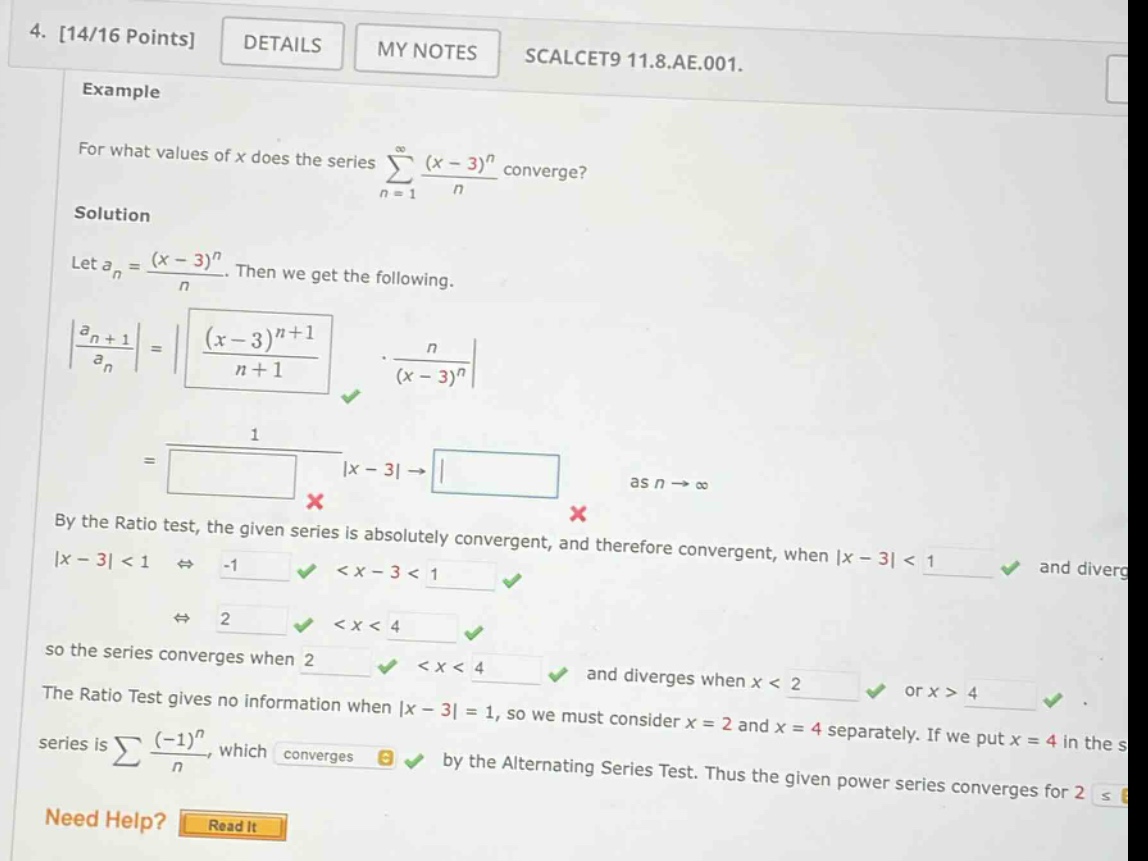
4. 14/16 points details my notes scalcet9 11.8.ae.001. example for what values of x does the series ∑(n = 1 to ∞) (x - 3)^n / n converge? solution let a_n=(x - 3)^n / n. then we get the following. |a_n + 1 / a_n|=|((x - 3)^(n + 1) / (n + 1)) * (n / (x - 3)^n)| = 1 / |x - 3|→ as n→∞ by the ratio test, the given series is absolutely convergent, and therefore convergent, when |x - 3| < 1 |x - 3| < 1 ⇔ -1 < x - 3 < 1 ⇔ 2 < x < 4 so the series converges when 2 < x < 4 and diverges when x < 2 or x > 4 the ratio test gives no information when |x - 3| = 1, so we must consider x = 2 and x = 4 separately. if we put x = 4 in the series is ∑((-1)^n / n), which converges by the alternating series test. thus the given power series converges for 2 ≤ need help? read it
Answer
Explanation:
Step1: Apply Ratio - Test formula
Let (a_n=\frac{(x - 3)^n}{n}), then (a_{n + 1}=\frac{(x - 3)^{n+1}}{n + 1}). Calculate (\left|\frac{a_{n+1}}{a_n}\right|=\left|\frac{\frac{(x - 3)^{n+1}}{n + 1}}{\frac{(x - 3)^n}{n}}\right|=\left|\frac{n}{n + 1}(x - 3)\right|). As (n\to\infty), (\lim_{n\to\infty}\left|\frac{n}{n + 1}\right| = 1), so (\lim_{n\to\infty}\left|\frac{a_{n+1}}{a_n}\right|=\left|x - 3\right|).
Step2: Determine convergence interval from Ratio - Test
By the Ratio - Test, the series is absolutely convergent when (\left|x - 3\right|<1). Solving the inequality (\left|x - 3\right|<1) gives (- 1<x - 3<1), which simplifies to (2<x<4).
Step3: Check endpoints
When (x = 2), the series becomes (\sum_{n = 1}^{\infty}\frac{(2 - 3)^n}{n}=\sum_{n=1}^{\infty}\frac{(-1)^n}{n}), which converges by the Alternating - Series Test. When (x = 4), the series becomes (\sum_{n = 1}^{\infty}\frac{(4 - 3)^n}{n}=\sum_{n=1}^{\infty}\frac{1}{n}), which is the harmonic series and diverges.
Answer:
The series (\sum_{n = 1}^{\infty}\frac{(x - 3)^n}{n}) converges for (2\leq x<4).