14. -/6.66 points details my notes larcalc11 10.4.063. find dy/dx and the slopes of the tangent lines shown…
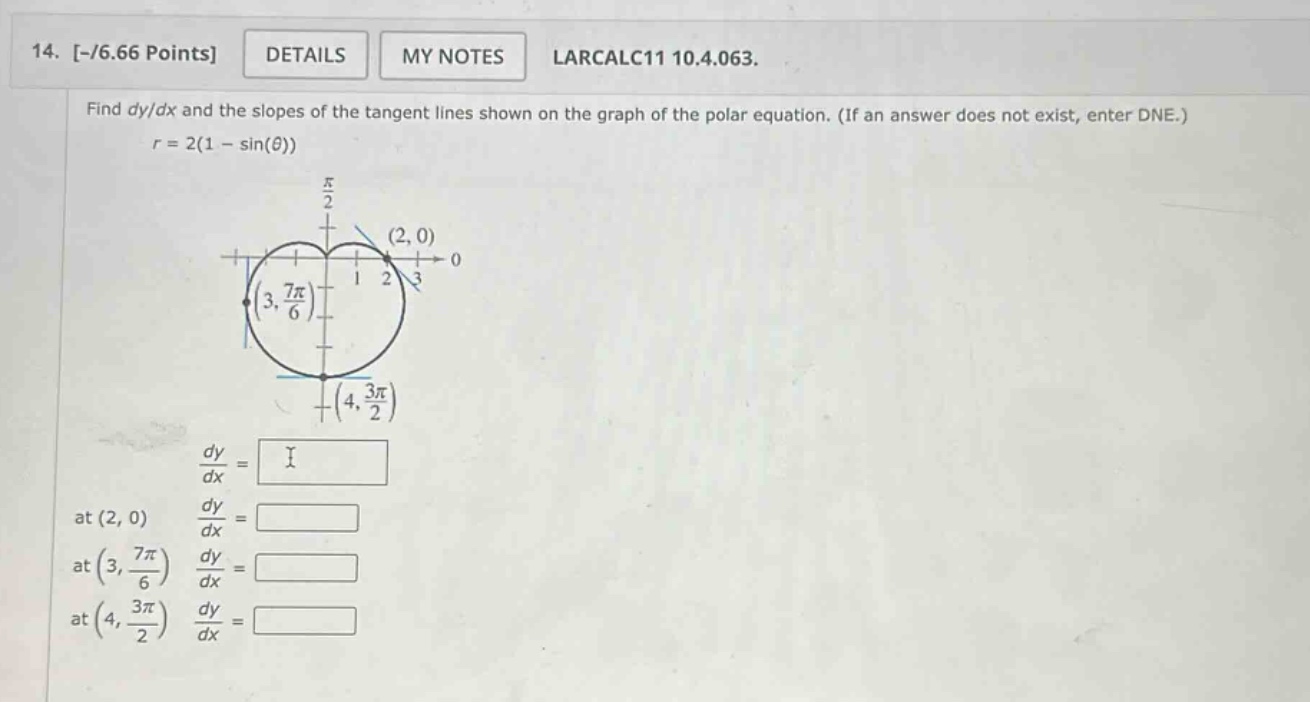
14. -/6.66 points details my notes larcalc11 10.4.063. find dy/dx and the slopes of the tangent lines shown on the graph of the polar equation. (if an answer does not exist, enter dne.) r = 2(1 - sin(θ)) at (2, 0) dy/dx = at (3, 7π/6) dy/dx = at (4, 3π/2) dy/dx =
Answer
Explanation:
Step1: Recall polar - to - rectangular conversion
We know that $x = r\cos\theta$ and $y=r\sin\theta$, and $r = 2(1-\sin\theta)$. So $x=2(1 - \sin\theta)\cos\theta=2\cos\theta-2\sin\theta\cos\theta=2\cos\theta-\sin2\theta$, and $y = 2(1 - \sin\theta)\sin\theta=2\sin\theta-2\sin^{2}\theta$.
Step2: Differentiate $x$ and $y$ with respect to $\theta$
Using the chain - rule, $\frac{dx}{d\theta}=-2\sin\theta - 2\cos2\theta$ and $\frac{dy}{d\theta}=2\cos\theta-4\sin\theta\cos\theta=2\cos\theta - 2\sin2\theta$.
Step3: Use the formula for $\frac{dy}{dx}$
By the formula $\frac{dy}{dx}=\frac{\frac{dy}{d\theta}}{\frac{dx}{d\theta}}=\frac{2\cos\theta - 2\sin2\theta}{-2\sin\theta - 2\cos2\theta}=\frac{\cos\theta-\sin2\theta}{-\sin\theta - \cos2\theta}$.
Step4: Evaluate $\frac{dy}{dx}$ at the given points
Point $(2,0)$:
When $\theta = 0$, $r = 2(1-\sin0)=2$. Substitute $\theta = 0$ into $\frac{dy}{dx}$: $\frac{dy}{dx}=\frac{\cos0-\sin0}{-\sin0 - \cos0}=\frac{1 - 0}{0 - 1}=-1$.
Point $(3,\frac{7\pi}{6})$:
When $\theta=\frac{7\pi}{6}$, $r = 2(1-\sin\frac{7\pi}{6})=2(1+\frac{1}{2}) = 3$. $\cos\frac{7\pi}{6}=-\frac{\sqrt{3}}{2}$, $\sin\frac{7\pi}{6}=-\frac{1}{2}$, $\sin2\theta=\sin\frac{7\pi}{3}=\frac{\sqrt{3}}{2}$, $\cos2\theta=\cos\frac{7\pi}{3}=\frac{1}{2}$. $\frac{dy}{dx}=\frac{-\frac{\sqrt{3}}{2}-\frac{\sqrt{3}}{2}}{\frac{1}{2}-\frac{1}{2}}=\text{DNE}$.
Point $(4,\frac{3\pi}{2})$:
When $\theta=\frac{3\pi}{2}$, $r = 2(1-\sin\frac{3\pi}{2})=2(1 + 1)=4$. Substitute $\theta=\frac{3\pi}{2}$ into $\frac{dy}{dx}$: $\frac{dy}{dx}=\frac{0 - 0}{-(-1)-(-1)} = 0$.
Answer:
$\frac{dy}{dx}=\frac{\cos\theta-\sin2\theta}{-\sin\theta - \cos2\theta}$ at $(2,0)$: $\frac{dy}{dx}=-1$ at $(3,\frac{7\pi}{6})$: $\frac{dy}{dx}=\text{DNE}$ at $(4,\frac{3\pi}{2})$: $\frac{dy}{dx}=0$