14. find the second derivative of the function. (4pts)\n$f(x)=e^{-3x}+e^{4x}$\n\n15. use logarithmic…
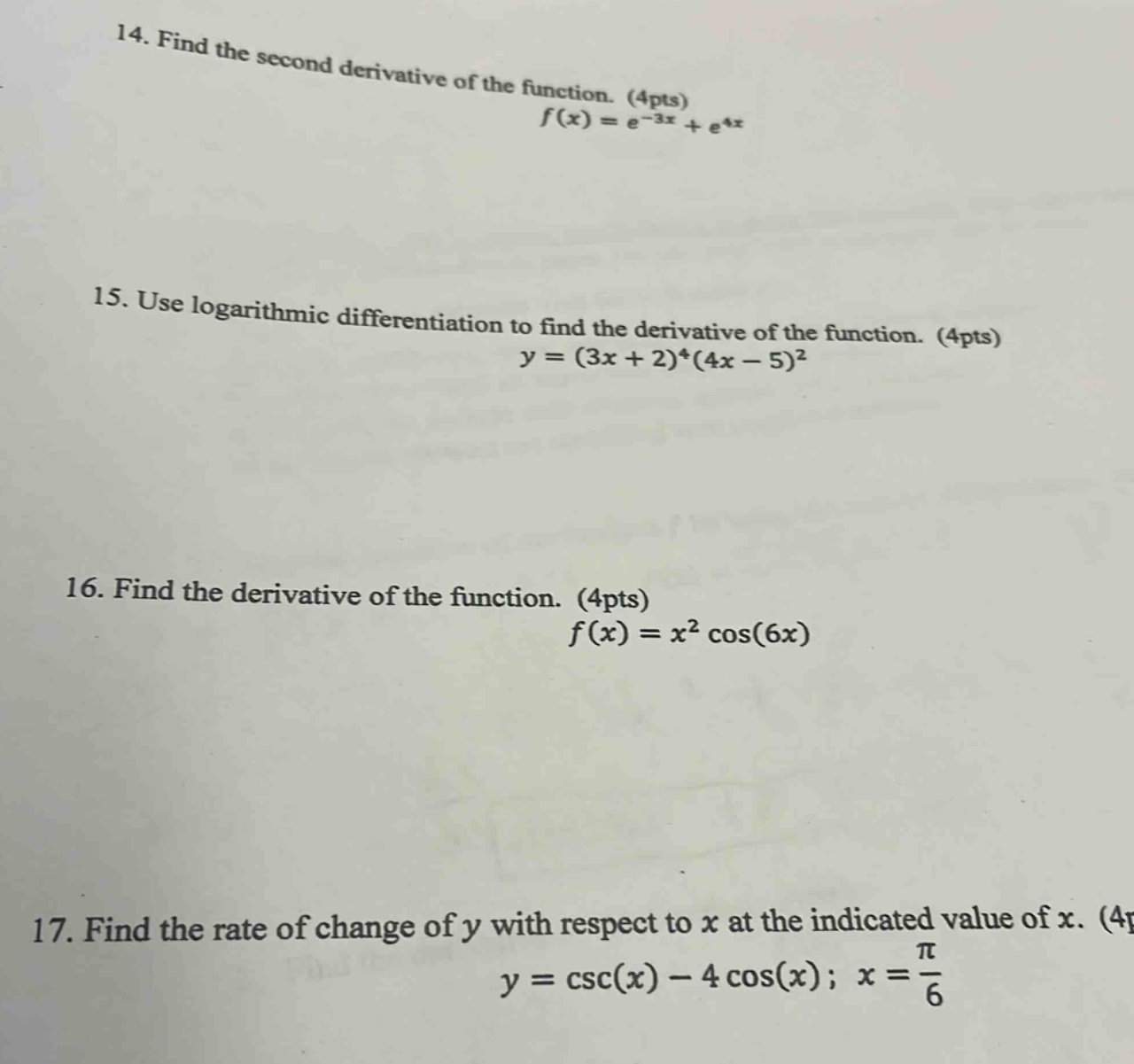
14. find the second derivative of the function. (4pts)\n$f(x)=e^{-3x}+e^{4x}$\n\n15. use logarithmic differentiation to find the derivative of the function. (4pts)\n$y=(3x + 2)^4(4x - 5)^2$\n\n16. find the derivative of the function. (4pts)\n$f(x)=x^2cos(6x)$\n\n17. find the rate of change of $y$ with respect to $x$ at the indicated value of $x$. (4pts)\n$y = csc(x)-4cos(x);x=\frac{pi}{6}$
Answer
Explanation:
Step1: Find first - derivative of (f(x)=e^{-3x}+e^{4x})
Using the chain - rule ((e^{ax})^\prime = ae^{ax}), we have (f^\prime(x)=-3e^{-3x}+4e^{4x}).
Step2: Find second - derivative of (f(x))
Differentiate (f^\prime(x)) again. Using the chain - rule, (f^{\prime\prime}(x)=(-3)\times(-3)e^{-3x}+4\times4e^{4x}=9e^{-3x}+16e^{4x})
Answer:
(9e^{-3x}+16e^{4x})
Explanation:
Step1: Take natural logarithm of both sides of (y=(3x + 2)^4(4x-5)^2)
(\ln y=\ln((3x + 2)^4(4x-5)^2)=4\ln(3x + 2)+2\ln(4x-5))
Step2: Differentiate both sides with respect to (x)
(\frac{y^\prime}{y}=\frac{4\times3}{3x + 2}+\frac{2\times4}{4x-5}=\frac{12}{3x + 2}+\frac{8}{4x-5})
Step3: Solve for (y^\prime)
(y^\prime=y\left(\frac{12}{3x + 2}+\frac{8}{4x-5}\right)=(3x + 2)^4(4x-5)^2\left(\frac{12}{3x + 2}+\frac{8}{4x-5}\right))
Answer:
((3x + 2)^4(4x-5)^2\left(\frac{12}{3x + 2}+\frac{8}{4x-5}\right))
Explanation:
Step1: Use the product - rule ((uv)^\prime = u^\prime v+uv^\prime) where (u = x^2) and (v=\cos(6x))
(u^\prime = 2x), and using the chain - rule (v^\prime=-\sin(6x)\times6=-6\sin(6x))
Step2: Calculate (f^\prime(x))
(f^\prime(x)=2x\cos(6x)+x^2\times(-6\sin(6x))=2x\cos(6x)-6x^2\sin(6x))
Answer:
(2x\cos(6x)-6x^2\sin(6x))
Explanation:
Step1: Find the derivative of (y = \csc(x)-4\cos(x))
The derivative of (\csc(x)=-\csc(x)\cot(x)) and the derivative of (\cos(x)=-\sin(x)), so (y^\prime=-\csc(x)\cot(x)+4\sin(x))
Step2: Evaluate (y^\prime) at (x = \frac{\pi}{6})
(\csc\left(\frac{\pi}{6}\right)=2), (\cot\left(\frac{\pi}{6}\right)=\sqrt{3}), (\sin\left(\frac{\pi}{6}\right)=\frac{1}{2}) (y^\prime\left(\frac{\pi}{6}\right)=-2\times\sqrt{3}+4\times\frac{1}{2}=2 - 2\sqrt{3})
Answer:
(2 - 2\sqrt{3})