14) $lim_{x\rightarrow - 4^{+}}\frac{x + 5}{x^{2}+8x + 16}$
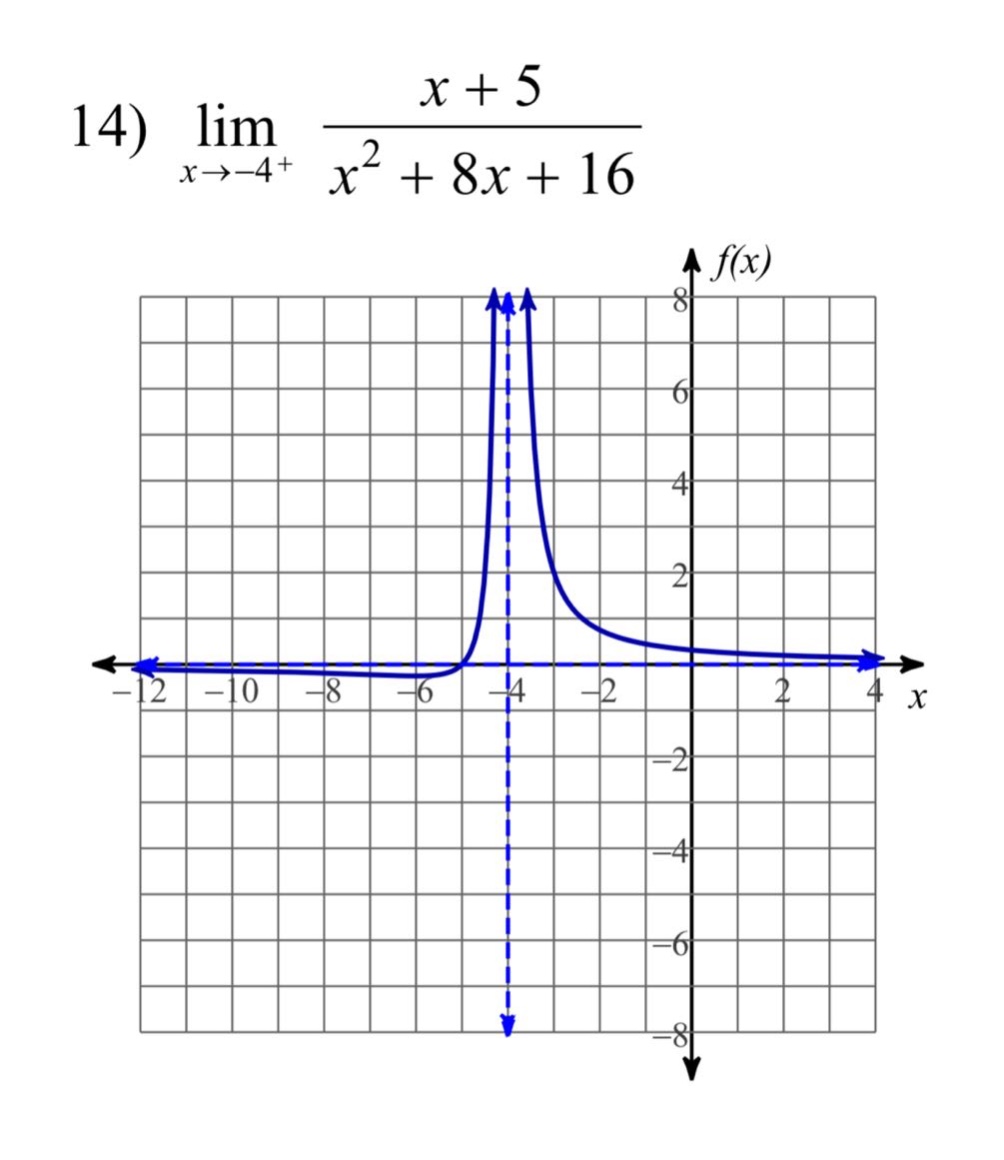
14) $lim_{x\rightarrow - 4^{+}}\frac{x + 5}{x^{2}+8x + 16}$
Answer
Explanation:
Step1: Factor the denominator of the expression.
The denominator is $x^2 + 8x + 16$. This is a perfect square trinomial, which can be factored as $(x+4)^2$. So the expression becomes: $$ \lim_{x \to -4^+} \frac{x+5}{(x+4)^2} $$
Step2: Analyze the numerator as $x$ approaches $-4$ from the right.
As $x \to -4^+$, the numerator $x+5$ approaches $-4+5 = 1$.
Step3: Analyze the denominator as $x$ approaches $-4$ from the right.
As $x \to -4^+$, let $x = -4 + h$, where $h$ is a small positive number ($h \to 0^+$). Then $x+4 = (-4+h)+4 = h$. So, $(x+4)^2 = h^2$. Since $h \to 0^+$, $h^2$ is a very small positive number, approaching $0$ from the positive side ($0^+$).
Step4: Evaluate the limit.
The limit is of the form $\frac{\text{a positive number (approaching 1)}}{\text{a very small positive number (approaching } 0^+)}$. $$ \lim_{x \to -4^+} \frac{x+5}{(x+4)^2} = \frac{1}{0^+} = +\infty $$ Alternatively, observing the provided graph, as $x$ approaches $-4$ from the right side, the function $f(x)$ increases without bound, tending towards $+\infty$.
Answer:
$$ +\infty $$