14 mark for review consider the graph of the polar function r = f(θ), where f(θ)=θ(θ - 2)(θ - 4), in the…
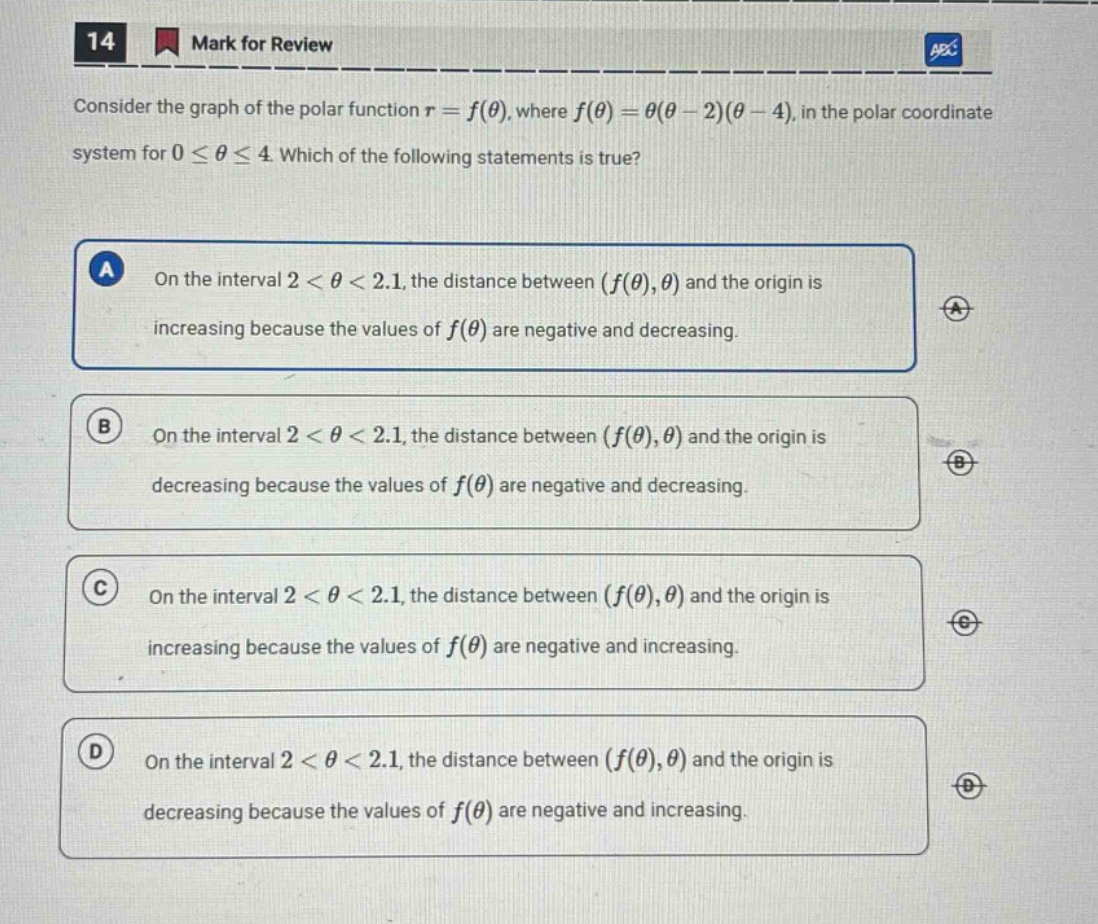
14 mark for review consider the graph of the polar function r = f(θ), where f(θ)=θ(θ - 2)(θ - 4), in the polar coordinate system for 0 ≤ θ ≤ 4. which of the following statements is true? a on the interval 2 < θ < 2.1, the distance between (f(θ),θ) and the origin is increasing because the values of f(θ) are negative and decreasing. b on the interval 2 < θ < 2.1, the distance between (f(θ),θ) and the origin is decreasing because the values of f(θ) are negative and decreasing. c on the interval 2 < θ < 2.1, the distance between (f(θ),θ) and the origin is increasing because the values of f(θ) are negative and increasing. d on the interval 2 < θ < 2.1, the distance between (f(θ),θ) and the origin is decreasing because the values of f(θ) are negative and increasing.
Answer
Explanation:
Step1: Recall polar - distance property
In polar coordinates, the distance between the point $(r,\theta)$ and the origin is given by $|r|$. Here $r = f(\theta)=\theta(\theta - 2)(\theta - 4)$.
Step2: Analyze the sign of $f(\theta)$ on the interval $2<\theta<2.1$
Let's consider the function $y = f(\theta)=\theta(\theta - 2)(\theta - 4)=\theta^3-6\theta^2 + 8\theta$. When $2<\theta<2.1$, $\theta>0$, $\theta - 2>0$ and $\theta - 4<0$. So $f(\theta)<0$ on the interval $2<\theta<2.1$.
Step3: Analyze the behavior of $f(\theta)$ on the interval $2<\theta<2.1$
We can take the derivative of $f(\theta)$ using the power - rule. $f'(\theta)=3\theta^2-12\theta + 8$. Evaluate $f'(\theta)$ at a value in the interval $2<\theta<2.1$, say $\theta = 2.05$. $f'(2.05)=3\times(2.05)^2-12\times2.05 + 8=3\times4.2025-24.6 + 8=12.6075-24.6 + 8=-4.9925<0$. So $f(\theta)$ is decreasing on the interval $2<\theta<2.1$. Since $|f(\theta)|=-f(\theta)$ (because $f(\theta)<0$), when $f(\theta)$ is negative and decreasing, $|f(\theta)|$ is increasing. The distance between $(f(\theta),\theta)$ and the origin is $|f(\theta)|$.
Answer:
A. On the interval $2<\theta<2.1$, the distance between $(f(\theta),\theta)$ and the origin is increasing because the values of $f(\theta)$ are negative and decreasing.