14 mark for review the depth of water in a bay periodically increases and decreases with a period of 12…
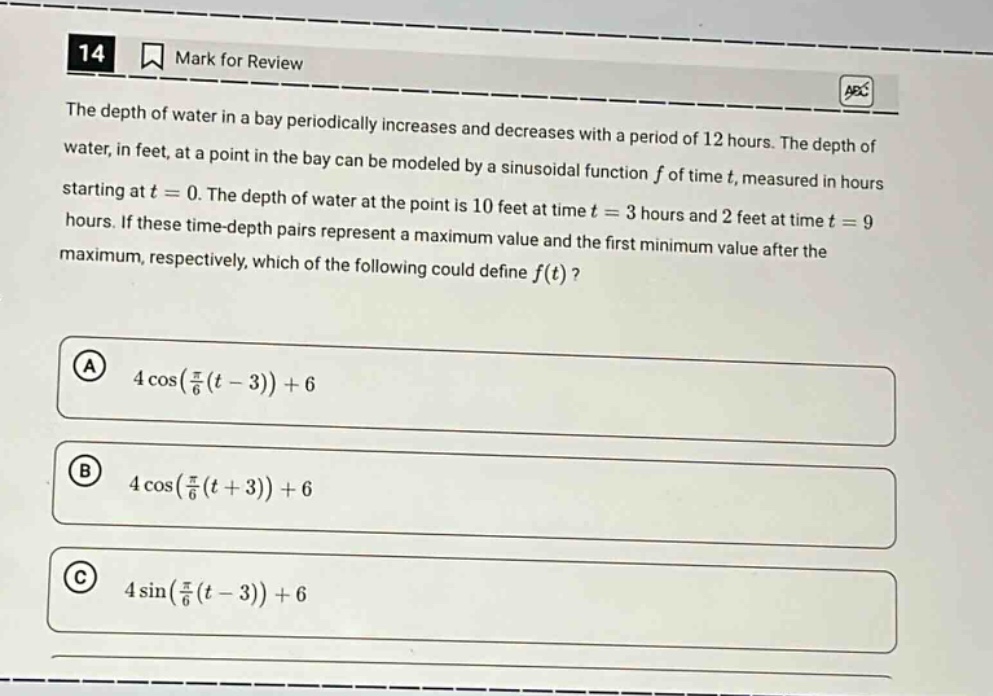
14 mark for review the depth of water in a bay periodically increases and decreases with a period of 12 hours. the depth of water, in feet, at a point in the bay can be modeled by a sinusoidal function f of time t, measured in hours starting at t = 0. the depth of water at the point is 10 feet at time t = 3 hours and 2 feet at time t = 9 hours. if these time - depth pairs represent a maximum value and the first minimum value after the maximum, respectively, which of the following could define f(t)? a 4 cos(π/6(t - 3)) + 6 b 4 cos(π/6(t + 3)) + 6 c 4 sin(π/6(t - 3)) + 6
Answer
Explanation:
Step1: Determine the general form of sinusoidal function
The general form of a sinusoidal function is $y = A\sin(B(t - h))+k$ or $y = A\cos(B(t - h))+k$, where $A$ is the amplitude, $B=\frac{2\pi}{T}$ ($T$ is the period), $(h,k)$ is the phase - shift and vertical shift. Given $T = 12$, then $B=\frac{2\pi}{12}=\frac{\pi}{6}$.
Step2: Calculate the amplitude and vertical shift
The amplitude $A=\frac{\text{max}-\text{min}}{2}=\frac{10 - 2}{2}=4$. The vertical shift $k=\frac{\text{max}+\text{min}}{2}=\frac{10 + 2}{2}=6$.
Step3: Check the phase - shift
We know that the maximum occurs at $t = 3$. For a cosine function $y = A\cos(B(t - h))+k$, when $y$ is maximum, $\cos(B(t - h)) = 1$, i.e., $B(t - h)=2n\pi,n\in\mathbb{Z}$. Substituting $B=\frac{\pi}{6}$ and $t = 3$, we get $\frac{\pi}{6}(3 - h)=2n\pi$. When $n = 0$, $h = 3$.
Answer:
A. $4\cos(\frac{\pi}{6}(t - 3))+6$