-/14 points details my notes ask your graphs of the velocity functions of two particles are shown, where t…
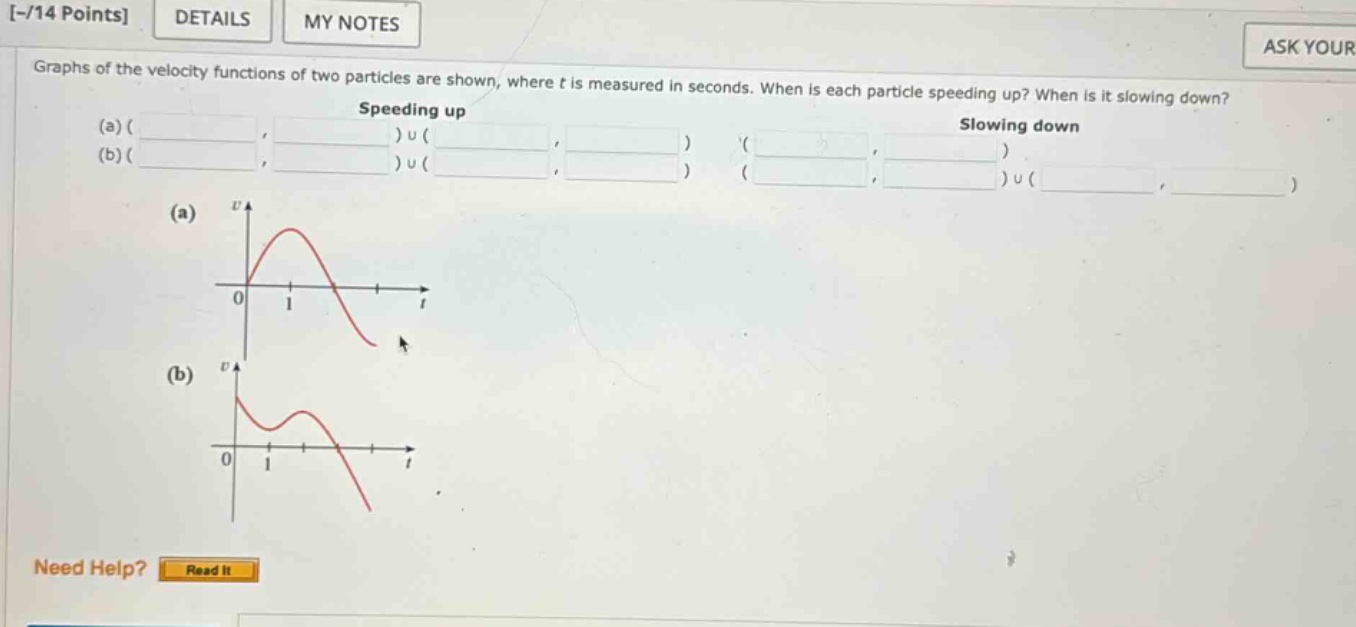
-/14 points details my notes ask your graphs of the velocity functions of two particles are shown, where t is measured in seconds. when is each particle speeding up? when is it slowing down? speeding up slowing down (a)( (b)( )u( )u( ) (a) (b) need help? read it
Answer
Explanation:
Step1: Recall the condition for speeding - up
A particle is speeding up when the velocity (v(t)) and acceleration (a(t)) have the same sign. Since (a(t)=v^{\prime}(t)), we need to check where the slope of the velocity - time graph has the same sign as the velocity.
Step2: Analyze graph (a)
For graph (a):
- The velocity (v(t)) is positive on ((0,1)) and the slope (v^{\prime}(t)>0) (the graph is increasing) on ((0,1)). The velocity (v(t)) is negative on ((1,3)) and the slope (v^{\prime}(t)<0) (the graph is decreasing) on ((1,3)).
- So the particle is speeding up on ((0,1)\cup(1,3)).
- The particle is slowing down when (v(t)) and (v^{\prime}(t)) have opposite signs. There are no such intervals in the given domain. So the slowing - down interval is (\varnothing).
Step3: Analyze graph (b)
For graph (b):
- The velocity (v(t)) is positive on ((0,1)) and the slope (v^{\prime}(t)<0) (the graph is decreasing) on ((0,1)). The velocity (v(t)) is negative on ((1,3)) and the slope (v^{\prime}(t)>0) (the graph is increasing) on ((1,3)). So the particle is slowing down on ((0,1)\cup(1,3)).
- There are no intervals where (v(t)) and (v^{\prime}(t)) have the same sign in the given domain. So the speeding - up interval is (\varnothing).
Answer:
(a) Speeding up: ((0,1)\cup(1,3)), Slowing down: (\varnothing) (b) Speeding up: (\varnothing), Slowing down: ((0,1)\cup(1,3))