15) $y = - 2cos(pi\theta+\frac{pi}{2}) + 3$
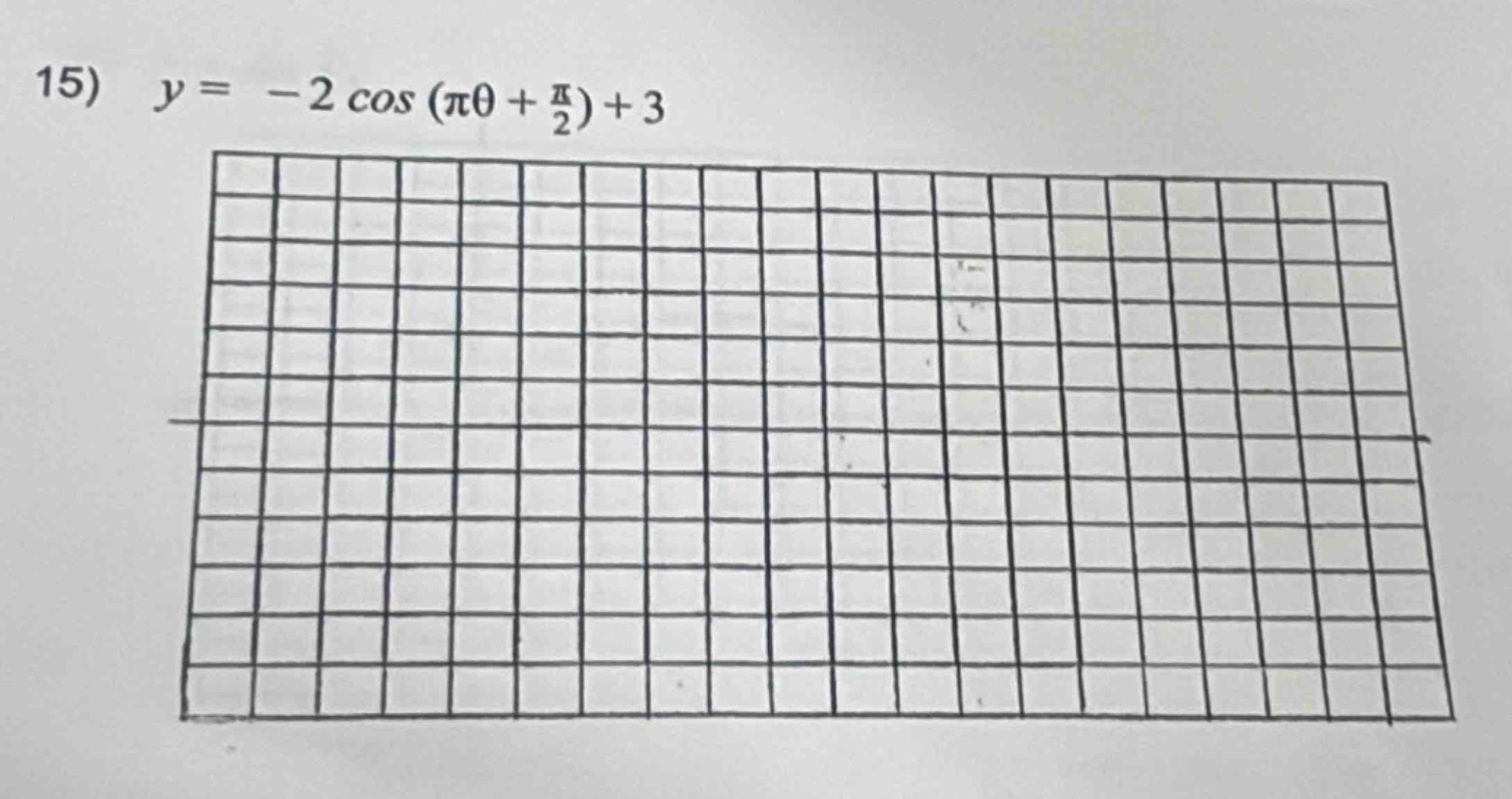
15) $y = - 2cos(pi\theta+\frac{pi}{2}) + 3$
Answer
Explanation:
Step1: Identify the general form of cosine function
The general form of a cosine - function is $y = A\cos(B\theta - C)+D$. For the given function $y=-2\cos(\pi\theta+\frac{\pi}{2}) + 3$, we have $A=-2$, $B = \pi$, $C=-\frac{\pi}{2}$, and $D = 3$.
Step2: Find the amplitude
The amplitude is given by $|A|$. So, $|A|=|-2| = 2$.
Step3: Find the period
The period of a cosine function $y = A\cos(B\theta - C)+D$ is $T=\frac{2\pi}{|B|}$. Since $B=\pi$, then $T=\frac{2\pi}{\pi}=2$.
Step4: Find the phase - shift
The phase - shift is given by $\frac{C}{B}$. Here, $\frac{C}{B}=\frac{-\frac{\pi}{2}}{\pi}=-\frac{1}{2}$.
Step5: Find the vertical shift
The vertical shift is $D = 3$.
Step6: Create a table of values
Choose some values of $\theta$. For example, when $\theta=-\frac{1}{2}$, $y=-2\cos(\pi(-\frac{1}{2})+\frac{\pi}{2})+3=-2\cos(0)+3=-2\times1 + 3=1$. When $\theta = 0$, $y=-2\cos(\frac{\pi}{2})+3=3$. When $\theta=\frac{1}{2}$, $y=-2\cos(\pi\times\frac[Client Connection Error][Connection Error]