15 consider the graph of the function $f(x)=\frac{x^{2}-7x + 12}{x - 2}$. which statement is true? a it has…
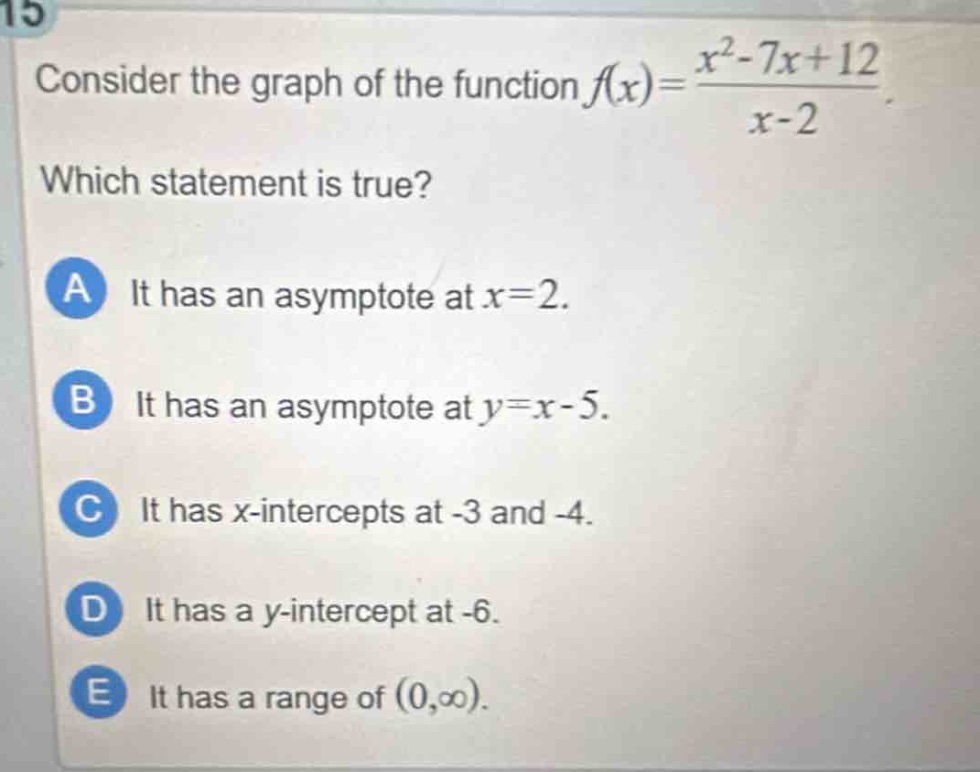
15 consider the graph of the function $f(x)=\frac{x^{2}-7x + 12}{x - 2}$. which statement is true? a it has an asymptote at $x = 2$. b it has an asymptote at $y=x - 5$. c it has $x$-intercepts at -3 and -4. d it has a $y$-intercept at -6. e it has a range of $(0,infty)$.
Answer
Explanation:
Step1: Analyze vertical asymptote
Set the denominator equal to 0. For $f(x)=\frac{x^{2}-7x + 12}{x - 2}$, when $x-2=0$, i.e., $x = 2$, the function is undefined. So there is a vertical - asymptote at $x = 2$.
Step2: Analyze slant asymptote
Use polynomial long - division. Divide $x^{2}-7x + 12$ by $x - 2$. $x^{2}-7x + 12=(x - 2)(x-5)+2$. So $y=x - 5+\frac{2}{x - 2}$, and $y=x - 5$ is a slant asymptote.
Step3: Analyze x - intercepts
Set $y = 0$, then $x^{2}-7x + 12=0$. Factoring gives $(x - 3)(x - 4)=0$, so $x=3$ and $x = 4$ are the x - intercepts.
Step4: Analyze y - intercepts
Set $x = 0$, then $y=\frac{0^{2}-7\times0 + 12}{0 - 2}=-6$.
Step5: Analyze range
The function is a rational function. Since it has a slant asymptote and a vertical asymptote, its range is not $(0,\infty)$.
Answer:
A. It has an asymptote at $x = 2$; B. It has an asymptote at $y=x - 5$; D. It has a y - intercept at $-6$.