15 drag each tile to the correct box. using rectangles of unit width on the interval 3, 5, arrange the…
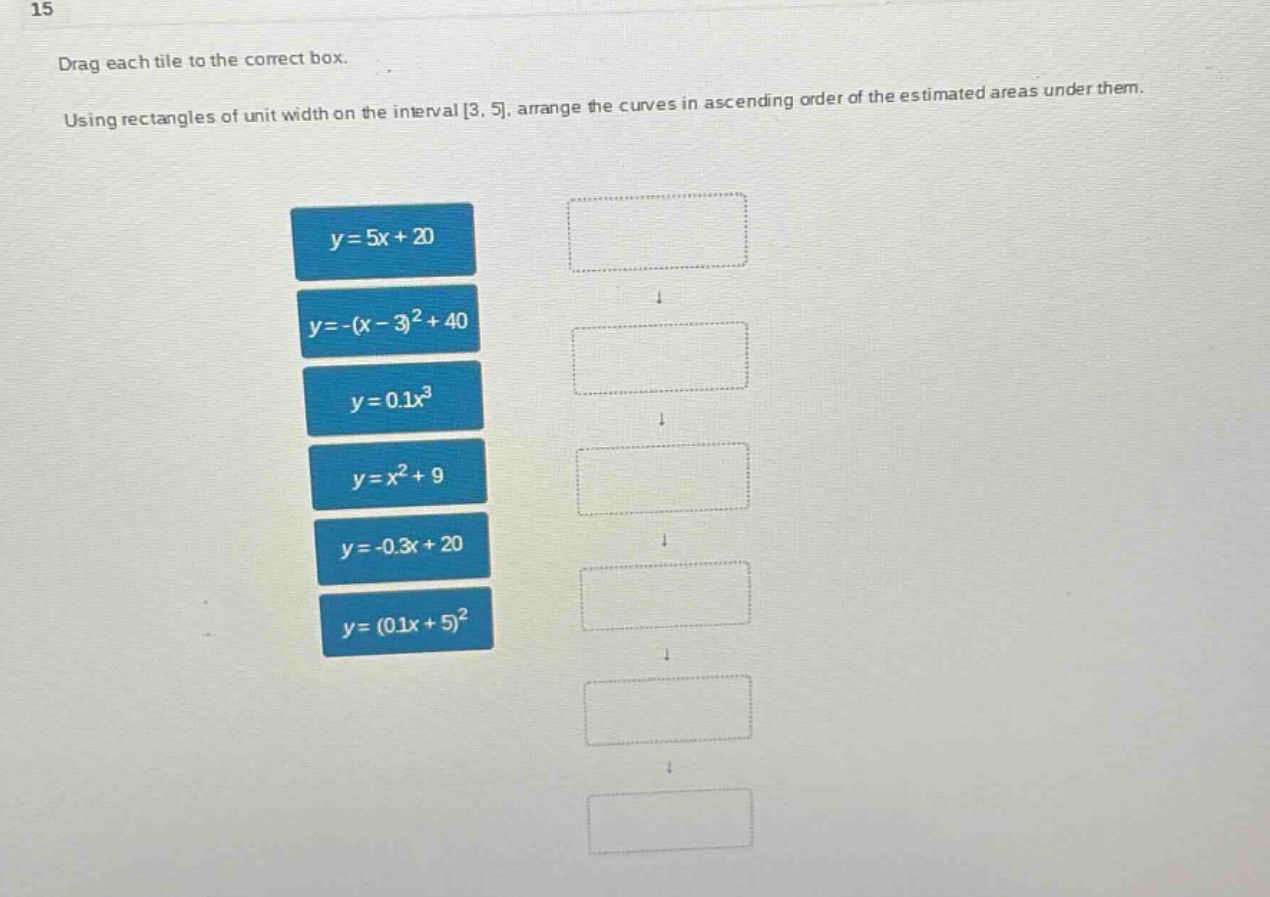
15 drag each tile to the correct box. using rectangles of unit width on the interval 3, 5, arrange the curves in ascending order of the estimated areas under them. y = 5x + 20 y = -(x - 3)^2 + 40 y = 0.1x^3 y = x^2 + 9 y = -0.3x + 20 y = (0.1x + 5)^2
Answer
Explanation:
Step1: Recall the left - hand and right - hand Riemann sum formula
For a function (y = f(x)) on the interval ([a,b]) with (n) sub - intervals of width (\Delta x=\frac{b - a}{n}), the left - hand Riemann sum (L_n=\sum_{i = 0}^{n - 1}f(x_i)\Delta x) and the right - hand Riemann sum (R_n=\sum_{i = 1}^{n}f(x_i)\Delta x), where (x_i=a + i\Delta x). Here (a = 3), (b = 5), and (n=2), (\Delta x = 1).
Step2: Calculate the left - hand Riemann sum for (y=-0.3x + 20)
When (x_1 = 3), (y_1=-0.3\times3 + 20=19.1); when (x_2 = 4), (y_2=-0.3\times4+20 = 18.8). The left - hand Riemann sum (L=\sum_{i = 1}^{2}y_i\Delta x=(19.1 + 18.8)\times1=37.9).
Step3: Calculate the left - hand Riemann sum for (y = 5x+20)
When (x_1 = 3), (y_1=5\times3 + 20=35); when (x_2 = 4), (y_2=5\times4+20 = 40). The left - hand Riemann sum (L=(35 + 40)\times1 = 75).
Step4: Calculate the left - hand Riemann sum for (y=-(x - 3)^2+40)
When (x_1 = 3), (y_1=-(3 - 3)^2+40 = 40); when (x_2 = 4), (y_2=-(4 - 3)^2+40=39). The left - hand Riemann sum (L=(40 + 39)\times1=79).
Step5: Calculate the left - hand Riemann sum for (y = 0.1x^3)
When (x_1 = 3), (y_1=0.1\times3^3=2.7); when (x_2 = 4), (y_2=0.1\times4^3 = 6.4). The left - hand Riemann sum (L=(2.7+6.4)\times1 = 9.1).
Step6: Calculate the left - hand Riemann sum for (y=x^2 + 9)
When (x_1 = 3), (y_1=3^2+9=18); when (x_2 = 4), (y_2=4^2+9 = 25). The left - hand Riemann sum (L=(18 + 25)\times1=43).
Step7: Calculate the left - hand Riemann sum for (y=(0.1x + 5)^2)
When (x_1 = 3), (y_1=(0.1\times3+5)^2=(0.3 + 5)^2=28.09); when (x_2 = 4), (y_2=(0.1\times4+5)^2=(0.4 + 5)^2=29.16). The left - hand Riemann sum (L=(28.09+29.16)\times1=57.25).
Step8: Arrange the sums in ascending order
The ascending order of the sums (and thus the curves in terms of the estimated area under them) is: (y = 0.1x^3), (y=-0.3x + 20), (y=x^2 + 9), (y=(0.1x + 5)^2), (y = 5x+20), (y=-(x - 3)^2+40).
Answer:
- (y = 0.1x^3)
- (y=-0.3x + 20)
- (y=x^2 + 9)
- (y=(0.1x + 5)^2)
- (y = 5x+20)
- (y=-(x - 3)^2+40)