15.) if the function y = a sin(π/6 x)+c is graphed below, answer the following questions about point d…
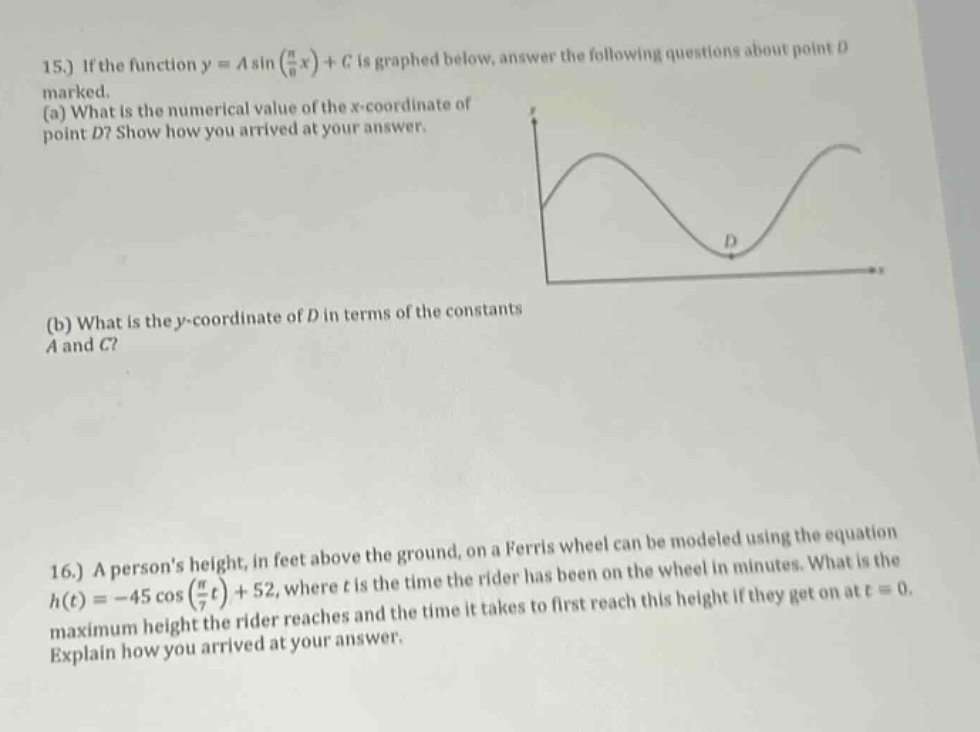
15.) if the function y = a sin(π/6 x)+c is graphed below, answer the following questions about point d marked. (a) what is the numerical value of the x - coordinate of point d? show how you arrived at your answer. (b) what is the y - coordinate of d in terms of the constants a and c? 16.) a persons height, in feet above the ground, on a ferris wheel can be modeled using the equation h(t)= - 45 cos(π/7 t)+52, where t is the time the rider has been on the wheel in minutes. what is the maximum height the rider reaches and the time it takes to first reach this height if they get on at t = 0. explain how you arrived at your answer.
Answer
Explanation:
Step1: Analyze sine - function properties for part (a)
The general form of a sine function is $y = A\sin(\frac{\pi}{a}x)+C$. The period of the sine function $y = \sin(u)$ is $2\pi$. For the function $y=\sin(\frac{\pi}{a}x)$, the period $T=\frac{2\pi}{\frac{\pi}{a}} = 2a$. Assuming the standard sine - wave pattern, if we consider the basic cycle of the sine function $y = A\sin(\frac{\pi}{a}x)+C$, the minimum of the sine function $\sin(\frac{\pi}{a}x)$ occurs at $\frac{\pi}{a}x=\frac{3\pi}{2}+ 2k\pi,k\in\mathbb{Z}$. Solving for $x$ gives $x=\frac{3a}{2}+2ka$. If we assume the basic cycle ($k = 0$) and without loss of generality, if $a = 1$, the $x$ - coordinate of the minimum (point $D$) of $y = A\sin(\pi x)+C$ occurs when $\pi x=\frac{3\pi}{2}$, so $x=\frac{3}{2}$.
Step2: Analyze sine - function for part (b)
The minimum value of the sine function $\sin(\frac{\pi}{a}x)$ is $- 1$. For the function $y = A\sin(\frac{\pi}{a}x)+C$, when $\sin(\frac{\pi}{a}x)=-1$, the $y$ - value is $y=-A + C$.
Step3: Analyze cosine - function for part 16
The general form of a cosine function is $y = A\cos(Bt)+C$. For the function $h(t)=-45\cos(\frac{\pi}{7}t)+52$, the amplitude is $|A| = 45$ and the vertical shift is $C = 52$. The maximum value of the cosine function $\cos(u)$ is $1$ and the minimum is $-1$. Since $h(t)=-45\cos(\frac{\pi}{7}t)+52$, the maximum value of $h(t)$ occurs when $\cos(\frac{\pi}{7}t)=-1$.
- First, find the maximum height: When $\cos(\frac{\pi}{7}t)=-1$, $h(t)=-45\times(-1)+52=45 + 52=97$ feet.
- Then, find the time to reach the maximum height: Set $\cos(\frac{\pi}{7}t)=-1$. We know that $\cos(u)=-1$ when $u=(2k + 1)\pi,k\in\mathbb{Z}$. So, $\frac{\pi}{7}t=\pi$, and solving for $t$ gives $t = 7$ minutes (when $k = 0$ as we are looking for the first - time value starting from $t = 0$).
Answer:
(a) $\frac{3}{2}$ (b) $-A + C$ 16. Maximum height: 97 feet, Time: 7 minutes