15. let f be the function defined above. which of the following statements about f are true? i. lim f(x) =…
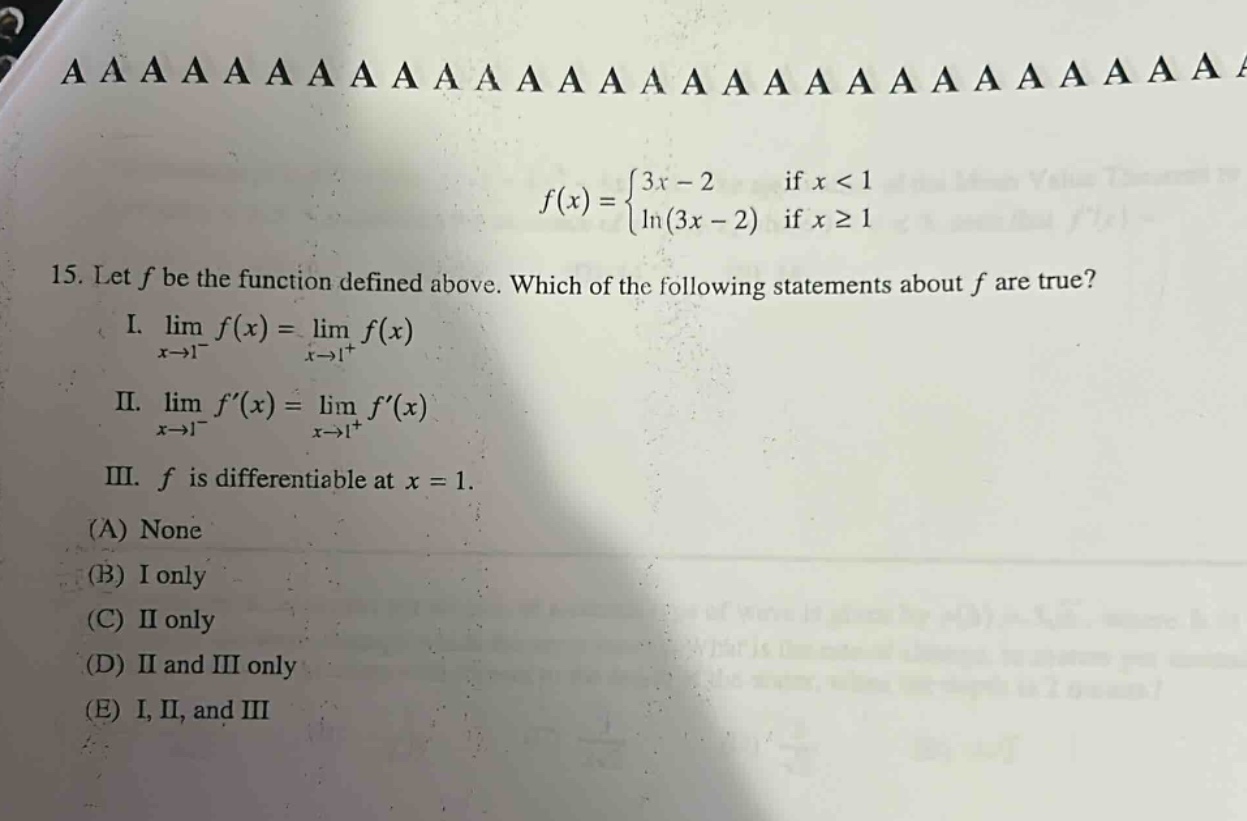
15. let f be the function defined above. which of the following statements about f are true? i. lim f(x) = lim f(x) x→1⁻ x→1⁺ ii. lim f(x) = lim f(x) x→1⁻ x→1⁺ iii. f is differentiable at x = 1. (a) none (b) i only (c) ii only (d) ii and iii only (e) i, ii, and iii f(x) = {3x - 2 if x < 1 {ln(3x - 2) if x ≥ 1
Answer
Explanation:
Step1: Calculate left - hand limit of $f(x)$ at $x = 1$
For $x<1$, $f(x)=3x - 2$. Then $\lim_{x\rightarrow1^{-}}f(x)=\lim_{x\rightarrow1^{-}}(3x - 2)=3\times1-2 = 1$.
Step2: Calculate right - hand limit of $f(x)$ at $x = 1$
For $x\geq1$, $f(x)=\ln(3x - 2)$. Then $\lim_{x\rightarrow1^{+}}f(x)=\ln(3\times1 - 2)=\ln(1)=0$. Since $\lim_{x\rightarrow1^{-}}f(x)=1$ and $\lim_{x\rightarrow1^{+}}f(x)=0$, $\lim_{x\rightarrow1^{-}}f(x)\neq\lim_{x\rightarrow1^{+}}f(x)$, so statement I is false.
Step3: Find the derivative of $f(x)$ for $x < 1$
If $f(x)=3x - 2$ for $x < 1$, then $f^{\prime}(x)=3$.
Step4: Find the derivative of $f(x)$ for $x>1$
If $f(x)=\ln(3x - 2)$ for $x\geq1$, then using the chain - rule, $f^{\prime}(x)=\frac{3}{3x - 2}$.
Step5: Calculate left - hand limit of $f^{\prime}(x)$ at $x = 1$
$\lim_{x\rightarrow1^{-}}f^{\prime}(x)=3$.
Step6: Calculate right - hand limit of $f^{\prime}(x)$ at $x = 1$
$\lim_{x\rightarrow1^{+}}f^{\prime}(x)=\lim_{x\rightarrow1^{+}}\frac{3}{3x - 2}=\infty$. So $\lim_{x\rightarrow1^{-}}f^{\prime}(x)\neq\lim_{x\rightarrow1^{+}}f^{\prime}(x)$, and statement II is false.
Step7: Check differentiability at $x = 1$
Since $\lim_{x\rightarrow1^{-}}f(x)\neq\lim_{x\rightarrow1^{+}}f(x)$, the function $f(x)$ is not continuous at $x = 1$. A function must be continuous at a point to be differentiable at that point. So $f(x)$ is not differentiable at $x = 1$, and statement III is false.
Answer:
A. None