15 in a particular city, the amount of daylight hours is modeled by the function d, defined by…
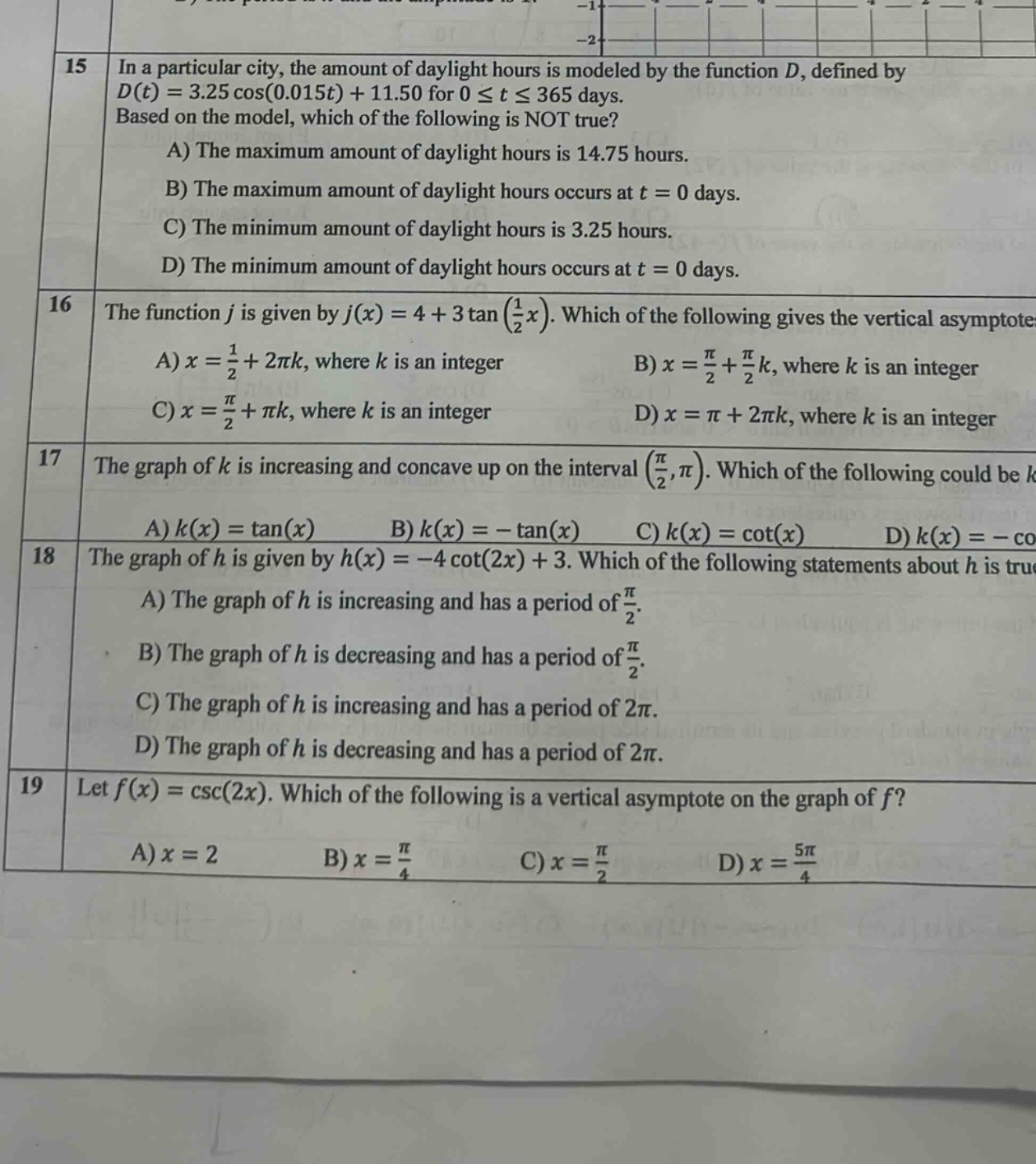
15 in a particular city, the amount of daylight hours is modeled by the function d, defined by d(t)=3.25cos(0.015t)+11.50 for 0≤t≤365 days. based on the model, which of the following is not true? a) the maximum amount of daylight hours is 14.75 hours. b) the maximum amount of daylight hours occurs at t = 0 days. c) the minimum amount of daylight hours is 3.25 hours. d) the minimum amount of daylight hours occurs at t = 0 days. 16 the function j is given by j(x)=4 + 3tan(1/2x). which of the following gives the vertical asymptote: a) x = 1/2+2πk, where k is an integer b) x = π/2+π/2k, where k is an integer c) x = π/2+πk, where k is an integer d) x = π+2πk, where k is an integer 17 the graph of k is increasing and concave up on the interval (π/2,π). which of the following could be k a) k(x)=tan(x) b) k(x)= - tan(x) c) k(x)=cot(x) d) k(x)= - co 18 the graph of h is given by h(x)= - 4cot(2x)+3. which of the following statements about h is true a) the graph of h is increasing and has a period of π/2. b) the graph of h is decreasing and has a period of π/2. c) the graph of h is increasing and has a period of 2π. d) the graph of h is decreasing and has a period of 2π. 19 let f(x)=csc(2x). which of the following is a vertical asymptote on the graph of f? a) x = 2 b) x = π/4 c) x = π/2 d) x = 5π/4
Answer
Explanation:
Step1: Analyze question 15
The cosine - function has a range of $[- 1,1]$. For $D(t)=3.25\cos(0.015t)+11.5$, when $\cos(0.015t) = 1$, $D(t){max}=3.25\times1 + 11.5=14.75$. When $\cos(0.015t)=-1$, $D(t){min}=3.25\times(-1)+11.5 = 8.25$.
Step2: Analyze question 16
The vertical asymptotes of $y = \tan(x)$ occur at $x=\frac{\pi}{2}+k\pi,k\in\mathbb{Z}$. For $j(x)=4 + 3\tan(\frac{1}{2}x)$, set $\frac{1}{2}x=\frac{\pi}{2}+k\pi$, then $x=\pi + 2k\pi,k\in\mathbb{Z}$.
Step3: Analyze question 17
The derivative of $y = \tan(x)$ is $y'=\sec^{2}(x)>0$ and the second - derivative $y'' = 2\sec^{2}(x)\tan(x)>0$ on the interval $(\frac{\pi}{2},\pi)$.
Step4: Analyze question 18
The period of $y = A\cot(Bx)+C$ is $T=\frac{\pi}{|B|}$. For $h(x)=-4\cot(2x)+3$, $B = 2$, so $T=\frac{\pi}{2}$. The cotangent function $y=\cot(x)$ is decreasing, and $y=-4\cot(2x)+3$ is also decreasing.
Step5: Analyze question 19
The vertical asymptotes of $y=\csc(x)=\frac{1}{\sin(x)}$ occur when $\sin(x)=0$. For $y = \csc(2x)$, set $\sin(2x)=0$, then $2x = k\pi,k\in\mathbb{Z}$, or $x=\frac{k\pi}{2},k\in\mathbb{Z}$. When $k = 1$, $x=\frac{\pi}{2}$.
Answer:
- C
- D
- A
- B
- C