15. (2 points) which of the following represents the end behavior of f(x) = (7x - 5)/(x + 2)? a. as x goes…
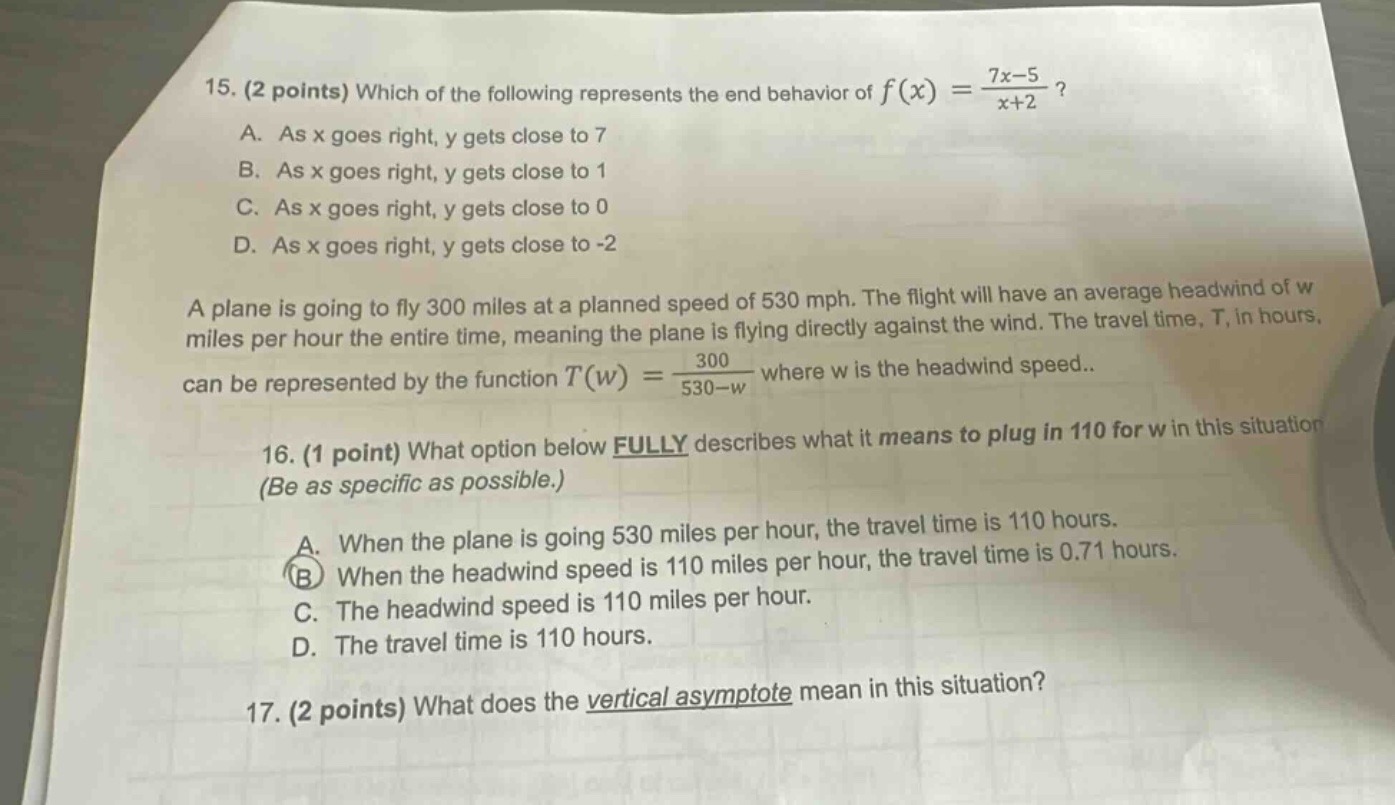
15. (2 points) which of the following represents the end behavior of f(x) = (7x - 5)/(x + 2)? a. as x goes right, y gets close to 7 b. as x goes right, y gets close to 1 c. as x goes right, y gets close to 0 d. as x goes right, y gets close to -2 a plane is going to fly 300 miles at a planned speed of 530 mph. the flight will have an average head - wind of w miles per hour the entire time, meaning the plane is flying directly against the wind. the travel time, t, in hours, can be represented by the function t(w) = 300/(530 - w) where w is the headwind speed.. 16. (1 point) what option below fully describes what it means to plug in 110 for w in this situation (be as specific as possible.) a. when the plane is going 530 miles per hour, the travel time is 110 hours. b when the headwind speed is 110 miles per hour, the travel time is 0.71 hours. c. the headwind speed is 110 miles per hour. d. the travel time is 110 hours. 17. (2 points) what does the vertical asymptote mean in this situation?
Answer
15.
Explanation:
Step1: Analyze rational - function end - behavior
For a rational function $f(x)=\frac{ax + b}{cx + d}$ ($c\neq0$), the horizontal asymptote is given by $y=\frac{a}{c}$ when the degree of the numerator and the denominator are the same. Here, for $f(x)=\frac{7x - 5}{x + 2}$, $a = 7$, $c = 1$.
Step2: Find the horizontal asymptote
The horizontal asymptote is $y=\frac{7}{1}=7$. As $x\to+\infty$ (x goes right), $y$ gets close to the horizontal asymptote value.
Answer:
A. As x goes right, y gets close to 7
16.
Explanation:
The function $T(w)=\frac{300}{530 - w}$ represents the travel time $T$ in hours as a function of the head - wind speed $w$. When we plug in $w = 110$ into the function, we are finding the travel time when the head - wind speed is 110 miles per hour. $T(110)=\frac{300}{530-110}=\frac{300}{420}\approx0.71$ hours.
Answer:
B. When the headwind speed is 110 miles per hour, the travel time is 0.71 hours.
17.
Explanation:
For the function $T(w)=\frac{300}{530 - w}$, the vertical asymptote occurs when the denominator is equal to zero. Set $530 - w=0$, then $w = 530$. In the context of the problem, the vertical asymptote means that when the head - wind speed is 530 mph, the travel time $T(w)$ is undefined. Physically, it means that the head - wind speed is equal to the planned speed of the plane, and the plane cannot make progress against such a strong head - wind, so the travel time becomes infinite (the plane cannot reach its destination).
Answer:
The vertical asymptote at $w = 530$ means that when the head - wind speed is 530 mph, the plane cannot make progress (travel time is undefined) because the head - wind speed is equal to the plane's planned speed.