15. $f(x)=\tan^{-1}\frac{1}{2}(x + 1)+\frac{pi}{2}$
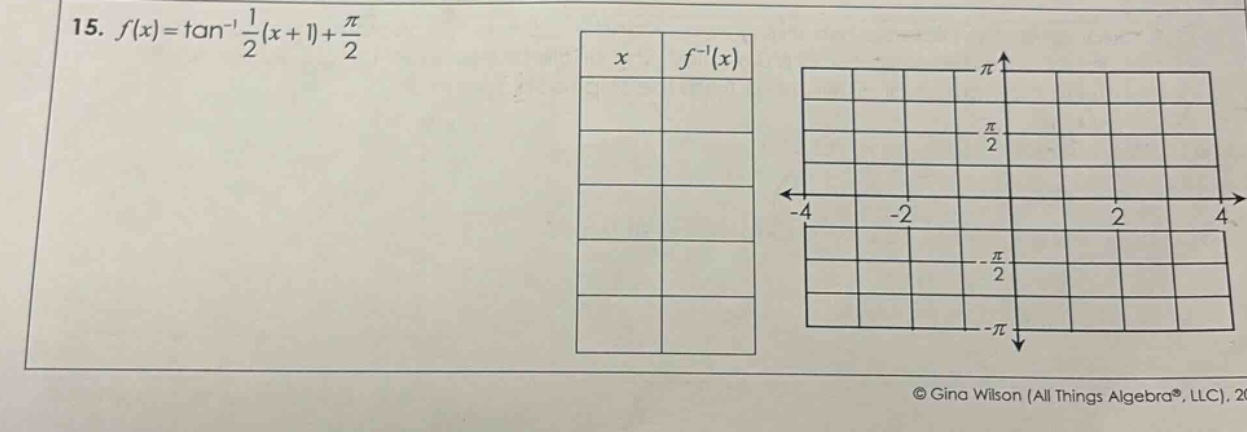
15. $f(x)=\tan^{-1}\frac{1}{2}(x + 1)+\frac{pi}{2}$
Answer
Explanation:
Step1: Let (y = f(x))
[y=\tan^{- 1}\left(\frac{1}{2}(x + 1)\right)+\frac{\pi}{2}]
Step2: Solve for (x) in terms of (y)
First, subtract (\frac{\pi}{2}) from both sides: [y-\frac{\pi}{2}=\tan^{- 1}\left(\frac{1}{2}(x + 1)\right)] Then, take the tangent of both sides: [\tan\left(y-\frac{\pi}{2}\right)=\frac{1}{2}(x + 1)] Since (\tan\left(y-\frac{\pi}{2}\right)=-\cot y), we have (-\cot y=\frac{1}{2}(x + 1)). Multiply both sides by 2: (-2\cot y=x + 1). Finally, solve for (x): (x=-2\cot y-1). So, (f^{-1}(x)=-2\cot x-1).
Step3: Fill the table
We can choose some values of (x) and find the corresponding (f^{-1}(x)) values. Let's take (x =-\frac{\pi}{2}), then (f^{-1}\left(-\frac{\pi}{2}\right)=-2\cot\left(-\frac{\pi}{2}\right)-1=- 1). Let (x = 0), then (f^{-1}(0)=-2\cot(0)-1=-\infty - 1=-\infty) (but we can analyze the behavior). Since (\cot(0)) is undefined in the real - valued sense, we can consider the limit. Let (x=\frac{\pi}{2}), then (f^{-1}\left(\frac{\pi}{2}\right)=-2\cot\left(\frac{\pi}{2}\right)-1=-1).
Answer:
The inverse function is (f^{-1}(x)=-2\cot x - 1) and values can be filled in the table by substituting (x) values into (f^{-1}(x)) as shown in the step - by - step process above.