15.7 triple integrals in cylindrical coordinates: problem 4 (1 point) the motion of a solid object can be…
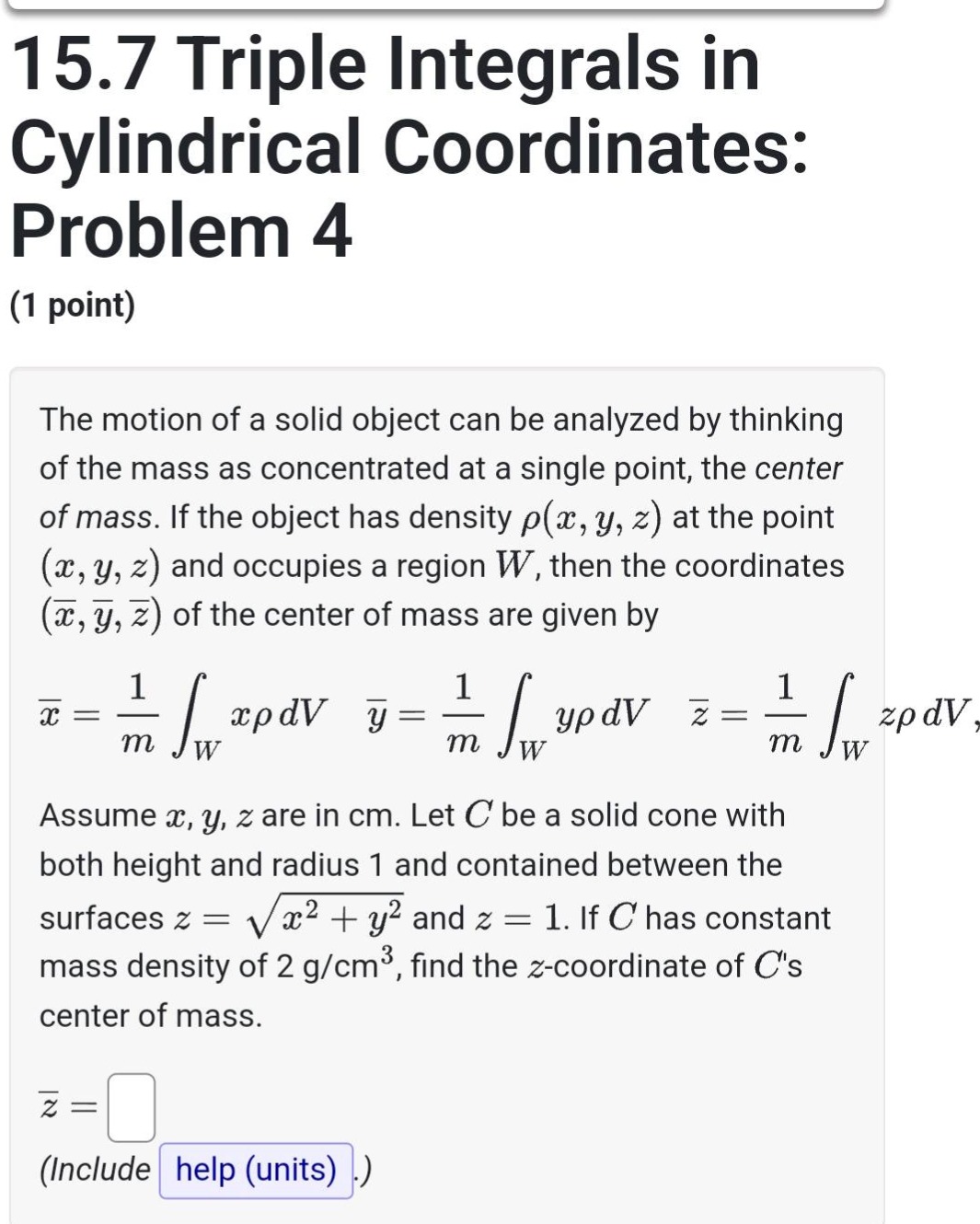
15.7 triple integrals in cylindrical coordinates: problem 4 (1 point) the motion of a solid object can be analyzed by thinking of the mass as concentrated at a single point, the center of mass. if the object has density ρ(x, y, z) at the point (x, y, z) and occupies a region w, then the coordinates (x̄, ȳ, z̄) of the center of mass are given by x̄ = 1/m ∫_w xρdv ȳ = 1/m ∫_w yρdv z̄ = 1/m ∫_w zρdv, assume x, y, z are in cm. let c be a solid cone with both height and radius 1 and contained between the surfaces z = √(x² + y²) and z = 1. if c has constant mass density of 2 g/cm³, find the z - coordinate of cs center of mass. z̄ = (include help (units) .)
Answer
Explanation:
Step1: Convert to cylindrical coordinates
In cylindrical coordinates, $x = r\cos\theta$, $y = r\sin\theta$, $z=z$, and $dV=r\ dz\ dr\ d\theta$. The region $W$ for the cone: $0\leq\theta\leq 2\pi$, $0\leq r\leq 1$, $r\leq z\leq 1$. The density $\rho = 2$. First, find the mass $m$. [m=\int_{0}^{2\pi}\int_{0}^{1}\int_{r}^{1}2r\ dz\ dr\ d\theta]
Step2: Calculate the mass $m$
Integrate with respect to $z$ first: [m = 2\int_{0}^{2\pi}\int_{0}^{1}r\left[z\right]{z = r}^{z = 1}dr\ d\theta=2\int{0}^{2\pi}\int_{0}^{1}r(1 - r)dr\ d\theta] Integrate with respect to $r$: [m=2\int_{0}^{2\pi}\left[\frac{r^{2}}{2}-\frac{r^{3}}{3}\right]{0}^{1}d\theta=2\int{0}^{2\pi}\left(\frac{1}{2}-\frac{1}{3}\right)d\theta] [m = 2\int_{0}^{2\pi}\frac{1}{6}d\theta=\frac{2\pi}{3}]
Step3: Calculate $\int_{W}z\rho dV$
[ \int_{W}z\rho dV=2\int_{0}^{2\pi}\int_{0}^{1}\int_{r}^{1}zr\ dz\ dr\ d\theta] Integrate with respect to $z$: [2\int_{0}^{2\pi}\int_{0}^{1}r\left[\frac{z^{2}}{2}\right]{z = r}^{z = 1}dr\ d\theta=\int{0}^{2\pi}\int_{0}^{1}r(1 - r^{2})dr\ d\theta] Integrate with respect to $r$: [\int_{0}^{2\pi}\left[\frac{r^{2}}{2}-\frac{r^{4}}{4}\right]{0}^{1}d\theta=\int{0}^{2\pi}\left(\frac{1}{2}-\frac{1}{4}\right)d\theta=\frac{\pi}{2}]
Step4: Calculate $\bar{z}$
[ \bar{z}=\frac{1}{m}\int_{W}z\rho dV] Substitute $m=\frac{2\pi}{3}$ and $\int_{W}z\rho dV=\frac{\pi}{2}$: [ \bar{z}=\frac{\frac{\pi}{2}}{\frac{2\pi}{3}}=\frac{3}{4}]
Answer:
$\frac{3}{4}$ cm