16 mark for review which of the following limits does not yield an indeterminate form? a lim x→0 4x³ /…
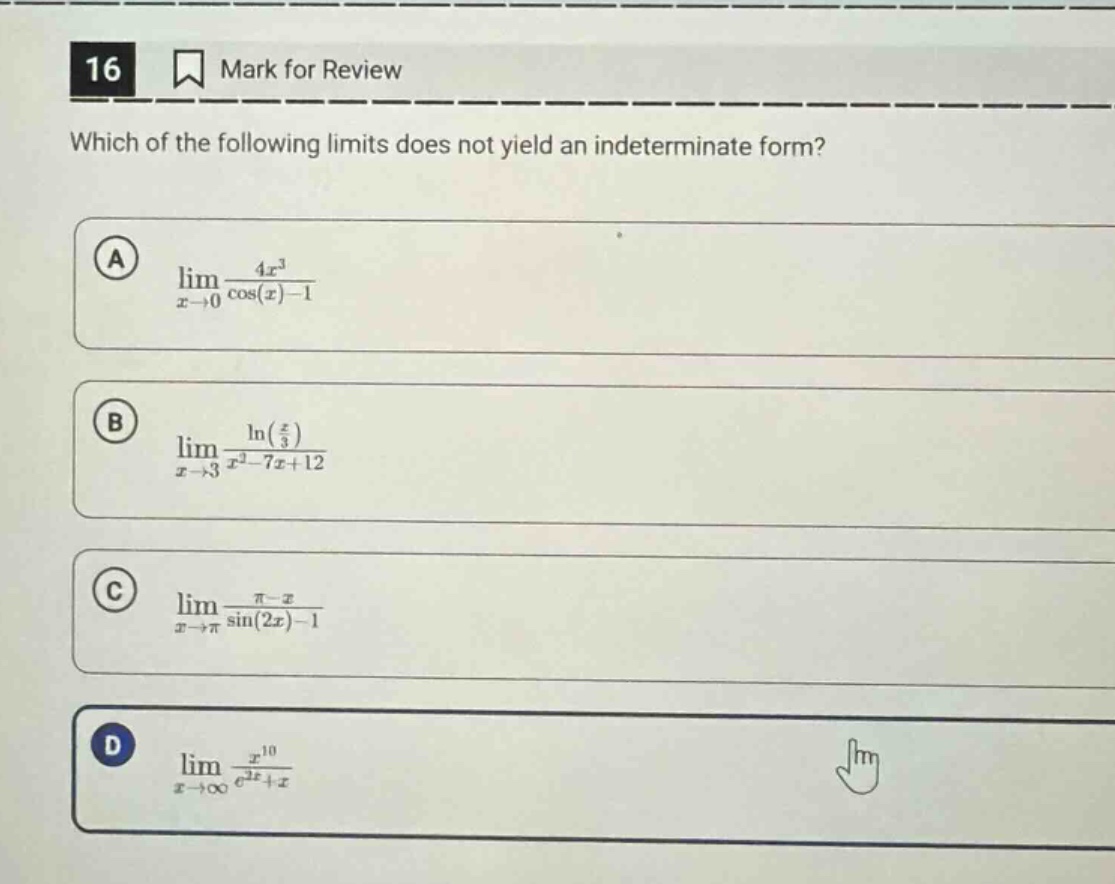
16 mark for review which of the following limits does not yield an indeterminate form? a lim x→0 4x³ / (cos(x) - 1) b lim x→3 ln(x/3) / (x² - 7x + 12) c lim x→π (π - x) / (sin(2x) - 1) d lim x→∞ x¹⁰ / (e²x + x)
Answer
Explanation:
Step1: Recall indeterminate - form types
Indeterminate forms include $\frac{0}{0},\frac{\infty}{\infty},0\times\infty,\infty-\infty,1^{\infty},0^{0},\infty^{0}$.
Step2: Analyze option A
When $x\rightarrow0$, $\cos(x)\rightarrow1$, so $\cos(x) - 1\rightarrow0$ and $4x^{3}\rightarrow0$. The limit $\lim_{x\rightarrow0}\frac{4x^{3}}{\cos(x)-1}$ is of the form $\frac{0}{0}$.
Step3: Analyze option B
When $x\rightarrow3$, $x^{2}-7x + 12=(x - 3)(x - 4)\rightarrow0$ and $\ln(\frac{x}{3})\rightarrow\ln(1)=0$. The limit $\lim_{x\rightarrow3}\frac{\ln(\frac{x}{3})}{x^{2}-7x + 12}$ is of the form $\frac{0}{0}$.
Step4: Analyze option C
When $x\rightarrow\pi$, $\sin(2x)=\sin(2\pi)=0$, so $\sin(2x)-1=-1$ and $\pi - x\rightarrow0$. The limit $\lim_{x\rightarrow\pi}\frac{\pi - x}{\sin(2x)-1}$ is of the form $\frac{0}{-1}=0$, which is not an indeterminate form.
Step5: Analyze option D
When $x\rightarrow\infty$, $x^{10}\rightarrow\infty$ and $e^{2x}+x\rightarrow\infty$. The limit $\lim_{x\rightarrow\infty}\frac{x^{10}}{e^{2x}+x}$ is of the form $\frac{\infty}{\infty}$.
Answer:
C. $\lim_{x\rightarrow\pi}\frac{\pi - x}{\sin(2x)-1}$