16 mark for review the periodic function f has a period of 4. the function is increasing on the input…
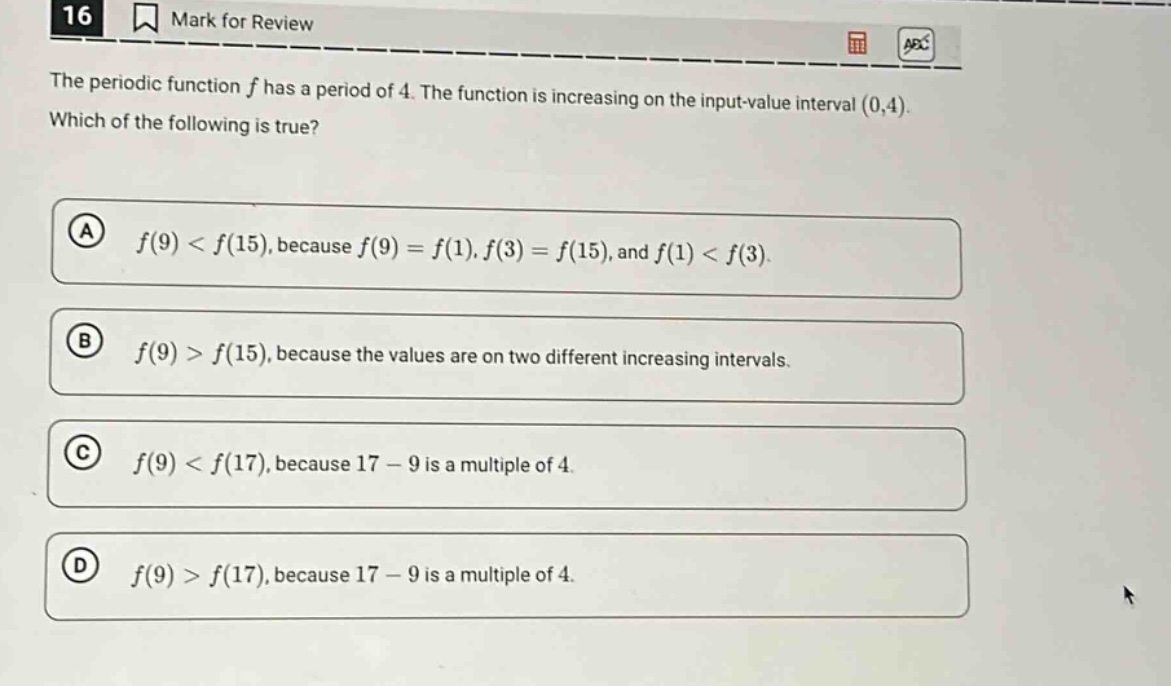
16 mark for review the periodic function f has a period of 4. the function is increasing on the input - value interval (0,4). which of the following is true? a f(9) < f(15), because f(9) = f(1), f(3) = f(15), and f(1) < f(3). b f(9) > f(15), because the values are on two different increasing intervals. c f(9) < f(17), because 17 - 9 is a multiple of 4. d f(9) > f(17), because 17 - 9 is a multiple of 4.
Answer
Explanation:
Step1: Use the periodic - property of the function
Since the period of the function (f) is (4), for any real - number (x), (f(x)=f(x + 4n)), where (n\in\mathbb{Z}). For (x = 9), we can write (9=4\times2 + 1), so (f(9)=f(4\times2 + 1)=f(1)) according to the periodic - property of the function ((n = 2)). For (x = 15), we can write (15=4\times3+3), so (f(15)=f(4\times3 + 3)=f(3)) according to the periodic - property of the function ((n = 3)).
Step2: Use the increasing property of the function
The function (f) is increasing on the interval ((0,4)). That is, if (a,b\in(0,4)) and (a < b), then (f(a)<f(b)). Since (1,3\in(0,4)) and (1 < 3), we have (f(1)<f(3)). Substituting (f(9)=f(1)) and (f(15)=f(3)), we get (f(9)<f(15)).
Answer:
A. (f(9)<f(15)), because (f(9)=f(1)), (f(3)=f(15)), and (f(1)<f(3))