17. given the below functions of f(x), g(x), and h(x), determine which of them has the greatest rate of…
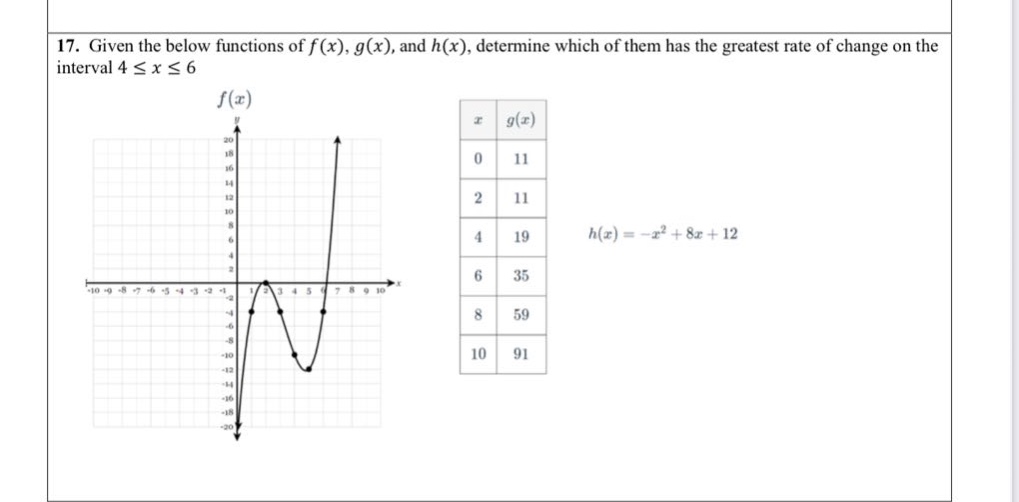
17. given the below functions of f(x), g(x), and h(x), determine which of them has the greatest rate of change on the interval 4 ≤ x ≤ 6\nf(x)\nx g(x)\n0 11\n2 11\n4 19\n6 35\n8 59\n10 91\nh(x)=-x² + 8x + 12
Answer
Explanation:
Step1: Recall rate - of - change formula
The average rate of change of a function $y = f(x)$ on the interval $[a,b]$ is $\frac{f(b)-f(a)}{b - a}$. Here, $a = 4$ and $b = 6$.
Step2: Find rate of change of $f(x)$
From the graph of $f(x)$, when $x = 4$, $f(4)\approx - 4$ and when $x = 6$, $f(6)=16$. The rate of change of $f(x)$ is $\frac{f(6)-f(4)}{6 - 4}=\frac{16-(-4)}{2}=\frac{20}{2}=10$.
Step3: Find rate of change of $g(x)$
From the table of $g(x)$, when $x = 4$, $g(4)=19$ and when $x = 6$, $g(6)=35$. The rate of change of $g(x)$ is $\frac{g(6)-g(4)}{6 - 4}=\frac{35 - 19}{2}=\frac{16}{2}=8$.
Step4: Find rate of change of $h(x)$
First, find $h(4)$ and $h(6)$. $h(x)=-x^{2}+8x + 12$. $h(4)=-4^{2}+8\times4 + 12=-16 + 32+12=28$. $h(6)=-6^{2}+8\times6 + 12=-36+48 + 12=24$. The rate of change of $h(x)$ is $\frac{h(6)-h(4)}{6 - 4}=\frac{24 - 28}{2}=\frac{-4}{2}=-2$.
Answer:
$f(x)$ has the greatest rate of change on the interval $4\leq x\leq6$.