17 mark for review in the xy - plane, two angles in standard position have measures of α and β. if \\(…
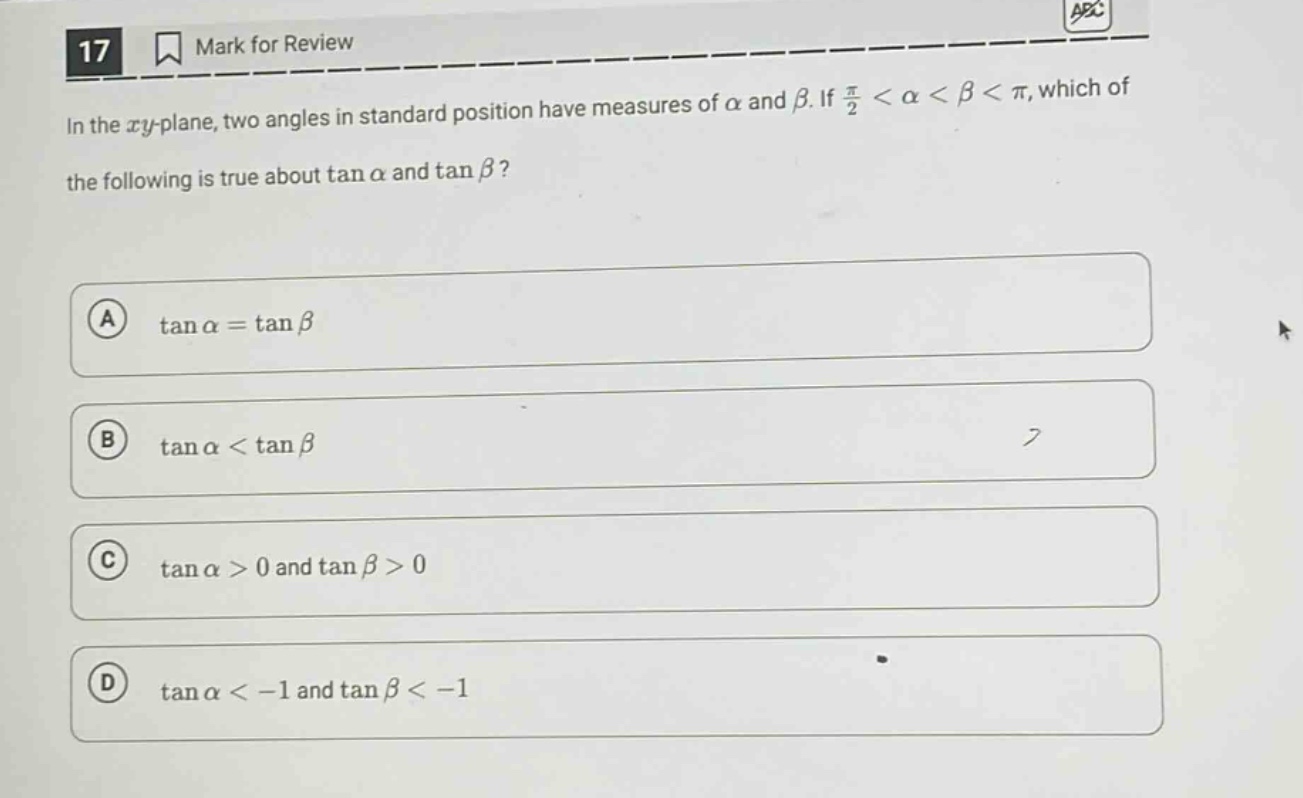
17 mark for review in the xy - plane, two angles in standard position have measures of α and β. if \\( \\frac { \\pi } { 2 } < \\alpha < \\beta < \\pi \\), which of the following is true about \\( \\tan \\alpha \\) and \\( \\tan \\beta \\)? a \\( \\tan \\alpha = \\tan \\beta \\) b \\( \\tan \\alpha < \\tan \\beta \\) c \\( \\tan \\alpha > 0 \\) and \\( \\tan \\beta > 0 \\) d \\( \\tan \\alpha < - 1 \\) and \\( \\tan \\beta < - 1 \\)
Answer
Explanation:
Step1: Analyze the sign of tangent function in the given interval
The formula for the tangent function is (\tan\theta=\frac{\sin\theta}{\cos\theta}). In the interval (\frac{\pi}{2}<\theta <\pi) (the second - quadrant), (\sin\theta>0) and (\cos\theta < 0). So, (\tan\theta=\frac{\sin\theta}{\cos\theta}<0) for (\theta\in(\frac{\pi}{2},\pi)). So, option C is wrong.
Step2: Analyze the monotonicity of the tangent function
The tangent function (y = \tan x) has a period of (\pi), and its derivative is (y'=\sec^{2}x=\frac{1}{\cos^{2}x}). The function (y = \tan x) is increasing on each interval ((-\frac{\pi}{2}+k\pi,\frac{\pi}{2}+k\pi),k\in\mathbb{Z}). The function (y = \tan x) is decreasing on the interval ((\frac{\pi}{2},\pi)) (since the period is (\pi) and we can consider the behavior of the function in the relevant sub - interval). If (\frac{\pi}{2}<\alpha<\beta<\pi), and (y = \tan x) is decreasing on ((\frac{\pi}{2},\pi)), then (\tan\alpha>\tan\beta). So, option A and B are wrong.
Step3: Analyze the range of the tangent function
We know that (\lim_{x\rightarrow\frac{\pi}{2}^{+}}\tan x=-\infty) and (\tan(\frac{3\pi}{4})=- 1). Since (y = \tan x) is decreasing on ((\frac{\pi}{2},\pi)) and (x\in(\frac{\pi}{2},\pi)) (i.e., (x>\frac{\pi}{2}) and (x <\pi)), for (x\in(\frac{\pi}{2},\pi)), (\tan x<\tan(\frac{3\pi}{4})=-1).
Answer:
D. (\tan\alpha < - 1) and (\tan\beta < - 1)