17 multiple choice 1 point if f(x)=2/x and f(√e)=5, then f(e)=(a) 2 (b) ln 25 (c) 5 + 2/e - 2/e² (d) 6 (e) 25
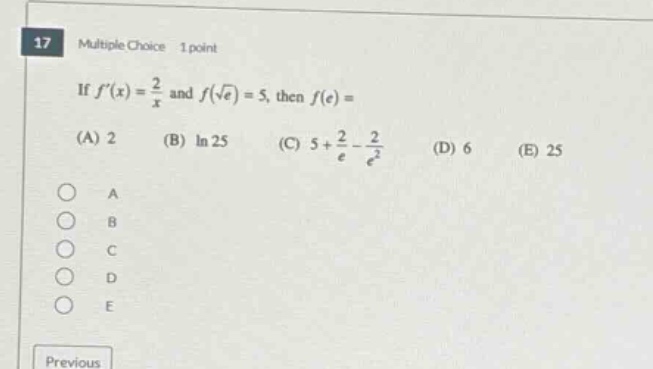
17 multiple choice 1 point if f(x)=2/x and f(√e)=5, then f(e)=(a) 2 (b) ln 25 (c) 5 + 2/e - 2/e² (d) 6 (e) 25
Answer
Answer:
D. 6
Explanation:
Step1: Integrate $f^{\prime}(x)$
We know that if $f^{\prime}(x)=\frac{2}{x}$, then by the integral formula $\int\frac{1}{x}dx=\ln|x| + C$, we have $f(x)=2\ln|x|+C$.
Step2: Find the value of $C$
Given $f(\sqrt{e}) = 5$. Substitute $x = \sqrt{e}$ into $f(x)=2\ln|x|+C$. Since $\ln(\sqrt{e})=\frac{1}{2}\ln(e)=\frac{1}{2}$, then $f(\sqrt{e})=2\ln(\sqrt{e})+C$. So $2\times\frac{1}{2}+C = 5$, which gives $1 + C=5$ and $C = 4$.
Step3: Calculate $f(e)$
Substitute $x = e$ into $f(x)=2\ln|x|+4$. Since $\ln(e)=1$, then $f(e)=2\ln(e)+4=2\times1 + 4=6$.