17. -/1 points details my notes larcalc12m 2.3.016.mi. use the quotient rule to find the derivative of the…
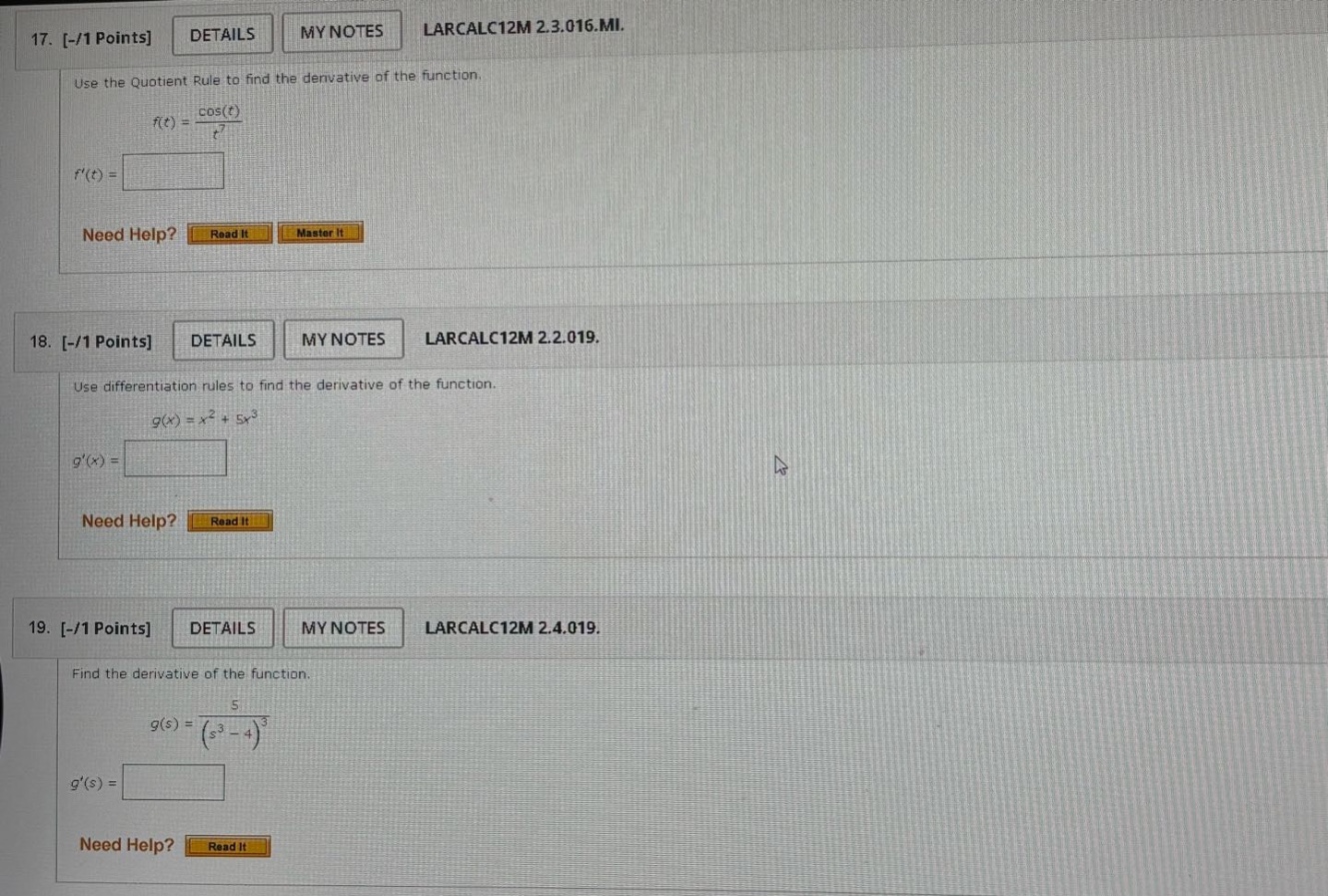
17. -/1 points details my notes larcalc12m 2.3.016.mi. use the quotient rule to find the derivative of the function. $f(t)=\frac{cos(t)}{t^{7}}$ $f(t)=$ need help? read it master it 18. -/1 points details my notes larcalc12m 2.2.019. use differentiation rules to find the derivative of the function. $g(x)=x^{2}+5x^{3}$ $g(x)=$ need help? read it 19. -/1 points details my notes larcalc12m 2.4.019. find the derivative of the function. $g(s)=\frac{5}{(s^{3}-4)^{3}}$ $g(s)=$ need help? read it
Answer
17.
Answer:
$-\frac{t\sin(t)+ 7\cos(t)}{t^{8}}$
Explanation:
Step1: Recall quotient - rule
The quotient rule states that if $y = \frac{u}{v}$, then $y'=\frac{u'v - uv'}{v^{2}}$. Here, $u=\cos(t)$ and $v = t^{7}$.
Step2: Find $u'$ and $v'$
The derivative of $u=\cos(t)$ is $u'=-\sin(t)$, and the derivative of $v = t^{7}$ using the power - rule $(x^{n})'=nx^{n - 1}$ is $v' = 7t^{6}$.
Step3: Apply quotient - rule
[ \begin{align*} f'(t)&=\frac{(-\sin(t))\cdot t^{7}-\cos(t)\cdot7t^{6}}{(t^{7})^{2}}\ &=\frac{-t^{7}\sin(t)-7t^{6}\cos(t)}{t^{14}}\ &=\frac{t^{6}(-t\sin(t)-7\cos(t))}{t^{14}}\ &=-\frac{t\sin(t)+ 7\cos(t)}{t^{8}} \end{align*} ]
18.
Answer:
$2x + 15x^{2}$
Explanation:
Step1: Recall sum - rule of differentiation
If $g(x)=u(x)+v(x)$, then $g'(x)=u'(x)+v'(x)$. Here, $u(x)=x^{2}$ and $v(x)=5x^{3}$.
Step2: Apply power - rule
The power - rule states that $(x^{n})'=nx^{n - 1}$. For $u(x)=x^{2}$, $u'(x)=2x$, and for $v(x)=5x^{3}$, $v'(x)=5\times3x^{2}=15x^{2}$.
Step3: Find $g'(x)$
$g'(x)=u'(x)+v'(x)=2x + 15x^{2}$
19.
Answer:
$-\frac{15s^{2}}{(s^{3}-4)^{4}}$
Explanation:
Step1: Rewrite the function
We can rewrite $g(s)=\frac{5}{(s^{3}-4)^{3}}=5(s^{3}-4)^{-3}$.
Step2: Apply chain - rule
The chain - rule states that if $y = f(u)$ and $u = h(x)$, then $y'=f'(u)\cdot h'(x)$. Let $u = s^{3}-4$, so $y = 5u^{-3}$. The derivative of $y$ with respect to $u$ is $y_{u}'=-15u^{-4}$, and the derivative of $u$ with respect to $s$ is $u_{s}' = 3s^{2}$.
Step3: Calculate $g'(s)$
[ \begin{align*} g'(s)&=y_{u}'\cdot u_{s}'\ &=-15(s^{3}-4)^{-4}\cdot3s^{2}\ &=-\frac{15s^{2}}{(s^{3}-4)^{4}} \end{align*} ]