18. 0/4 points details my notes scalc9 3.3.011. consider the following. (if an answer does not exist, enter…
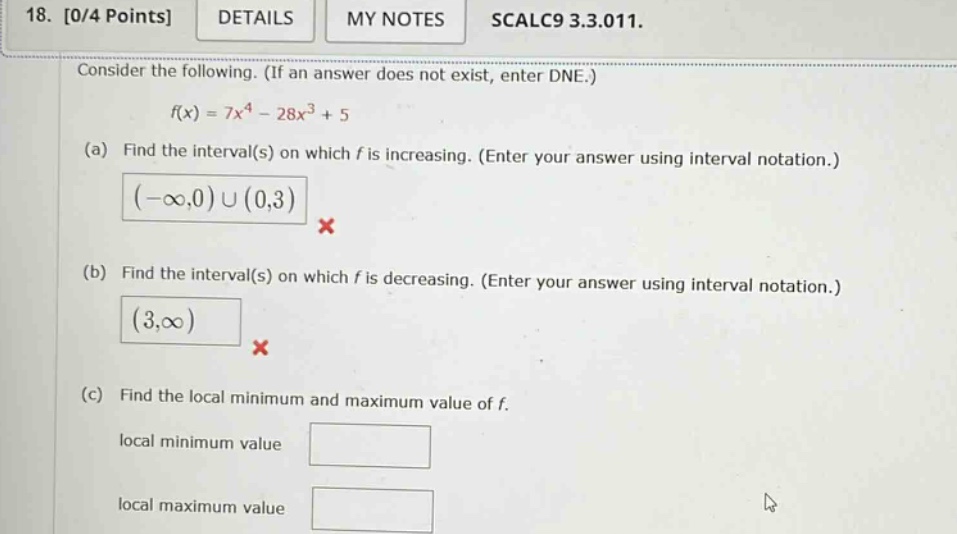
18. 0/4 points details my notes scalc9 3.3.011. consider the following. (if an answer does not exist, enter dne.) f(x)=7x^4 - 28x^3 + 5 (a) find the interval(s) on which f is increasing. (enter your answer using interval notation.) (-∞,0)∪(0,3) (b) find the interval(s) on which f is decreasing. (enter your answer using interval notation.) (3,∞) (c) find the local minimum and maximum value of f. local minimum value local maximum value
Answer
Explanation:
Step1: Find the derivative
Differentiate $f(x)=7x^{4}-28x^{3}+5$ using the power - rule. The derivative $f^\prime(x)=28x^{3}-84x^{2}=28x^{2}(x - 3)$.
Step2: Find the critical points
Set $f^\prime(x)=0$. Then $28x^{2}(x - 3)=0$. Solving this equation gives $x = 0$ and $x = 3$ as the critical points.
Step3: Determine the sign of the derivative on intervals
- For $x<0$, let's take a test - point, say $x=-1$. Then $f^\prime(-1)=28(-1)^{2}(-1 - 3)=28\times1\times(-4)<0$, so $f(x)$ is decreasing on $(-\infty,0)$.
- For $0<x<3$, take $x = 1$. Then $f^\prime(1)=28\times1^{2}(1 - 3)=28\times1\times(-2)<0$, so $f(x)$ is decreasing on $(0,3)$.
- For $x>3$, take $x = 4$. Then $f^\prime(4)=28\times4^{2}(4 - 3)=28\times16\times1>0$, so $f(x)$ is increasing on $(3,\infty)$.
Step4: Find local extrema
Since $f(x)$ is decreasing on $(-\infty,3)$ and increasing on $(3,\infty)$, then $f(x)$ has a local minimum at $x = 3$. Calculate $f(3)=7\times3^{4}-28\times3^{3}+5=7\times81-28\times27 + 5=567-756 + 5=-184$. Since the function does not change from increasing to decreasing at $x = 0$, there is no local maximum.
Answer:
(a) $(3,\infty)$ (b) $(-\infty,3)$ (c) local minimum value: $-184$ local maximum value: DNE