18. the sea ice area around the south pole fluctuates between about 18 million square kilometers in…
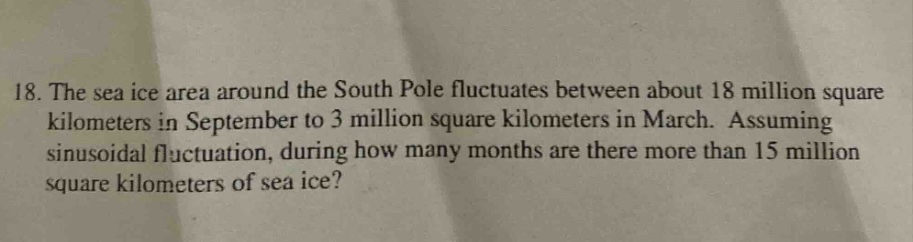
18. the sea ice area around the south pole fluctuates between about 18 million square kilometers in september to 3 million square kilometers in march. assuming sinusoidal fluctuation, during how many months are there more than 15 million square kilometers of sea ice?
Answer
Explanation:
Step1: Set up the sinusoidal - function
Let (t) be the number of months since January. The general form of a sinusoidal function is (y = A\sin(B(t - C))+D). The amplitude (A=\frac{18 - 3}{2}=\frac{15}{2}=7.5), the vertical shift (D=\frac{18 + 3}{2}=10.5), and the period (T = 12), so (B=\frac{2\pi}{T}=\frac{\pi}{6}). Since the maximum occurs at (t = 8) (September), we can write the function as (y = 7.5\sin(\frac{\pi}{6}(t - 8))+10.5).
Step2: Set up the inequality
We want to find when (y>15), so (7.5\sin(\frac{\pi}{6}(t - 8))+10.5>15). First, subtract 10.5 from both sides: (7.5\sin(\frac{\pi}{6}(t - 8))>4.5). Then divide both sides by 7.5: (\sin(\frac{\pi}{6}(t - 8))>\frac{4.5}{7.5}=0.6).
Step3: Solve the trigonometric - inequality
We know that if (\sin\theta>0.6), then (\theta\in(\arcsin(0.6)+2k\pi,\pi-\arcsin(0.6)+2k\pi)) for (k\in\mathbb{Z}). Let (\theta=\frac{\pi}{6}(t - 8)). (\arcsin(0.6)\approx0.6435) and (\pi-\arcsin(0.6)\approx3.1416 - 0.6435 = 2.4981). So (\frac{\pi}{6}(t - 8)\in(0.6435 + 2k\pi,2.4981+2k\pi)). For (k = 0): (0.6435<\frac{\pi}{6}(t - 8)<2.4981). Multiply through by (\frac{6}{\pi}): (\frac{6\times0.6435}{\pi}<t - 8<\frac{6\times2.4981}{\pi}). (\frac{3.861}{\pi}<t - 8<\frac{14.9886}{\pi}). (1.23<t - 8<4.77). (9.23<t<12.77) and for the next - cycle ((k = 1)): (0.6435 + 2\pi<\frac{\pi}{6}(t - 8)<2.4981+2\pi). Multiply through by (\frac{6}{\pi}): (\frac{6\times(0.6435 + 2\pi)}{\pi}<t - 8<\frac{6\times(2.4981+2\pi)}{\pi}). (\frac{3.861}{\pi}+12<t - 8<\frac{14.9886}{\pi}+12). (13.23<t<16.77) (but we are considering (t\in[0,12]) for the first - year cycle). The time interval for (y>15) in the first year is from (t\approx9.23) to (t = 12) and then from (t = 0) to (t\approx4.77). The length of this interval is ((12 - 9.23)+4.77 = 7.54\approx8) months.
Answer:
8 months