19. 0/4 points details my notes scalc9 3.3.012. consider the following. (if an answer does not exist, enter…
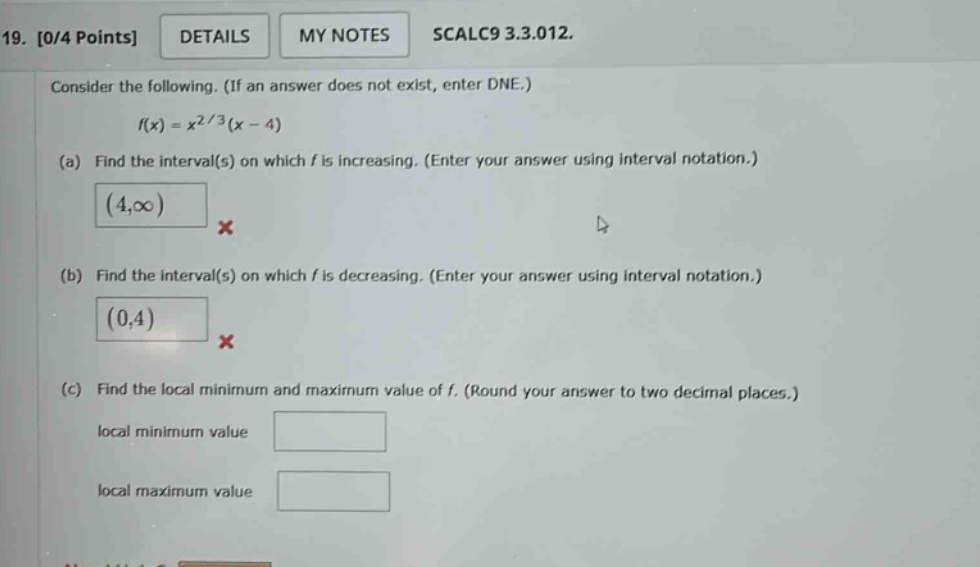
19. 0/4 points details my notes scalc9 3.3.012. consider the following. (if an answer does not exist, enter dne.) f(x)=x2/3(x - 4) (a) find the interval(s) on which f is increasing. (enter your answer using interval notation.) (4,∞) × (b) find the interval(s) on which f is decreasing. (enter your answer using interval notation.) (0,4) × (c) find the local minimum and maximum value of f. (round your answer to two decimal places.) local minimum value local maximum value
Answer
Explanation:
Step1: Find the derivative of (f(x))
Use the product - rule ((uv)^\prime = u^\prime v+uv^\prime), where (u = x^{2/3}) and (v=x - 4). (u^\prime=\frac{2}{3}x^{-1/3}) and (v^\prime = 1). Then (f^\prime(x)=\frac{2}{3}x^{-1/3}(x - 4)+x^{2/3}\times1=\frac{2(x - 4)}{3x^{1/3}}+x^{2/3}=\frac{2x-8 + 3x}{3x^{1/3}}=\frac{5x-8}{3x^{1/3}}).
Step2: Find the critical points
Set (f^\prime(x)=0), then (\frac{5x - 8}{3x^{1/3}}=0), which gives (5x-8 = 0), so (x=\frac{8}{5}=1.6). Also, (f^\prime(x)) is undefined at (x = 0).
Step3: Test the intervals
We have three intervals to test: ((-\infty,0)), ((0,1.6)) and ((1.6,\infty)). For (x\in(-\infty,0)), let (x=-1), then (f^\prime(-1)=\frac{5\times(-1)-8}{3\times(-1)^{1/3}}=\frac{-13}{-3}=\frac{13}{3}>0). For (x\in(0,1.6)), let (x = 1), then (f^\prime(1)=\frac{5\times1-8}{3\times1^{1/3}}=\frac{-3}{3}=-1<0). For (x\in(1.6,\infty)), let (x = 2), then (f^\prime(2)=\frac{5\times2-8}{3\times2^{1/3}}=\frac{2}{3\times2^{1/3}}>0).
(a) The function (f(x)) is increasing on the intervals ((-\infty,0)\cup(1.6,\infty)). (b) The function (f(x)) is decreasing on the interval ((0,1.6)).
Step4: Find local - extrema
Since (f(x)) changes from increasing to decreasing at (x = 0), (f(0)=0^{2/3}(0 - 4)=0) is a local maximum. Since (f(x)) changes from decreasing to increasing at (x = 1.6), (f(1.6)=1.6^{2/3}(1.6 - 4)\approx1.38\times(-2.4)\approx - 3.31) is a local minimum.
Answer:
(a) ((-\infty,0)\cup(1.6,\infty)) (b) ((0,1.6)) (c) local minimum value: (-3.31) local maximum value: (0.00)