20. let f be the function given above. which of the following statements are true about f? i. lim x→3 f(x)…
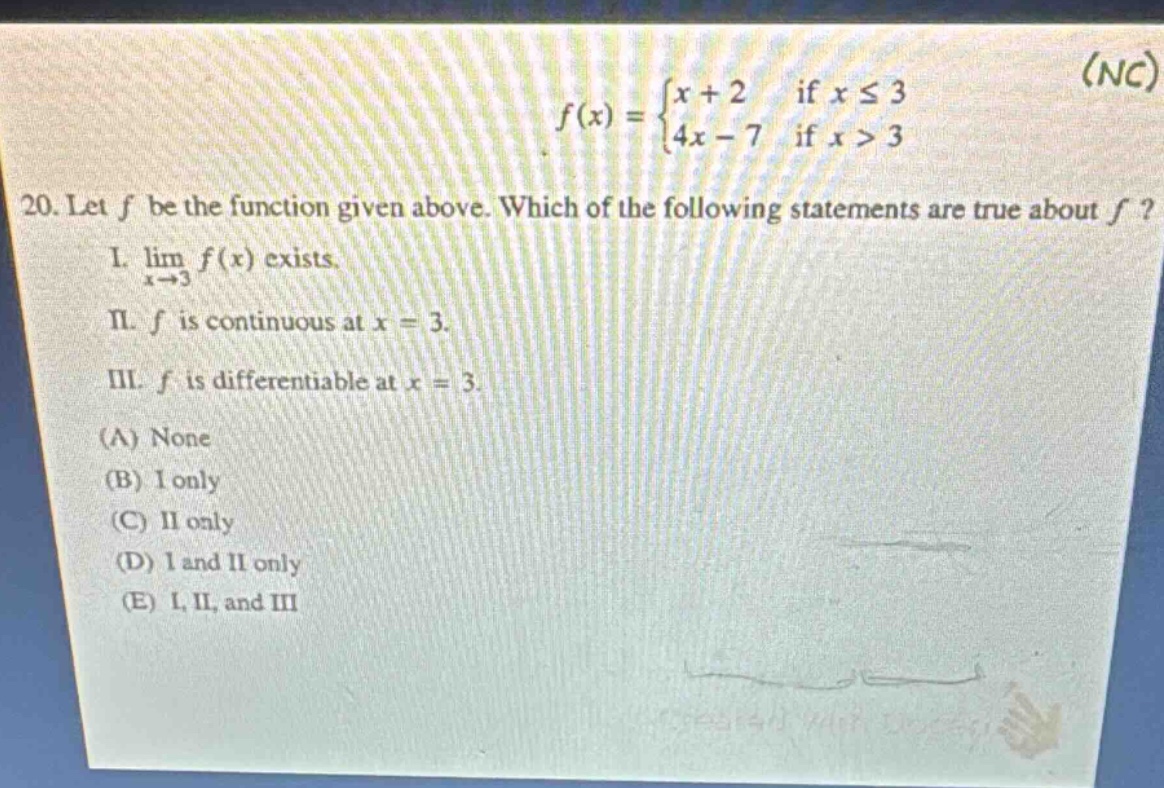
20. let f be the function given above. which of the following statements are true about f? i. lim x→3 f(x) exists. ii. f is continuous at x = 3. iii. f is differentiable at x = 3. (a) none (b) i only (c) ii only (d) i and ii only (e) i, ii, and iii f(x)={x + 2 if x ≤ 3; 4x - 7 if x > 3}
Answer
Explanation:
Step1: Calculate left - hand limit
For $x\leq3$, $f(x)=x + 2$. So, $\lim_{x\rightarrow3^{-}}f(x)=\lim_{x\rightarrow3^{-}}(x + 2)=3+2=5$.
Step2: Calculate right - hand limit
For $x>3$, $f(x)=4x - 7$. So, $\lim_{x\rightarrow3^{+}}f(x)=\lim_{x\rightarrow3^{+}}(4x - 7)=4\times3-7=12 - 7 = 5$. Since $\lim_{x\rightarrow3^{-}}f(x)=\lim_{x\rightarrow3^{+}}f(x)=5$, $\lim_{x\rightarrow3}f(x)$ exists.
Step3: Check continuity
$f(3)=3 + 2=5$. Since $\lim_{x\rightarrow3}f(x)=5$ and $f(3)=5$, the function $f(x)$ is continuous at $x = 3$.
Step4: Check differentiability
The derivative of $y=x + 2$ is $y^\prime=1$ for $x\leq3$. The derivative of $y = 4x-7$ is $y^\prime=4$ for $x>3$. The left - hand derivative at $x = 3$ is $1$ and the right - hand derivative at $x = 3$ is $4$. Since the left - hand derivative and the right - hand derivative are not equal at $x = 3$, the function is not differentiable at $x = 3$.
Answer:
D. I and II only