20 mark for review the function f is given by f(x)=sin x. it is claimed that if f(x)=b/a, where a≠0 and…
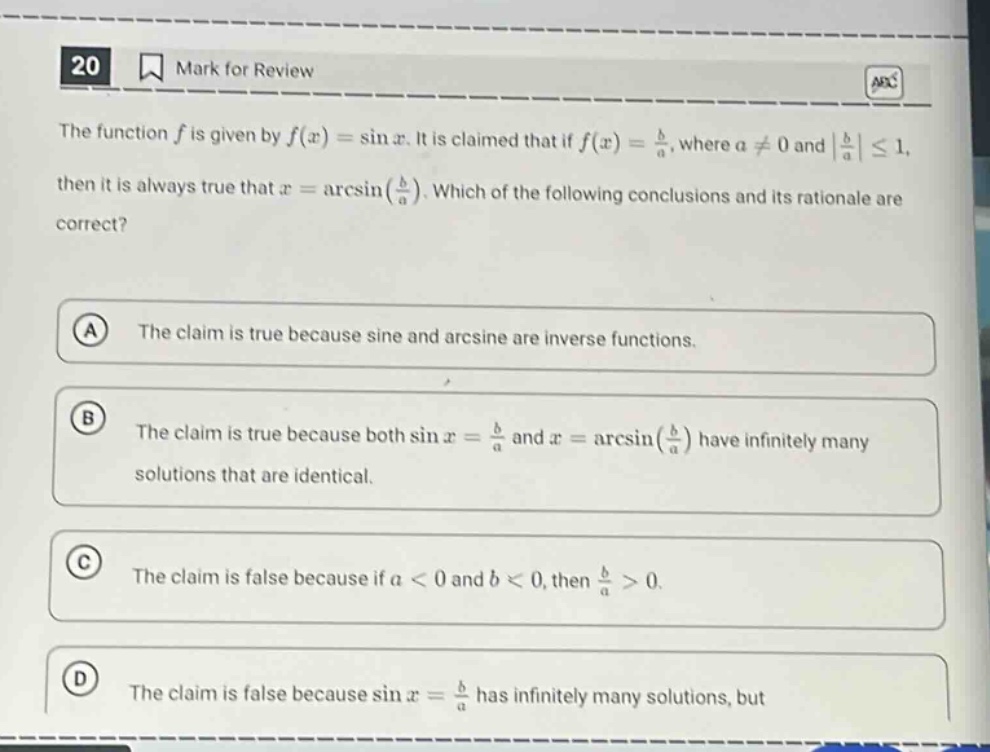
20 mark for review the function f is given by f(x)=sin x. it is claimed that if f(x)=b/a, where a≠0 and |b/a|≤1, then it is always true that x = arcsin(b/a). which of the following conclusions and its rationale are correct? a the claim is true because sine and arcsine are inverse functions. b the claim is true because both sin x = b/a and x = arcsin(b/a) have infinitely many solutions that are identical. c the claim is false because if a < 0 and b < 0, then b/a>0. d the claim is false because sin x = b/a has infinitely many solutions, but
Answer
Brief Explanations:
The arcsine function $y = \arcsin(u)$ has a restricted range of $[-\frac{\pi}{2},\frac{\pi}{2}]$. While $y=\sin(x)$ is a periodic function with period $2\pi$ and $\sin(x)=\frac{b}{a}$ ($|\frac{b}{a}|\leq1$) has infinitely - many solutions. The equation $x = \arcsin(\frac{b}{a})$ only gives the solution within the range of the arcsine function. So, just because $\sin(x)=\frac{b}{a}$, we can't always say $x=\arcsin(\frac{b}{a})$.
Answer:
D. The claim is false because $\sin x=\frac{b}{a}$ has infinitely many solutions, but