20. -/1 points details my notes larpcalclim4hs 5.3.071. use the quadratic formula to find all solutions of…
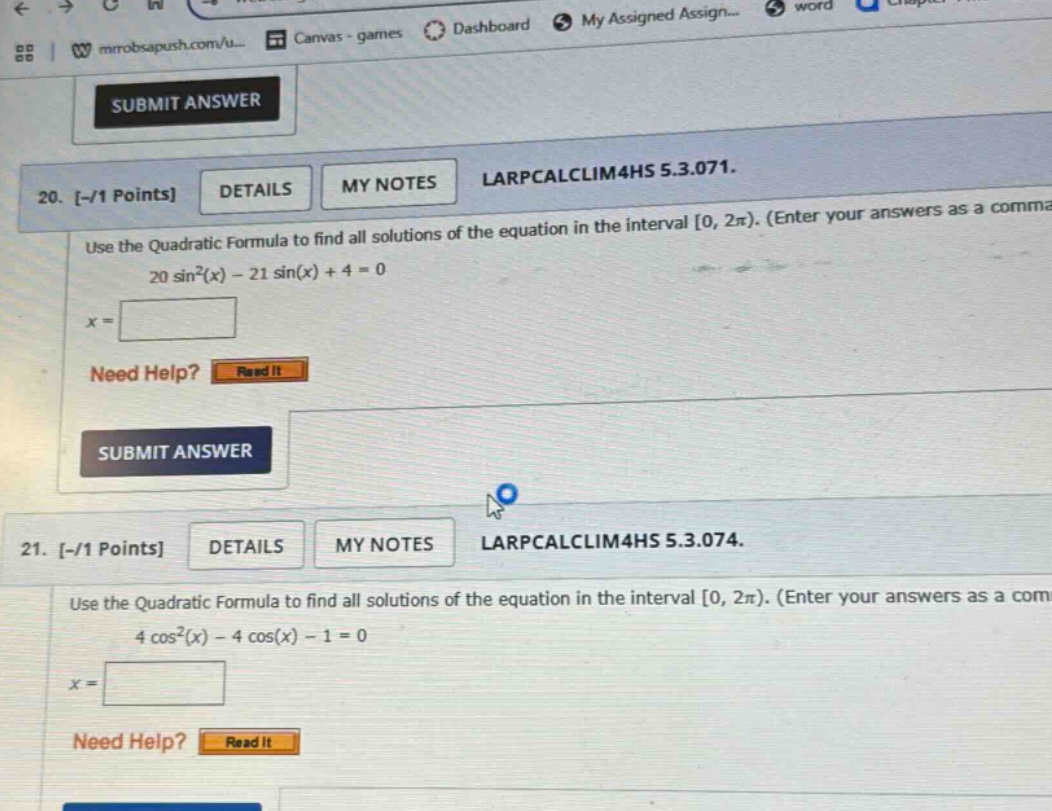
20. -/1 points details my notes larpcalclim4hs 5.3.071. use the quadratic formula to find all solutions of the equation in the interval 0, 2π). (enter your answers as a comma 20 sin²(x) - 21 sin(x) + 4 = 0 x = need help? read it submit answer 21. -/1 points details my notes larpcalclim4hs 5.3.074. use the quadratic formula to find all solutions of the equation in the interval 0, 2π). (enter your answers as a com 4 cos²(x) - 4 cos(x) - 1 = 0 x = need help? read it
Answer
Explanation:
Step1: Let (t = \sin(x)) for the first - equation
The equation (20\sin^{2}(x)-21\sin(x)+4 = 0) becomes (20t^{2}-21t + 4=0). The quadratic formula for (at^{2}+bt + c = 0) is (t=\frac{-b\pm\sqrt{b^{2}-4ac}}{2a}). Here, (a = 20), (b=-21), (c = 4). [t=\frac{21\pm\sqrt{(-21)^{2}-4\times20\times4}}{2\times20}=\frac{21\pm\sqrt{441 - 320}}{40}=\frac{21\pm\sqrt{121}}{40}=\frac{21\pm11}{40}]
Step2: Calculate the values of (t)
[t_1=\frac{21 + 11}{40}=\frac{32}{40}=\frac{4}{5}] [t_2=\frac{21-11}{40}=\frac{10}{40}=\frac{1}{4}]
Step3: Find (x) when (t=\sin(x))
When (\sin(x)=\frac{4}{5}), (x=\arcsin(\frac{4}{5})) or (x=\pi-\arcsin(\frac{4}{5})). When (\sin(x)=\frac{1}{4}), (x=\arcsin(\frac{1}{4})) or (x=\pi-\arcsin(\frac{1}{4}))
Step4: Let (u=\cos(x)) for the second - equation
The equation (4\cos^{2}(x)-4\cos(x)-1 = 0) becomes (4u^{2}-4u - 1=0). Using the quadratic formula with (a = 4), (b=-4), (c=-1), we have (u=\frac{4\pm\sqrt{(-4)^{2}-4\times4\times(-1)}}{2\times4}=\frac{4\pm\sqrt{16 + 16}}{8}=\frac{4\pm\sqrt{32}}{8}=\frac{4\pm4\sqrt{2}}{8}=\frac{1\pm\sqrt{2}}{2})
Step5: Calculate the values of (u)
[u_1=\frac{1+\sqrt{2}}{2}>1] (rejected since (- 1\leqslant\cos(x)\leqslant1)) [u_2=\frac{1 - \sqrt{2}}{2}]
Step6: Find (x) when (u = \cos(x))
(x=\arccos(\frac{1-\sqrt{2}}{2})) or (x = 2\pi-\arccos(\frac{1-\sqrt{2}}{2}))
Answer:
(\arcsin(\frac{1}{4}),\pi-\arcsin(\frac{1}{4}),\arcsin(\frac{4}{5}),\pi-\arcsin(\frac{4}{5}),\arccos(\frac{1 - \sqrt{2}}{2}),2\pi-\arccos(\frac{1 - \sqrt{2}}{2}))