20. what is the sum of the series 1 + ln 2 + (ln 2)^2 / 2! + ... + (ln 2)^n / n! + ... ? (a) ln 2 (b) ln(1 +…
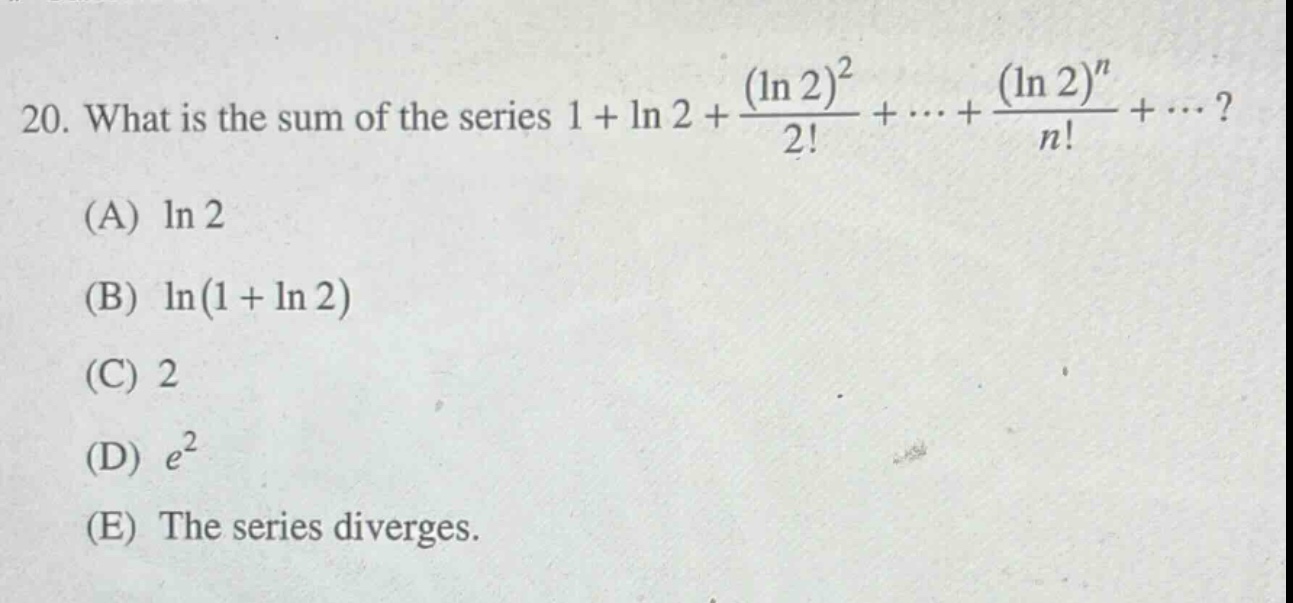
20. what is the sum of the series 1 + ln 2 + (ln 2)^2 / 2! + ... + (ln 2)^n / n! + ... ? (a) ln 2 (b) ln(1 + ln 2) (c) 2 (d) e^2 (e) the series diverges.
Answer
Explanation:
Step1: Recall the Mac - laurin series of $e^x$
The Mac - laurin series of the exponential function $e^x$ is given by $e^x=\sum_{n = 0}^{\infty}\frac{x^n}{n!}=1 + x+\frac{x^2}{2!}+\cdots+\frac{x^n}{n!}+\cdots$, where $x\in(-\infty,\infty)$.
Step2: Substitute $x = \ln 2$ into the Mac - laurin series of $e^x$
When we substitute $x=\ln 2$ into the series $e^x=\sum_{n = 0}^{\infty}\frac{x^n}{n!}$, we get $e^{\ln 2}=\sum_{n = 0}^{\infty}\frac{(\ln 2)^n}{n!}=1+\ln 2+\frac{(\ln 2)^2}{2!}+\cdots+\frac{(\ln 2)^n}{n!}+\cdots$.
Step3: Simplify $e^{\ln 2}$
By the property of the exponential and logarithmic functions, $e^{\ln a}=a$ for $a>0$. So, $e^{\ln 2}=2$.
Answer:
C. 2