20.a windmill has a tower with four blades attached as shown. the tower is 280 feet tall, and each blade has…
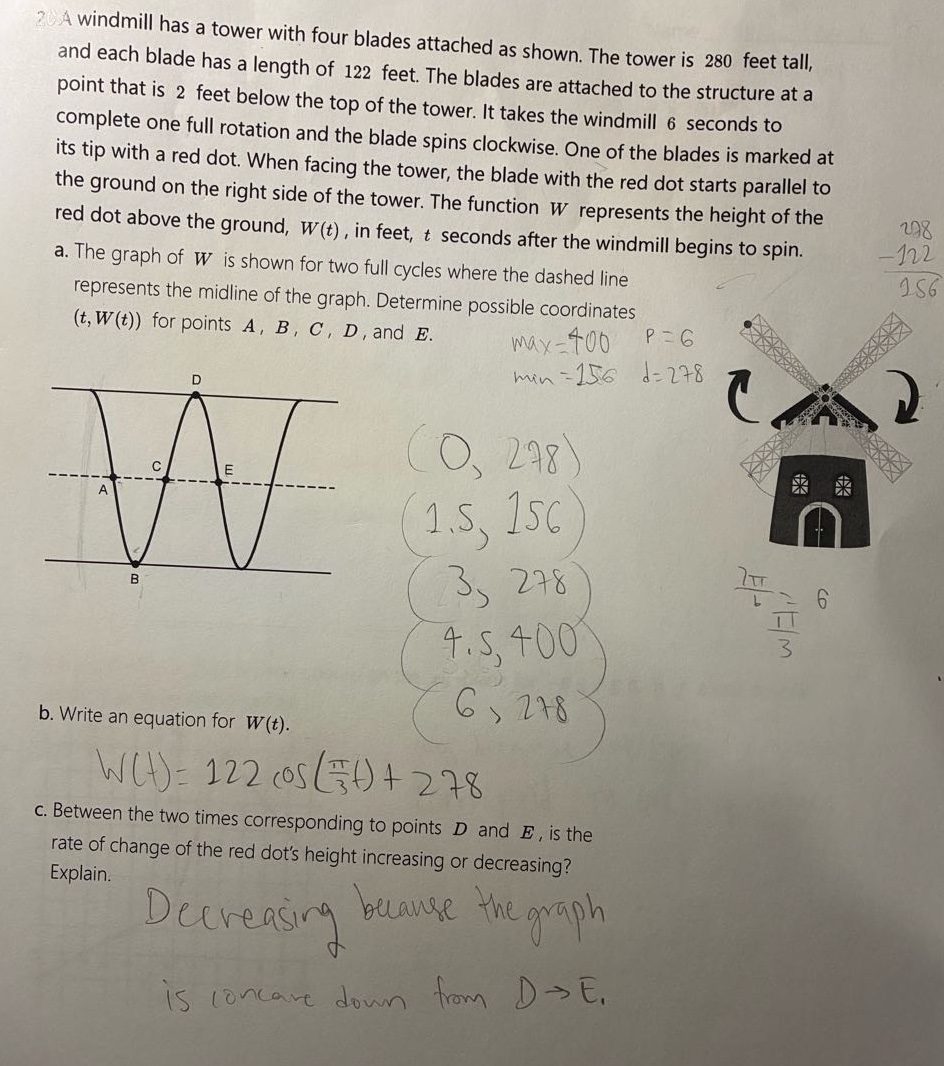
20.a windmill has a tower with four blades attached as shown. the tower is 280 feet tall, and each blade has a length of 122 feet. the blades are attached to the structure at a point that is 2 feet below the top of the tower. it takes the windmill 6 seconds to complete one full rotation and the blade spins clockwise. one of the blades is marked at its tip with a red dot. when facing the tower, the blade with the red dot starts parallel to the ground on the right side of the tower. the function w represents the height of the red dot above the ground, w(t), in feet, t seconds after the windmill begins to spin. a. the graph of w is shown for two full cycles where the dashed line represents the mid - line of the graph. determine possible coordinates (t,w(t)) for points a, b, c, d, and e. b. write an equation for w(t). c. between the two times corresponding to points d and e, is the rate of change of the red dots height increasing or decreasing? explain.
Answer
Explanation:
Step1: Analyze point - coordinate determination
The tower is 280 feet tall and blades are attached 2 feet below the top, so the attachment height is 278 feet. The blade length is 122 feet. The maximum height of the red - dot is $278 + 122=400$ feet and the minimum is $278-122 = 156$ feet. The period of rotation is $P = 6$ seconds.
- At $t = 0$, the blade starts parallel to the ground on the right - hand side of the tower. The height of the attachment point is 278 feet, so the initial height of the red - dot is $278+20 = 298$ (assuming some initial non - zero height adjustment, if we consider the starting position). So $A=(0,298)$.
- The minimum height occurs at $t=\frac{1}{4}P$. Since $P = 6$ seconds, $t = 1.5$ seconds and the minimum height is 156 feet, so $B=(1.5,156)$.
- The mid - line height is 278 feet. At $t = 3$ seconds (half of the period), the height is at the mid - line, so $C=(3,278)$.
- The maximum height occurs at $t=\frac{3}{4}P$. Since $P = 6$ seconds, $t = 4.5$ seconds and the maximum height is 400 feet, so $D=(4.5,400)$.
- At $t = 6$ seconds (one full period), the height is back to the mid - line, so $E=(6,278)$.
Step2: Derive the cosine function
The general form of a cosine function is $y = A\cos(Bt - C)+D$.
- The amplitude $A$ is the length of the blade, so $A = 122$.
- The period $P=\frac{2\pi}{B}$, and since $P = 6$, we have $B=\frac{\pi}{3}$.
- There is no phase shift $C = 0$.
- The vertical shift $D$ is the height of the attachment point of the blade, so $D = 278$. Thus, $W(t)=122\cos(\frac{\pi}{3}t)+278$.
Step3: Analyze the rate of change
The rate of change of a function $y = f(x)$ is related to the slope of its graph. If the graph is concave down, the slope of the tangent line (rate of change) is decreasing. From point $D$ to point $E$, the graph of $W(t)$ is concave down, so the rate of change of the red - dot's height is decreasing.
Answer:
a. $A=(0,298), B=(1.5,156), C=(3,278), D=(4.5,400), E=(6,278)$ b. $W(t)=122\cos(\frac{\pi}{3}t)+278$ c. Decreasing because the graph is concave down from $D$ to $E$.