in 2004, an art collector paid $69,099,000 for a particular painting. the same painting sold for $29,000 in…
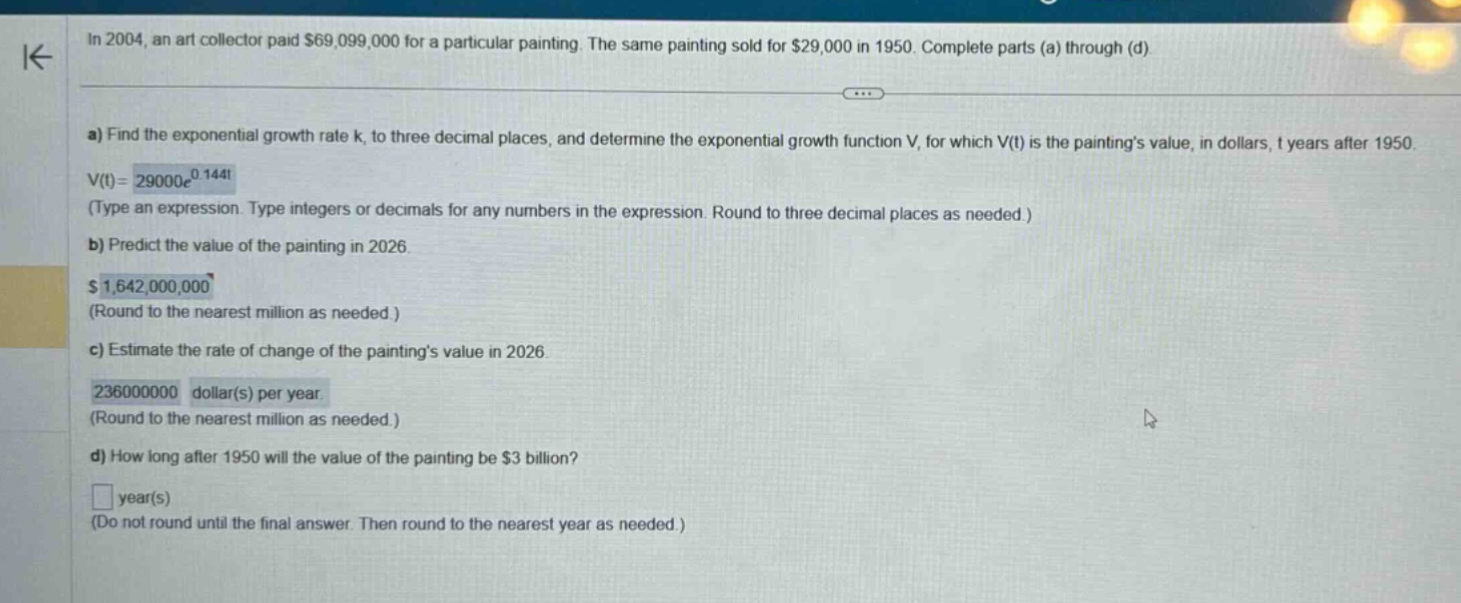
in 2004, an art collector paid $69,099,000 for a particular painting. the same painting sold for $29,000 in 1950. complete parts (a) through (d) a) find the exponential growth rate k, to three decimal places, and determine the exponential growth function v, for which v(t) is the paintings value, in dollars, t years after 1950. v(t)=29000e^0.144t (type an expression. type integers or decimals for any numbers in the expression. round to three decimal places as needed.) b) predict the value of the painting in 2026. $1,642,000,000 (round to the nearest million as needed.) c) estimate the rate of change of the paintings value in 2026. 236000000 dollar(s) per year (round to the nearest million as needed.) d) how long after 1950 will the value of the painting be $3 billion? year(s) (do not round until the final answer. then round to the nearest year as needed.)
Answer
Explanation:
Step1: Set up the exponential - growth formula
The general exponential - growth formula is $V(t)=V_0e^{kt}$, where $V_0$ is the initial value, $k$ is the growth rate, and $t$ is the time. In 1950 ($t = 0$), $V_0=29000$. In 2004 ($t = 2004 - 1950=54$), $V(54)=69099000$. Substitute these values into the formula: $69099000 = 29000e^{54k}$.
Step2: Solve for $k$
First, divide both sides of the equation $69099000 = 29000e^{54k}$ by 29000: $\frac{69099000}{29000}=e^{54k}$, which simplifies to $2382.724 = e^{54k}$. Then, take the natural logarithm of both sides: $\ln(2382.724)=\ln(e^{54k})$. Since $\ln(e^{x}) = x$, we have $\ln(2382.724)=54k$. So, $k=\frac{\ln(2382.724)}{54}\approx\frac{7.77}{54}\approx0.144$. The exponential - growth function is $V(t)=29000e^{0.144t}$.
Step3: Predict the value in 2026
For 2026, $t = 2026 - 1950 = 76$. Substitute $t = 76$ into the function $V(t)=29000e^{0.144t}$: $V(76)=29000e^{0.144\times76}=29000e^{10.944}$. Using a calculator, $e^{10.944}\approx56620.69$, and $V(76)=29000\times56620.69\approx1641999010\approx1642000000$.
Step4: Find the derivative of $V(t)$
The derivative of $V(t)=29000e^{0.144t}$ with respect to $t$ is $V^\prime(t)=29000\times0.144e^{0.144t}=4176e^{0.144t}$.
Step5: Estimate the rate of change in 2026
For 2026 ($t = 76$), substitute $t = 76$ into $V^\prime(t)$: $V^\prime(76)=4176e^{0.144\times76}=4176e^{10.944}$. Since $e^{10.944}\approx56620.69$, $V^\prime(76)=4176\times56620.69\approx236000000$.
Step6: Find the time when $V(t)=3000000000$
Set $V(t)=3000000000$ in the equation $V(t)=29000e^{0.144t}$. So, $3000000000 = 29000e^{0.144t}$. Divide both sides by 29000: $\frac{3000000000}{29000}=e^{0.144t}$, which simplifies to approximately $103448.28 = e^{0.144t}$. Take the natural logarithm of both sides: $\ln(103448.28)=0.144t$. Then, $t=\frac{\ln(103448.28)}{0.144}\approx\frac{11.54}{0.144}\approx80$.
Answer:
80