between 2006 and 2016, the number of applications for patents, n, grew by about 3.9% per year. that is…
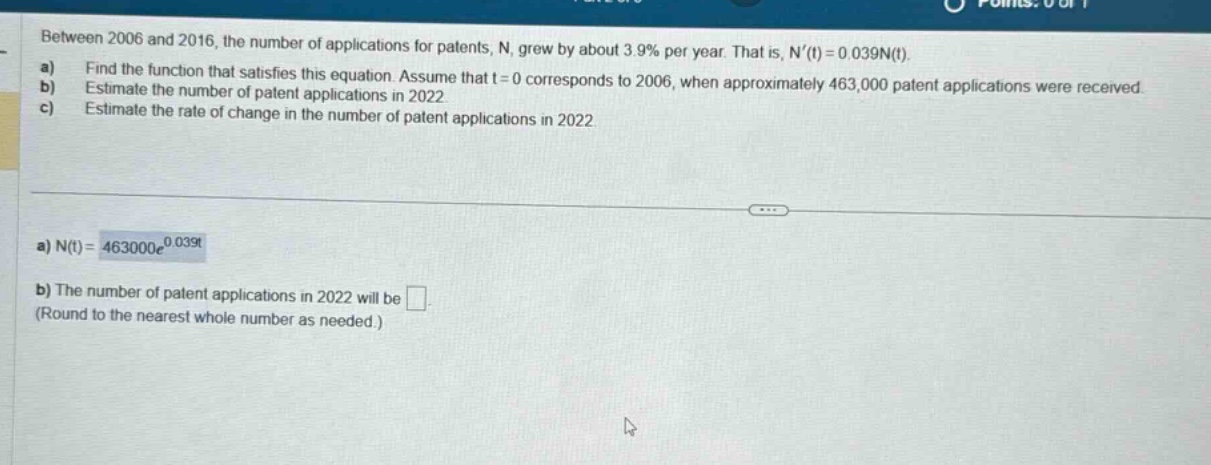
between 2006 and 2016, the number of applications for patents, n, grew by about 3.9% per year. that is, n(t)=0.039n(t). a) find the function that satisfies this equation. assume that t = 0 corresponds to 2006, when approximately 463,000 patent applications were received. b) estimate the number of patent applications in 2022. c) estimate the rate of change in the number of patent applications in 2022. a) n(t)=463000e^0.039t b) the number of patent applications in 2022 will be. (round to the nearest whole number as needed.)
Answer
Explanation:
Step1: Determine the value of t for 2022
Since (t = 0) corresponds to 2006, for 2022, (t=2022 - 2006=16).
Step2: Calculate the number of patent - applications in 2022
We have the function (N(t)=463000e^{0.039t}). Substitute (t = 16) into the function: [N(16)=463000e^{0.039\times16}] [N(16)=463000e^{0.624}] We know that (e^{0.624}\approx1.866). Then (N(16)=463000\times1.866 = 863958).
Step3: Find the derivative of (N(t))
The derivative of (N(t)=463000e^{0.039t}) with respect to (t) is (N^{\prime}(t)=463000\times0.039e^{0.039t}) (using the chain - rule ((e^{ax})^\prime=ae^{ax})).
Step4: Calculate the rate of change in 2022
Substitute (t = 16) into (N^{\prime}(t)): [N^{\prime}(16)=463000\times0.039e^{0.039\times16}] [N^{\prime}(16)=18057e^{0.624}] Since (e^{0.624}\approx1.866), then (N^{\prime}(16)=18057\times1.866 = 33794.362\approx33794).
Answer:
b) 863958 c) 33794