22. let g be the function given by g(x)=∫₁ˣ100(t² - 3t + 2)e⁻ᵗ² dt. which of the following statements about…
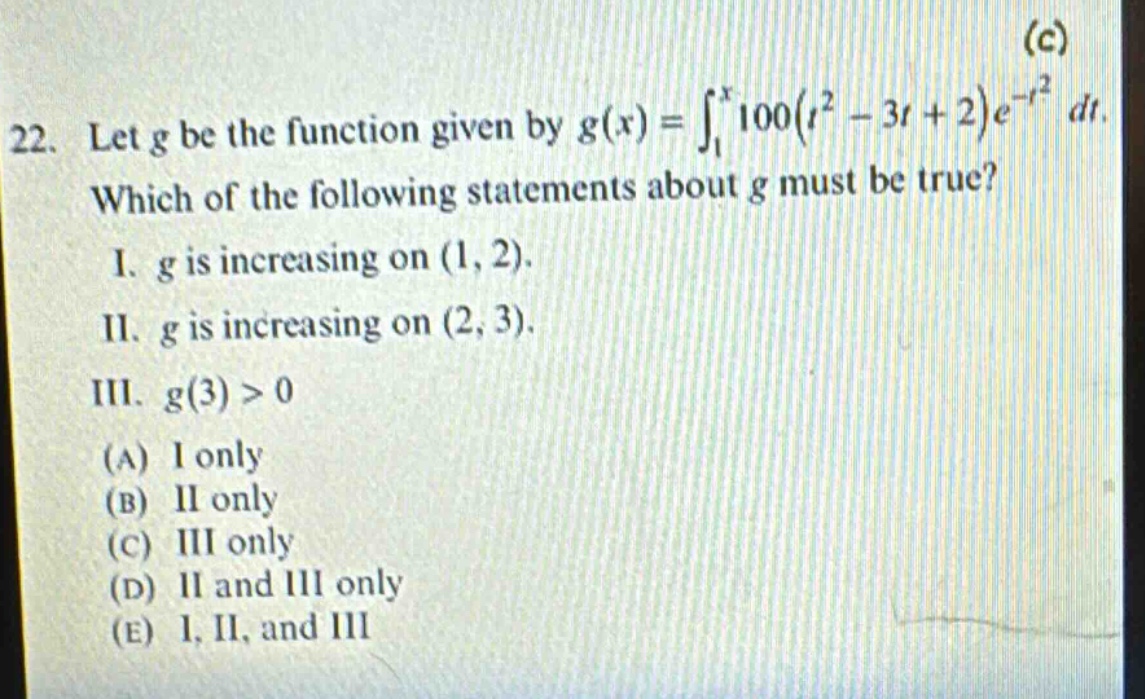
22. let g be the function given by g(x)=∫₁ˣ100(t² - 3t + 2)e⁻ᵗ² dt. which of the following statements about g must be true? i. g is increasing on (1, 2). ii. g is increasing on (2, 3). iii. g(3)>0 (a) i only (b) ii only (c) iii only (d) ii and iii only (e) i, ii, and iii
Answer
Explanation:
Step1: Apply the Fundamental Theorem of Calculus
By the Fundamental Theorem of Calculus, if $g(x)=\int_{a}^{x}f(t)dt$, then $g^\prime(x) = f(x)$. Here, $g(x)=\int_{1}^{x}100(t^{2}-3t + 2)e^{-t^{2}}dt$, so $g^\prime(x)=100(x^{2}-3x + 2)e^{-x^{2}}$.
Step2: Factor the quadratic part of $g^\prime(x)$
Factor $x^{2}-3x + 2=(x - 1)(x - 2)$. Then $g^\prime(x)=100(x - 1)(x - 2)e^{-x^{2}}$, and $e^{-x^{2}}>0$ for all real - valued $x$.
Step3: Analyze the sign of $g^\prime(x)$ on $(1,2)$
For $x\in(1,2)$, $(x - 1)>0$ and $(x - 2)<0$, so $g^\prime(x)=100(x - 1)(x - 2)e^{-x^{2}}<0$. Thus, $g(x)$ is decreasing on $(1,2)$.
Step4: Analyze the sign of $g^\prime(x)$ on $(2,3)$
For $x\in(2,3)$, $(x - 1)>0$ and $(x - 2)>0$, so $g^\prime(x)=100(x - 1)(x - 2)e^{-x^{2}}>0$. Thus, $g(x)$ is increasing on $(2,3)$.
Step5: Evaluate $g(3)$
$g(3)=\int_{1}^{3}100(t^{2}-3t + 2)e^{-t^{2}}dt=\int_{1}^{2}100(t^{2}-3t + 2)e^{-t^{2}}dt+\int_{2}^{3}100(t^{2}-3t + 2)e^{-t^{2}}dt$. We know that $\int_{1}^{2}100(t^{2}-3t + 2)e^{-t^{2}}dt<0$ (since $g^\prime(t)<0$ on $(1,2)$) and $\int_{2}^{3}100(t^{2}-3t + 2)e^{-t^{2}}dt>0$ (since $g^\prime(t)>0$ on $(2,3)$). Also, $| \int_{2}^{3}100(t^{2}-3t + 2)e^{-t^{2}}dt|>| \int_{1}^{2}100(t^{2}-3t + 2)e^{-t^{2}}dt|$. We can think of the integral as the net - signed area under the curve $y = 100(t^{2}-3t + 2)e^{-t^{2}}$. The positive area from $t = 2$ to $t = 3$ is larger than the negative area from $t = 1$ to $t = 2$. So $g(3)>0$.
Answer:
D. II and III only